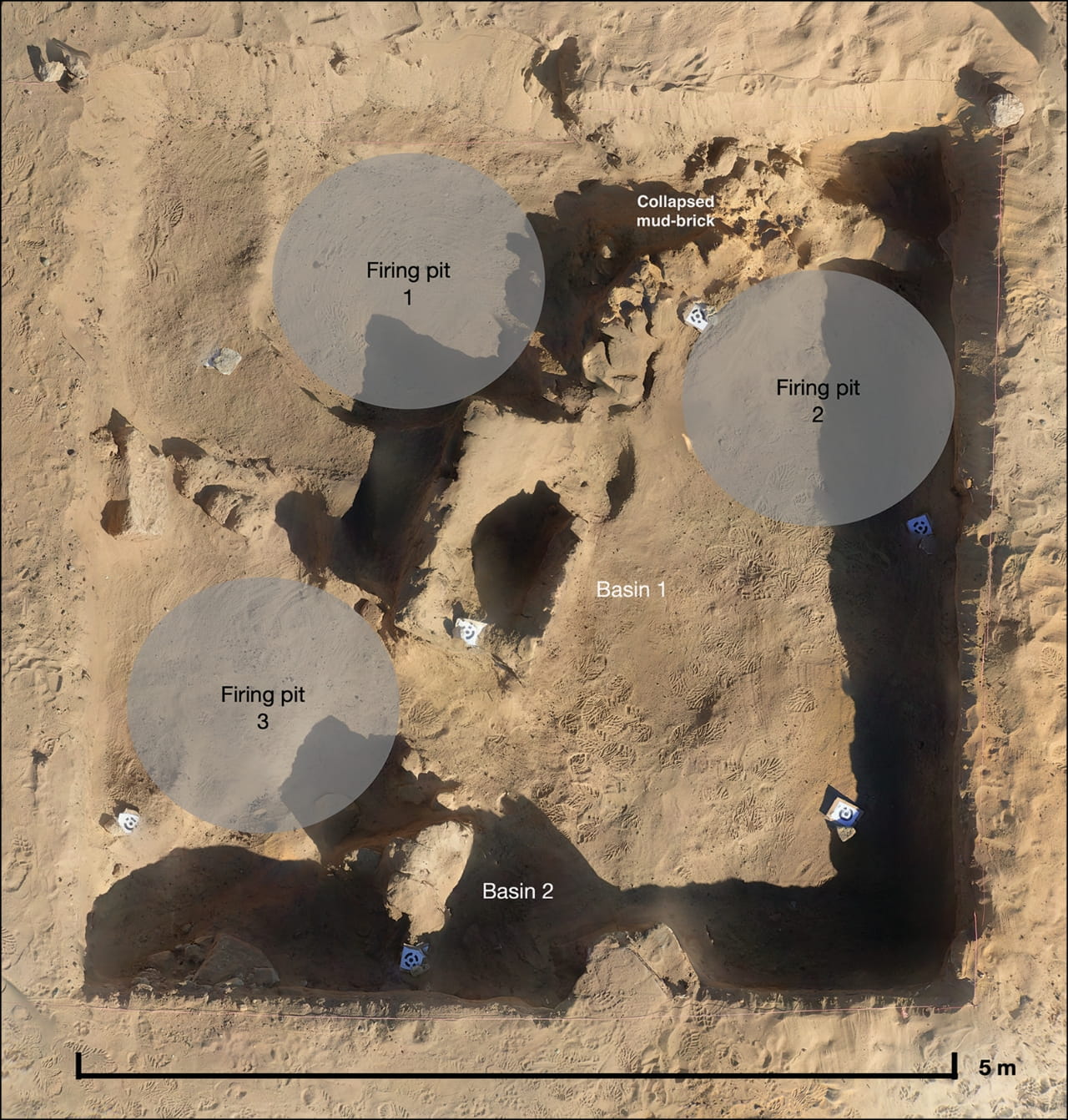
On 19 October 2026, a study published in the journal Antiquity brought renewed attention to an ancient technology. Beside a temple built more than 2,600 years ago, near the Kushite capital of Napata in what is now Sudan, archaeologists had uncovered the remains of a workshop: three firing pits, two mudbrick basins, grinding stones, discarded fragments, and hundreds of tiny beads in shades of blue, green, and white.[1] The material they were making was faience, and for thousands of years it had held the eye along the Nile.
Faience was neither pottery nor a precious stone, it was manufactured. Quartz-rich silica worked together with alkali and lime, then fired until the surface bloomed into a glassy glaze, most famously in brilliant shades of blue or green. It could be fashioned into beads, vessels, figurines, and objects intended to accompany the dead.[1] Behind that brilliance lies a long history of trial, secrecy, and exchange, one archaeologists are still piecing together today.
Sanam offers us rare proof that Kushite craftspeople produced their own faience. What it cannot tell us is how the knowledge arrived in Nubia, or who carried it, and that story is far older and more tangled than a single workshop allows us to see. To follow it, we have to go back more than a century, to 1913, when the American archaeologist George Andrew Reisner arrived at another great center of ancient Kush.
Across the broad plain of Kerma, two immense masses of mudbrick rose above the scattered remains of an ancient town. Centuries of wind and sun had worn their walls down, and the ground around them was strewn with potsherds, stone tools, and splinters of bone. These were the deffufas, the last standing witnesses of a city whose story no archaeologist had yet managed to tell. When George Andrew Reisner walked this ground in February 1913, on the eastern bank of the Nile in what is now northern Sudan, he could not have known how much this barren landscape was about to give up.[2]
On 12 February, his expedition opened its first trenches beside the western deffufa. Within a month the work shifted east, toward a vast cemetery, and the soil there seemed to glitter. Vessels, ornaments, figurines, and architectural decorations fashioned from blue and green faience came up in astonishing quantities, often in fragments. Reisner himself wrote that no Egyptian site then known could match such abundance.[3] But the finds raised a harder question than what they were. Who had made them?
Reisner did see signs of manufacture. Around the western deffufa his team recovered unfinished pieces and workshop debris, he even accepted that faience had been made at Kerma.[3] Yet he treated it as an Egyptian craft practiced with local materials, and he read the whole settlement as an Egyptian colony rather than the center of an independent Nubian kingdom.[3] That assumption was not incidental. It grew from an intellectual climate that ranked Egypt as inherently superior to its African neighbors, and Reisner said so plainly, crediting Egyptians with the “mental qualities of the highest race.”[5] His reading of the evidence is difficult to separate from that bias, and later scholars have had to work carefully to pull apart what he found from what he believed.
In the funerary chapel designated K XI, the faience has been broken and built again. Rosettes were assembled from reused fragments, glaze that had once belonged to other objects now set into a new design.[4]
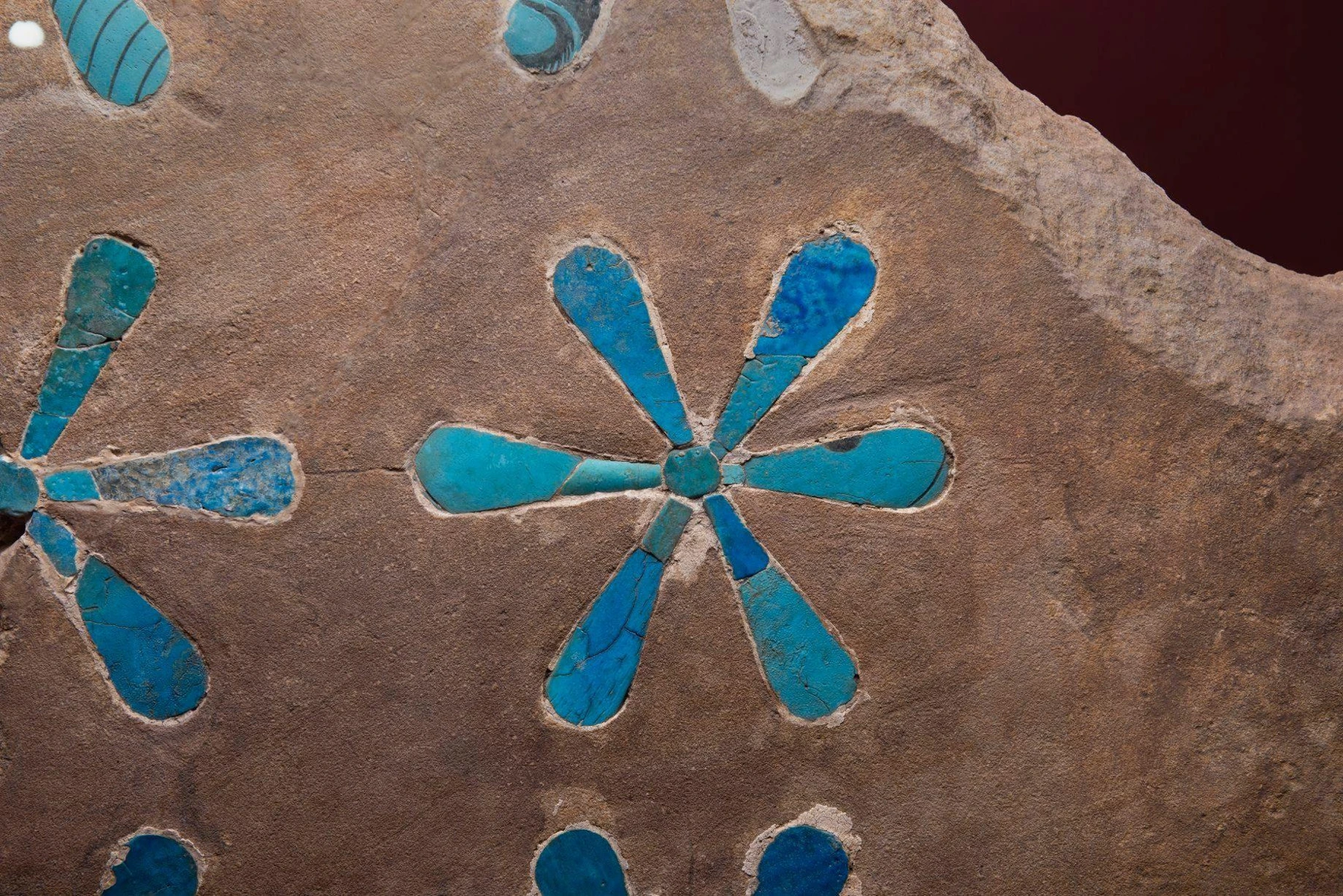
Figure I · Fragments Given New Form
Ceiling block with rosette pattern, funerary temple K XI, Kerma, Sudan, Classic Kerma period (c. 1700–1550 BCE). Fragments of earlier Egyptian faience objects were cut and inserted into carved cavities to form blue rosettes. Some retained traces of their original decoration, revealing how imported materials could be transformed within Nubian funerary architecture.
Even so, Kerma posed a deeper problem than recycled pieces. Reisner had found finished ornaments and vessels, fragments of architectural decoration, and the leftovers of manufacture itself, but how they related to one another was far from clear. Which had come from Egypt? Which had been made at Kerma? And might the way they were made reveal what their familiar blue surfaces concealed?
That question would require archaeologists to look beyond the brilliant blue of faience itself.
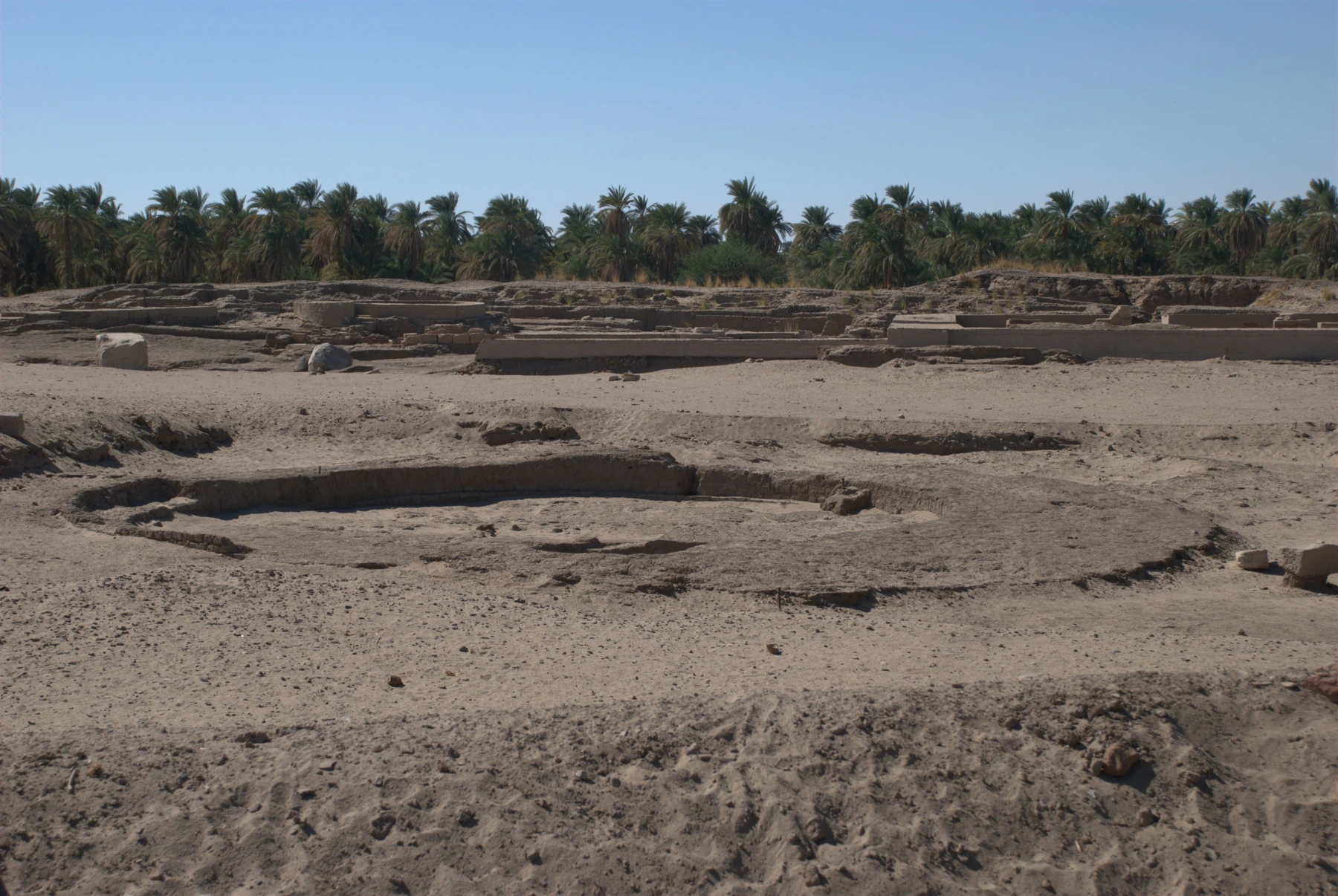
Figure II · The Landscape of Kerma
Archaeological remains near the Western Deffufa at Kerma, Sudan. The surviving landscape offers a view of the ancient urban setting excavated by Reisner and subsequently reinterpreted by generations of archaeologists.
More than a century after Reisner’s excavations, a collection of ancient beads from Kerma came under a different kind of scrutiny. In a study published in 2025, archaeometrist Juliet Spedding examined thirty faience objects recovered from five sites across Nubia, among them six beads from Tumulus K X, the great burial mound at Kerma.[6] Using scanning electron microscopy and chemical analysis, she looked at what no eye could see: how the elements were distributed, how the material was built, and what traces its making had managed to leave behind.[6]
Those traces matter because faience could be glazed in more than one way. Sometimes soluble salts rose to the surface as the object dried and formed a glaze on their own. Elsewhere, craftspeople applied a prepared coating, or buried the shaped piece in a powder that reacted in the kiln.[6] Each method could leave its own microscopic signature, even when the finished objects looked nearly identical, their surfaces tinted blue or green by copper.
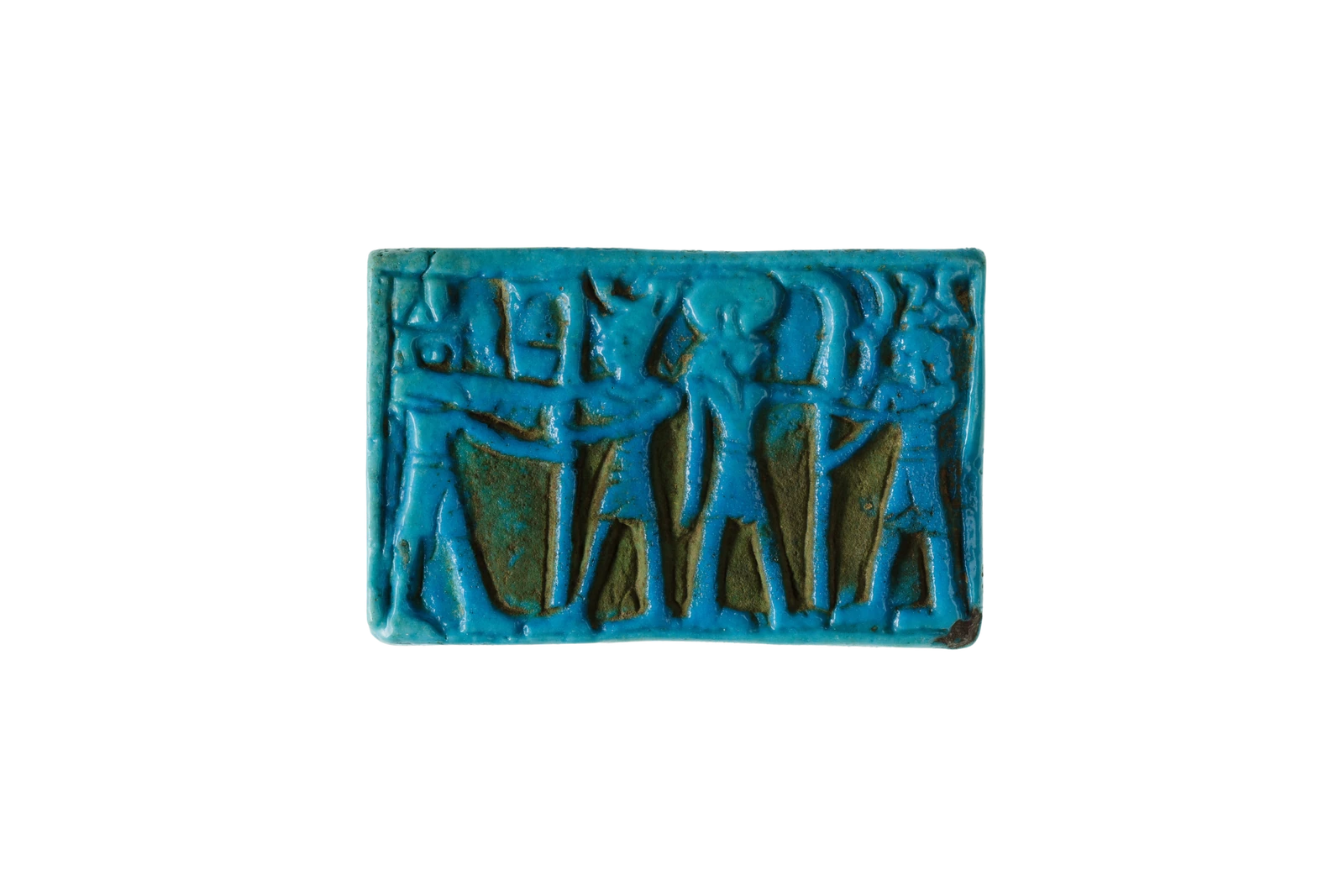
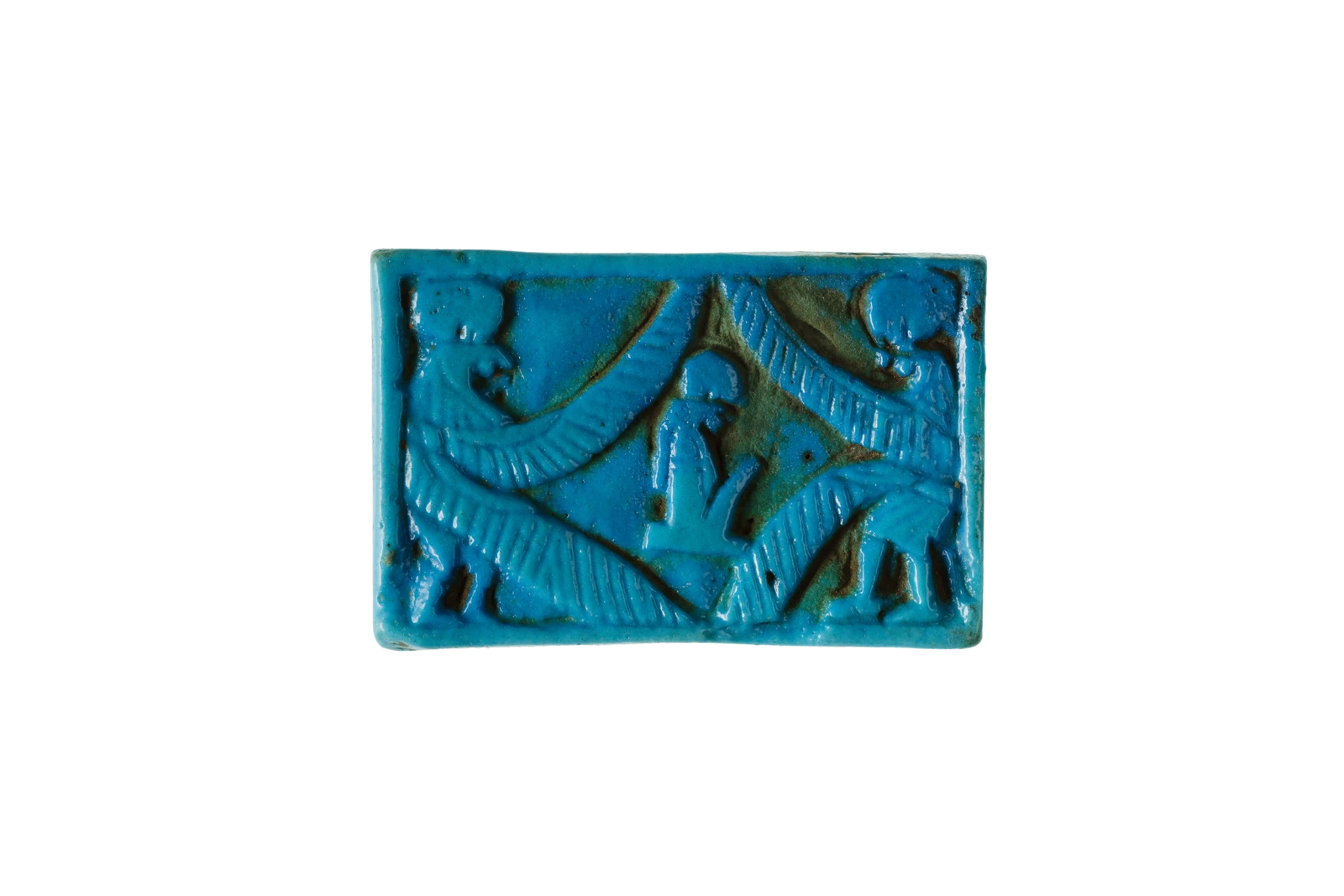
Figure III · Two Sides of Faience
Spacer-bead with images of divinities and a king, Egypt, Third Intermediate Period, ca. 1080–721 BCE. The two documented faces invite closer examination of the object’s form and finish, though appearance alone cannot establish its method of manufacture. This Egyptian object is later than the Classic Kerma rosette installation and is not one of Spedding’s analyzed beads.
Two documented faces of the same Egyptian spacer-bead. Select either side to examine its surface.
The Kerma beads did not follow the pattern. Ordinary faience has a glazed skin over a quartz-rich core, and these beads showed no such division.[6] The blue ran straight through a fairly uniform body. Spedding suggested they might represent glassy faience, a rare material that sits uneasily between faience and glass.[6]
Their chemistry pointed the same way. Elevated potassium hinted at a different alkali, possibly plant ash.[6] That raised the possibility that Kerma’s craftspeople were working with different recipes and different resources. Earlier compositional research, discussed by Peter Lacovara, had already drawn a line between imported Egyptian faience and later material associated with manufacture at Kerma.[4]
Among the debris recovered beside Sanam Temple lay a fragment of a green faience figurine, small enough to pass for waste. Then archaeologists matched it to a clay mold found inside the temple itself. Both belonged to the production of shabtis, the small funerary figures intended to accompany the dead. Earlier excavations at Sanam had recovered further moulds corresponding to shabtis discovered in the royal cemetery at Nuri, linking the manufacture of these objects to the funerary traditions of Kushite kings.[1]
The workshop’s position said as much. It stood just outside the temple built under King Taharqo, and its craftspeople worked with materials that may have travelled considerable distances before reaching their hands. Shells among the debris, some likely originating from the Red Sea, may have supplied the lime for the faience.[1] If so, the workshop drew on resources well beyond the Nile Valley, while its placement beside the temple raises the possibility that religious institutions played an important role in organizing production.[1]
At Nuri, royal demand was staggering. The tomb of King Senkaminsken held at least 1,277 shabtis, some propped upright against the walls of the burial chambers and corridors.[7] The figures belonged to an Egyptian-derived funerary tradition, but their number and arrangement set Kushite practice apart from many contemporary Egyptian burials.[7] In Napatan Nubia, they seem to have been reserved for royalty alone.
Faience itself, however, was never only a royal possession. In the cemetery at Sanam, beads turned up throughout the burials, alongside amulets, ornaments, and a much smaller number of faience vessels.[8] Some imitated cowrie shells, others lay near the head, neck, or limbs of the dead. Amulets were especially prominent in children’s graves, which suggests they served as protection and care as much as adornment.[8] The material that furnished a king’s tomb could also accompany people whose lives remain largely unknown to us, its meaning shifting with the form it took and the hands that placed it.
Then there is Gala Abu Ahmed. Some 110 kilometers west of the Nile, amid the arid reaches of the Lower Wadi Howar, stood a fortress where excavators recovered thousands of faience beads and amulets, along with fragments of Egyptian New Year’s flasks, vessels tied to renewal and regeneration.[1][11] Someone carried them across that dry country. Who, by what route, and what the objects meant to the people living behind those walls, we cannot say.
From the workshops of Sanam to the royal chambers of Nuri, from amulets in children’s graves to a fortress at the edge of the desert, faience passed through many worlds. Fire and chemistry can tell us how it was made. What it became depended on the people who acquired it, reshaped it, and gave it a purpose.
Centuries later, as the Kingdom of Kush entered its Meroitic age, faience still turned up among the possessions of the living and the dead. In the elite cemetery at Sedeinga, researchers found fragments of finely fashioned vessels whose forms closely mirror examples from Roman Egypt.[9] Some may indeed have travelled south from Egyptian workshops, though their appearance alone should not rule out the possibility of local manufacture. Other objects offered tantalizing clues. A decorated plaque from Meroe, once linked to royal clothing, bears feathered cartouches and religious symbols familiar from the Egyptian world. But an earlier chemical study, discussed by Aminata Sackho-Autissier, found a glaze unlike those usually associated with contemporary Roman Egyptian faience.[9] Even here, centuries removed from Reisner’s Kerma, the relationships between appearance, manufacture, and cultural identity remained difficult to untangle.
That is what makes the blue fragments at Kerma so hard to leave alone. Reisner saw their beauty, he measured their abundance, and noticed the debris of manufacture. What he could not see was the rest, such as which ingredients a maker reached for, what that maker had been taught, and how far a bead had travelled before it was laid in a grave. Those answers lay inside the material, and in 1913 no one had the means to look there.
Now someone has. The beads Spedding examined, with no seam between glaze and ore and a blue that runs straight through, do not settle who made them. They do make it harder to accept the answer provided by Reisner.
The color has outlasted everyone who chose it. The choices themselves have not quite vanished. They survive in an unexpected trace of potassium, in a missing boundary between surface and body, and in a green fragment that matched a mold, waiting for someone to ask the right question.
Image Credits
Cover artifact. Eye of Horus (wedjat) pectoral. Nubian, Sudan, 743–712 BCE, faience. Harvard University–Boston Museum of Fine Arts Expedition, 24.679. Photo © Museum of Fine Arts, Boston. Supplied image; public reuse rights require confirmation.
Cover landscape. Orthophoto of the Sanam faience workshop, with individual structures identified. Figure by Rennan Lemos, Kathryn Howley, Siobhan Shinn, and Shadia Abdu Rabo, in Crafting power in Kush (2026), Figure 4. Source · CC BY 4.0. The cover shows a cropped view; the complete image is available for inspection.
Figure I · Fragments Given New Form. Ceiling Block with Rosette Pattern, Kerma, Sudan, c. 1700–1550 BCE. Sandstone and faience. Museum of Fine Arts, Boston, accession 13.4360.1. Harvard University–Boston Museum of Fine Arts Expedition. Photograph supplied by the author; photographic reuse rights require confirmation before publication. Museum · photograph source unconfirmed
Figure II · The Landscape of Kerma. Kerma NNE. Photograph by Bertramz, November 2008. Wikimedia Commons, CC BY 3.0. Original photograph; no changes to colour or composition. Source · License
Figure III · Two Sides of Faience. Spacer-bead with images of divinities and a king. Egypt, Third Intermediate Period, ca. 1080–721 BCE. Faience, L. 5.1 × H. 3.4 × Th. 1 cm. The Metropolitan Museum of Art, Bequest of Nanette B. Kelekian, 2020, accession 2021.41.101. Public Domain. Transparent Side A and Side B PNGs supplied by the author, derived from photographs of the same object in the museum record. Source
References
[1] Rennan Lemos, Kathryn Howley, Siobhan Shinn, and Shadia Abdu Rabo, “Crafting Power in Kush: Faience Production and State Control in the Napatan Region,” Antiquity (published online October 19, 2026), https://doi.org/10.15184/aqy.2026.10434
[2] George A. Reisner, “New Acquisitions of the Egyptian Department: A Garrison Which Held the Northern Sudan in the Hyksos Period, about 1700 B.C.,” Bulletin of the Museum of Fine Arts 12, no. 69 (April 1914): 9–24.
[3] George A. Reisner, “Accessions to the Egyptian Collections during 1914,” Bulletin of the Museum of Fine Arts 13, no. 80 (December 1915): 71–83, especially 74–75 and 80. See also George A. Reisner, Excavations at Kerma, Parts IV–V (Cambridge, MA: Peabody Museum of Harvard University, 1923), 134–175.
[4] Peter Lacovara, “The Faience Industry at Kerma,” Journal of Ancient Egyptian Interconnections 29 (2021): 32–38.
[5] George A. Reisner, Excavations at Kerma, Parts IV–V (Cambridge, MA: Peabody Museum of Harvard University, 1923), 556.
[6] Juliet V. Spedding, “A Chemical Examination of Faience Found in Nubia: Preliminary Observations,” Journal of Archaeological Science: Reports 67 (2025): 105341, especially 3–7 and 11–12. https://doi.org/10.1016/j.jasrep.2025.105341
[7] Kathryn Howley, “Power Relations and the Adoption of Foreign Material Culture: A Different Perspective from First-Millennium BCE Nubia,” Journal of Ancient Egyptian Interconnections 17 (2018): 18–36, especially 23–25.
[8] Angelika Lohwasser, Aspekte der napatanischen Gesellschaft: Archäologisches Inventar und funeräre Praxis im Friedhof von Sanam—Perspektiven einer kulturhistorischen Interpretation (Vienna: Österreichische Akademie der Wissenschaften, 2012), especially 109–120, 157–160, and 259–262.
[9] Aminata Sackho-Autissier, “Les faïences d’époque méroïtique conservées au musée du Louvre. Technologie et production : les prémices d’une recherche,” Dotawo 3 (2016): 29–39, especially 31–35.
[10] Friederike Jesse, “Bollwerk im Niemandsland: Die Festung Gala Abu Ahmed zur Zeit der Pharaonen,” Der antike Sudan 26 (2015): 75–94, especially 85–90.
[11] Angelika Lohwasser, “Gala Abu Ahmed – The Small Finds,” Archéologie du Nil Moyen 10 (2006): 171–179, especially 171–174.