OBJECTS IN FOCUS · 002
When Death Comes Calling
Four Encounters in Holbein’s Dance of Death
31 October 2026
In the early sixteenth century, the German artist Hans Holbein the Younger imagined Death going about his business.
He was no longer content to summon the living into a solemn procession. Instead, he entered their homes, interrupted their work, and appeared in the middle of their most ordinary activities.
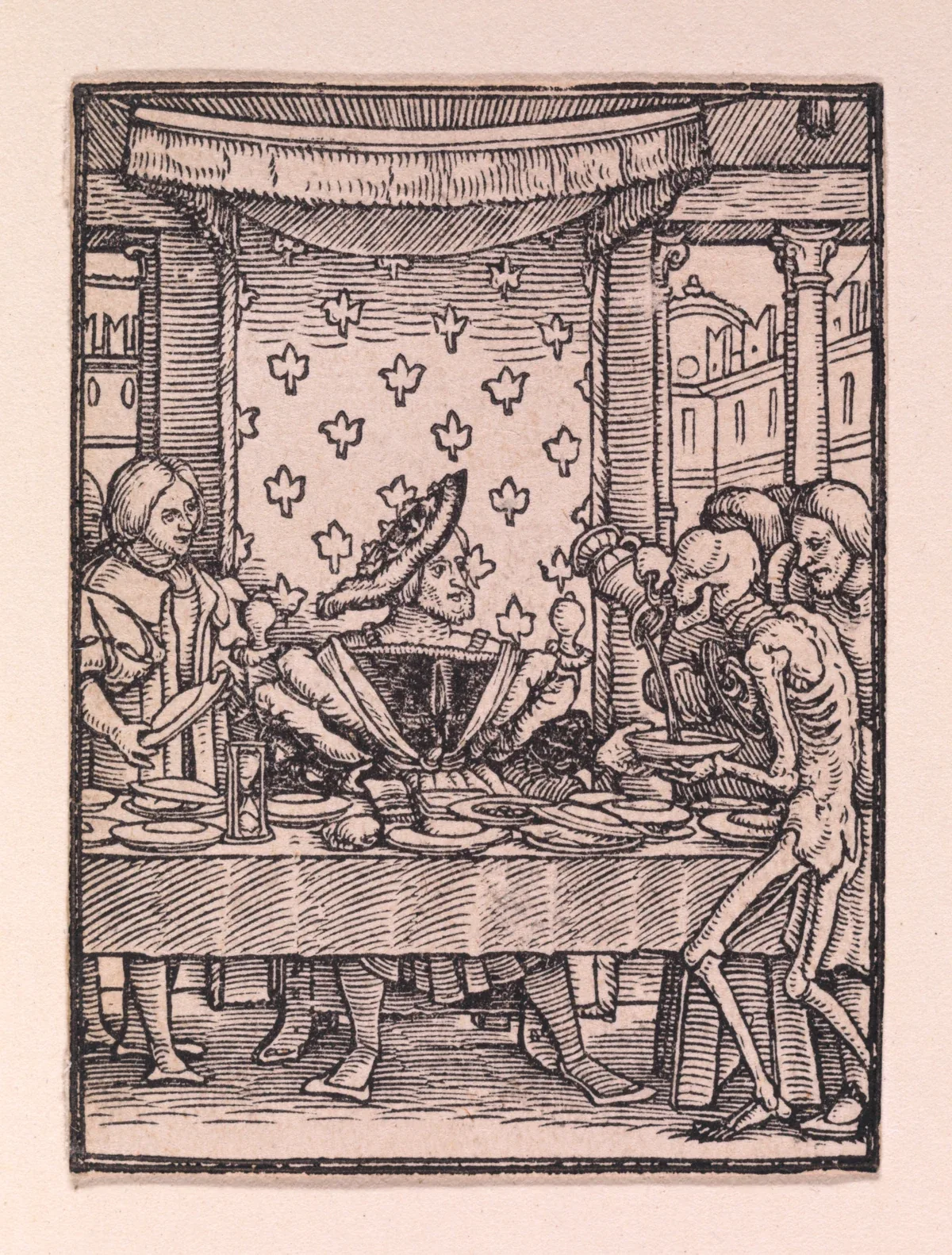
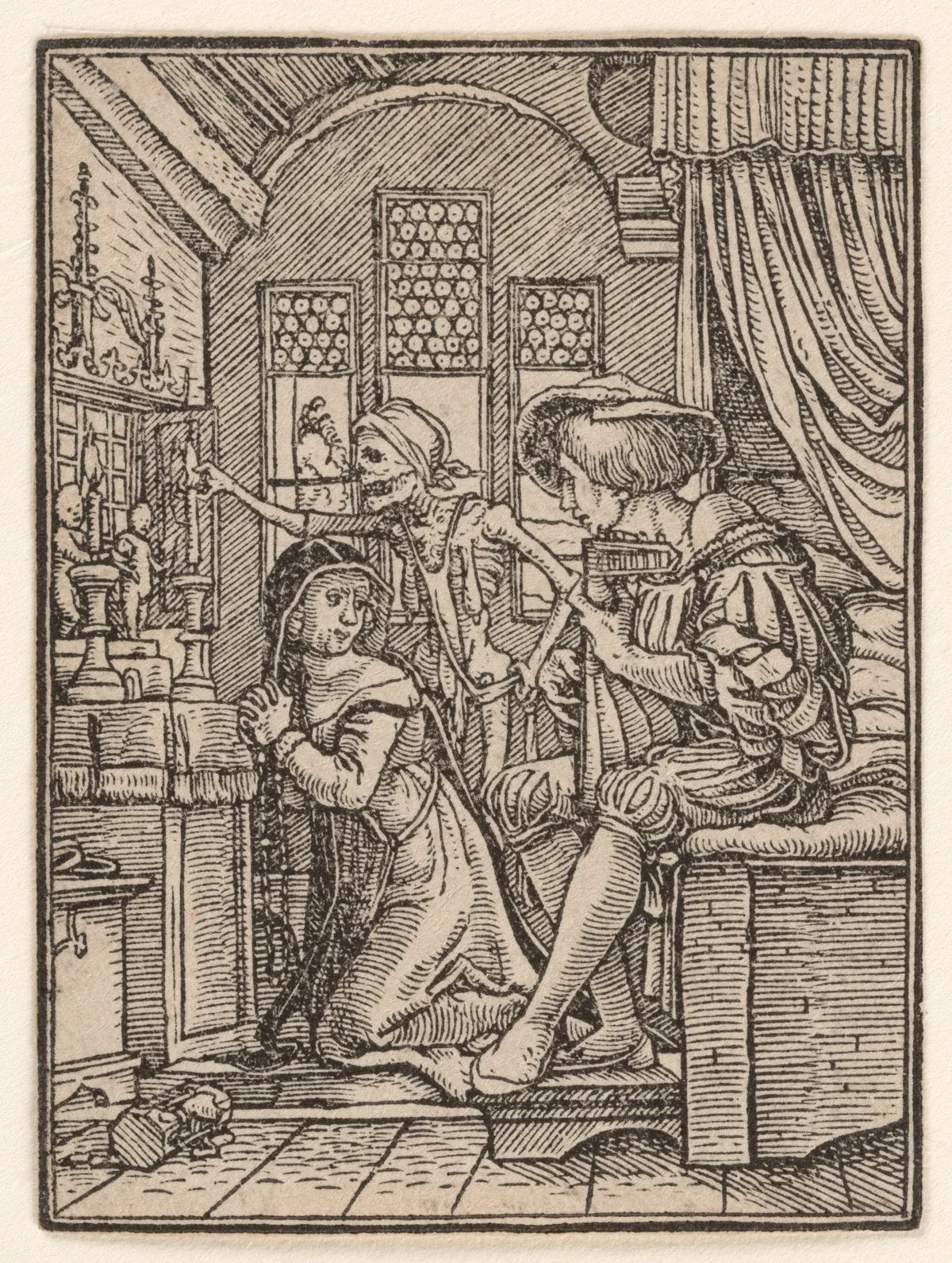
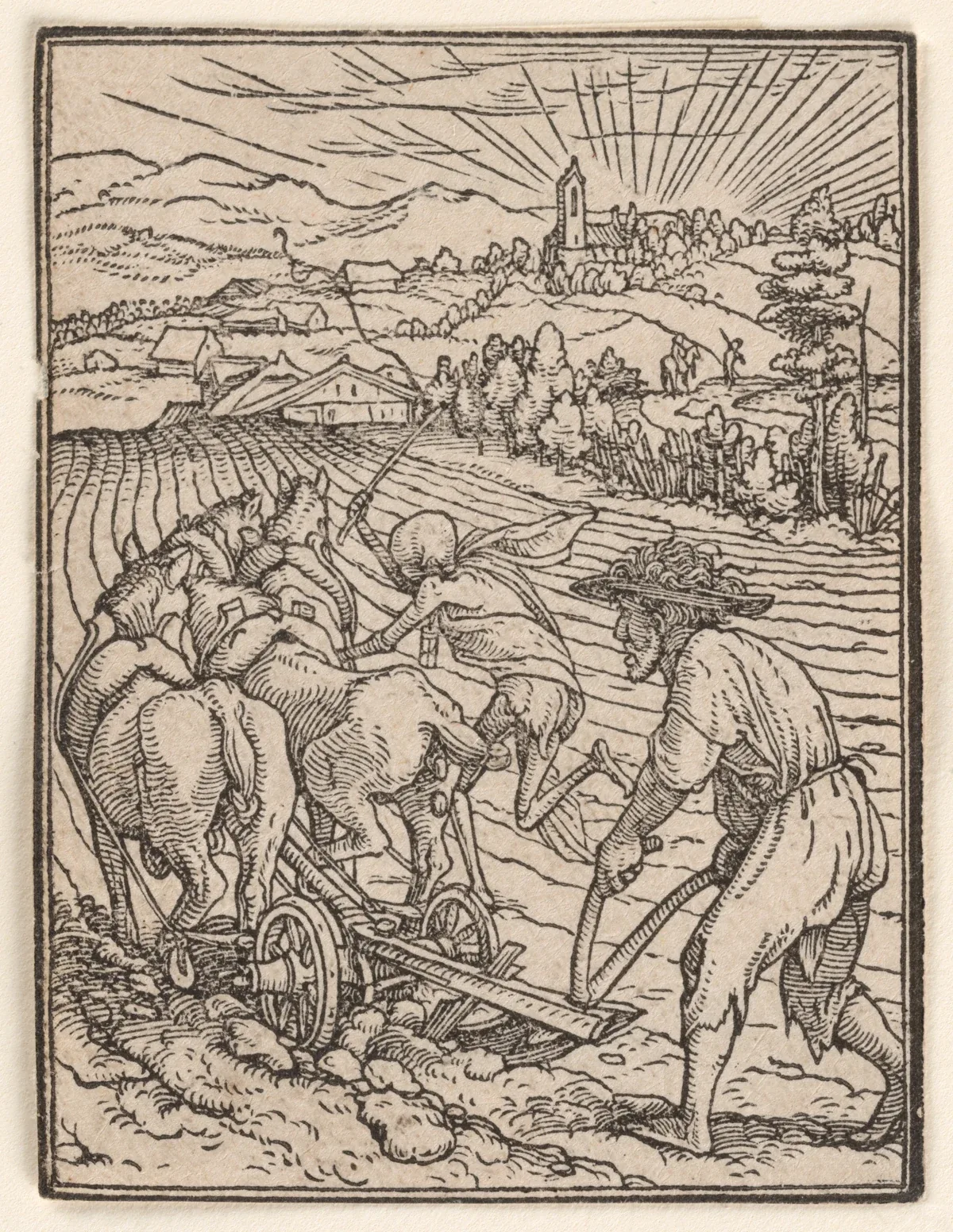
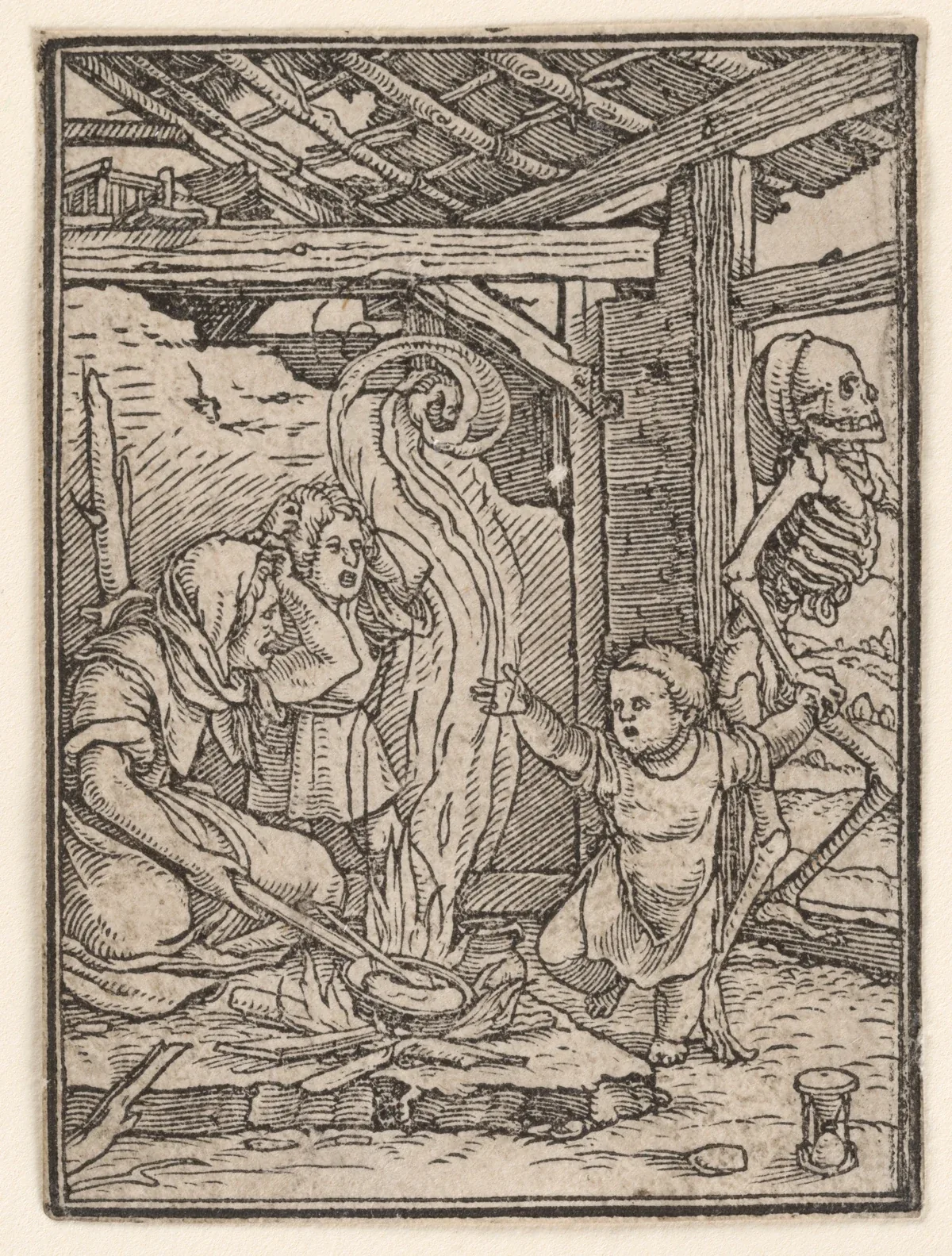
A wealthy man sits at his table. A nun kneels in prayer. A farmer works his fields. A child stands beside the family hearth.
Death visits them all.
But look closely. He does not behave quite the same way each time.
These four small woodcuts invite us to consider what Holbein was asking his viewers to see—and whether every encounter with Death could be explained in the same way.
Four Encounters, One Visitor
 The Nun
 The Ploughman
 The Child
Four small woodcuts. Four encounters with Death. Each belongs to Hans Holbein the Younger's remarkable reimagining of the medieval Dance of Death, a tradition that had once assembled the living into a procession according to their positions in society. Holbein changed the arrangement. Instead of summoning everyone into the same line, he sent Death into the places where people lived and worked.
The wealthy man meets him at a banquet. The nun encounters him in a religious interior. The ploughman finds him in the fields. The child is led away from a household hearth. Yet these scenes do not all invite the same interpretation. Wealth and religious conduct can be subjected to moral scrutiny. Labour introduces the possibility of hardship and release. The child makes the search for blame much more difficult.
Nor should we mistake these four images for a complete explanation of Holbein's series. They are only a selection from a larger group of designs, whose meanings were shaped by the religious, artistic, and social circumstances of the early sixteenth century. What makes the images so compelling is their attention to the particular. Holbein did not simply repeat a skeleton beside forty-one interchangeable people. He devised different spaces, gestures, objects, and interruptions.
The old procession had broken apart. Death could now appear anywhere.
Object Information
About the Series
The Dance of Death · Hans Holbein the Younger (designer); Hans Lützelburger (woodblock cutter). Designs c. 1526, Basel context, German-speaking Europe. First collected publication: Lyon, 1538. Medium: woodcuts. Four works are examined here; dates of individual impressions may differ from the first collected edition.
The Rich Man · 19.57.27
The Rich Man, from The Dance of Death. Hans Holbein the Younger; Hans Lützelburger. Woodcut. Museum catalogue date: ca. 1526, published 1538. Metropolitan Museum of Art, New York. Rogers Fund, 1919. 19.57.27. Public domain, museum Open Access image.
View full catalogue record and impression dateThe Nun · 19.57.24
The Nun, from The Dance of Death. Hans Holbein the Younger; Hans Lützelburger. Woodcut. Museum catalogue date: ca. 1526, published 1538. Metropolitan Museum of Art, New York. Rogers Fund, 1919. 19.57.24. Public domain, museum Open Access image.
View full catalogue record and impression dateThe Ploughman · 19.57.37
The Ploughman, from The Dance of Death. Hans Holbein the Younger; Hans Lützelburger. Woodcut. Museum catalogue date: ca. 1526, published 1538. Metropolitan Museum of Art, New York. Rogers Fund, 1919. 19.57.37. Public domain, museum Open Access image.
View full catalogue record and impression dateThe Child · 19.57.38
The Child, from The Dance of Death. Hans Holbein the Younger; Hans Lützelburger. Woodcut. Museum catalogue date: ca. 1526, published 1538. Metropolitan Museum of Art, New York. Rogers Fund, 1919. 19.57.38. Public domain, museum Open Access image.
View full catalogue record and impression dateSources and Further Reading
The Four Objects
Metropolitan Museum of Art. The Rich Man. 19.57.27.
Metropolitan Museum of Art. The Nun. 19.57.24.
Metropolitan Museum of Art. The Ploughman. 19.57.37.
Metropolitan Museum of Art. The Child. 19.57.38.
Interpreting Holbein
Peter Parshall. “Hans Holbein’s ‘Pictures of Death.’” Studies in the History of Art 60 (2001): 82–95.
Cleveland Museum of Art. Dance of Death: The Miser. 1929.161.
The guided details are editorial readings of the compositions; they do not establish Holbein’s personal intentions.
Continue the Story
Holbein's woodcuts belong to a much older and stranger tradition.
Long before Death entered the banquet hall, the convent, or the farmer's field, skeletal figures had already begun leading the living through painted processions on cemetery walls and church interiors.
Those processions travelled through manuscripts, printed books, and across Europe, changing as the societies that created them changed.
How did the Dance of Death begin? Why did it become so popular? And what can its surviving images tell us about the people who feared, mocked, and imagined their own mortality?
Follow the story beyond Holbein's four woodcuts.
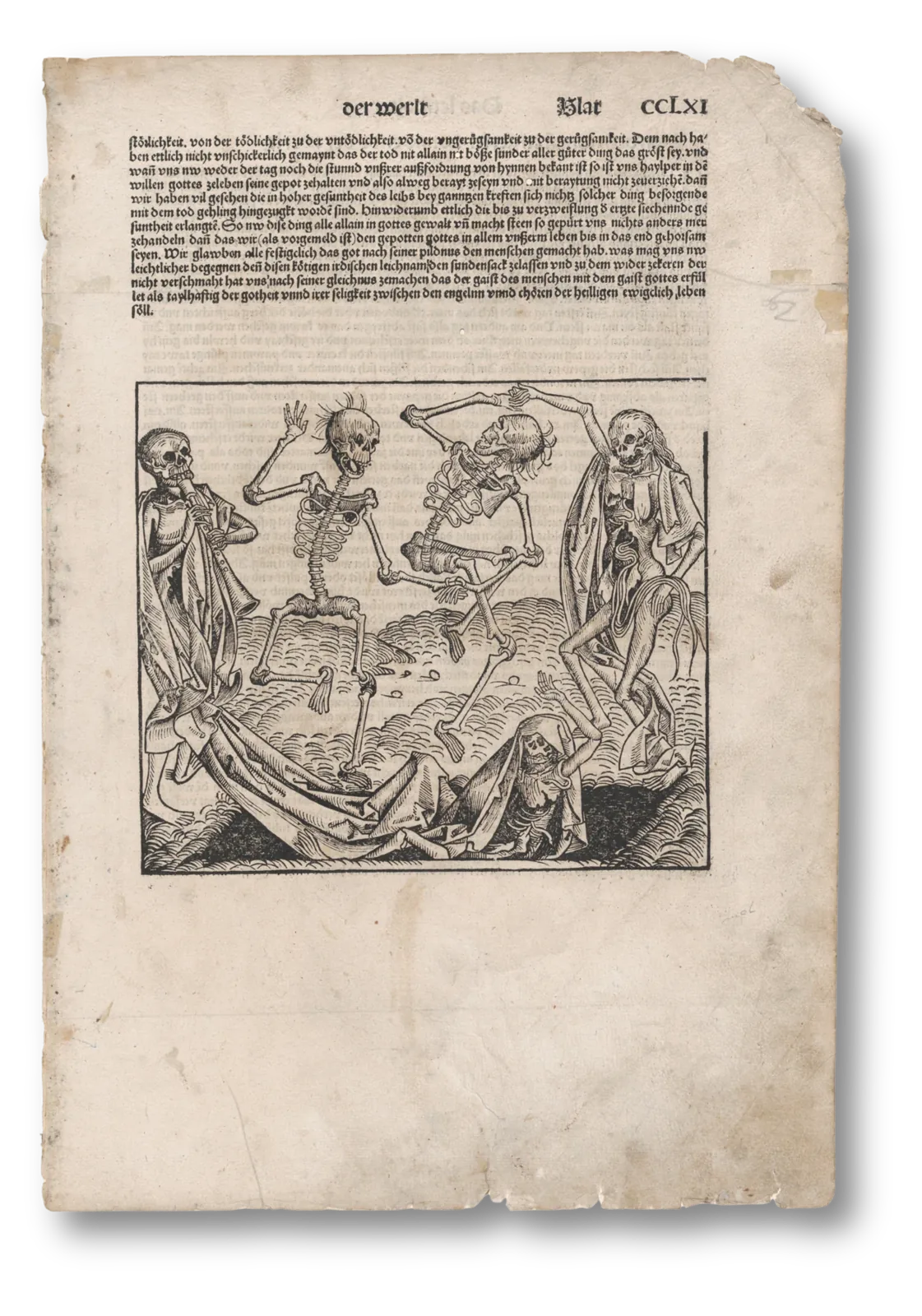
The Dead Have Come to Dance
Inside the strange world of the Danse Macabre
The dead have been dancing for centuries. Across forgotten cemetery walls, illuminated manuscripts, and the pages of ancient books, they have summoned kings, confronted priests, and beckoned to the living. But who first set them in motion? And what secrets lie behind their strange procession?
Enter the investigation →