
In 1929, Walt Disney brought the dead back to life.
Beneath the darkness of a moonlit cemetery, a skeleton crawls out of its grave. Three companions soon join him, and what began as a rather ominous gathering turns into something altogether stranger. The dead rattle their bones, leap and twist through the night, and turn one another into musical instruments. One skeleton even removes the bones of another and plays his spine like a xylophone.[1] Their antics grow wilder until the first crow of a rooster sends every performer scrambling back to their graves. The spectacle is over.
An excerpt from Walt Disney’s The Skeleton Dance (1929), the first of the Silly Symphonies. Animated principally by Ub Iwerks, the short transforms a moonlit cemetery into a stage for dancing skeletons, combining macabre imagery with slapstick comedy. The film belongs to a much longer history of imagining the dead in motion.
Film credit
Walt Disney Productions, 1929. Directed by Walt Disney; animation principally by Ub Iwerks; music by Carl Stalling. Source: 16 mm film print digitized by GumdroplandFilms, via Wikimedia Commons. Public-domain film in the United States. Silent excerpt, 03:00–04:30.
Original filmThe Skeleton Dance, released in 1929 as the first of Disney’s Silly Symphonies, was an experiment in the possibilities of music and animation.[2] Its concept owed much to the composer Carl Stalling, who had proposed a series of animated shorts in which music would shape the action rather than merely accompany it.[3] Animator Ubi Iwerks, working well ahead of his time, gave the idea its visual form.[3] The result was a cemetery transformed into a stage, its inhabitants seeming more interested in musical mischief than the solemn business of being dead.[2]
The joke, however, was not universally appreciated.
In Denmark, the cartoon was rejected by the state censor in 1931, reportedly considering it too macabre to appear on the screen.[4] A film that invited audiences to laugh at death had, somewhere in the laughter, crossed the line between comedy and horror. Yet whatever alarmed the censor was hardly new. The dead had been dancing for centuries before Disney gave them a soundtrack.
Stalling’s original inspiration had included Camille Saint-Saëns's celebrated Danse macabre, composed in the late nineteenth century, although none of that music appeared in the finished cartoon.[5] Iwerks, meanwhile, reportedly consulted illustrations by the English caricaturist Thomas Rowlandson, whose own representations of dancing skeletons belonged to a much older European artistic tradition.[6] Stalling himself later recalled a dancing skeleton toy from his childhood, as well as the skeleton performances he’d encountered in vaudeville.[6]The animated corpses of 1929 were, in a sense, the latest performers in a very old spectacle.
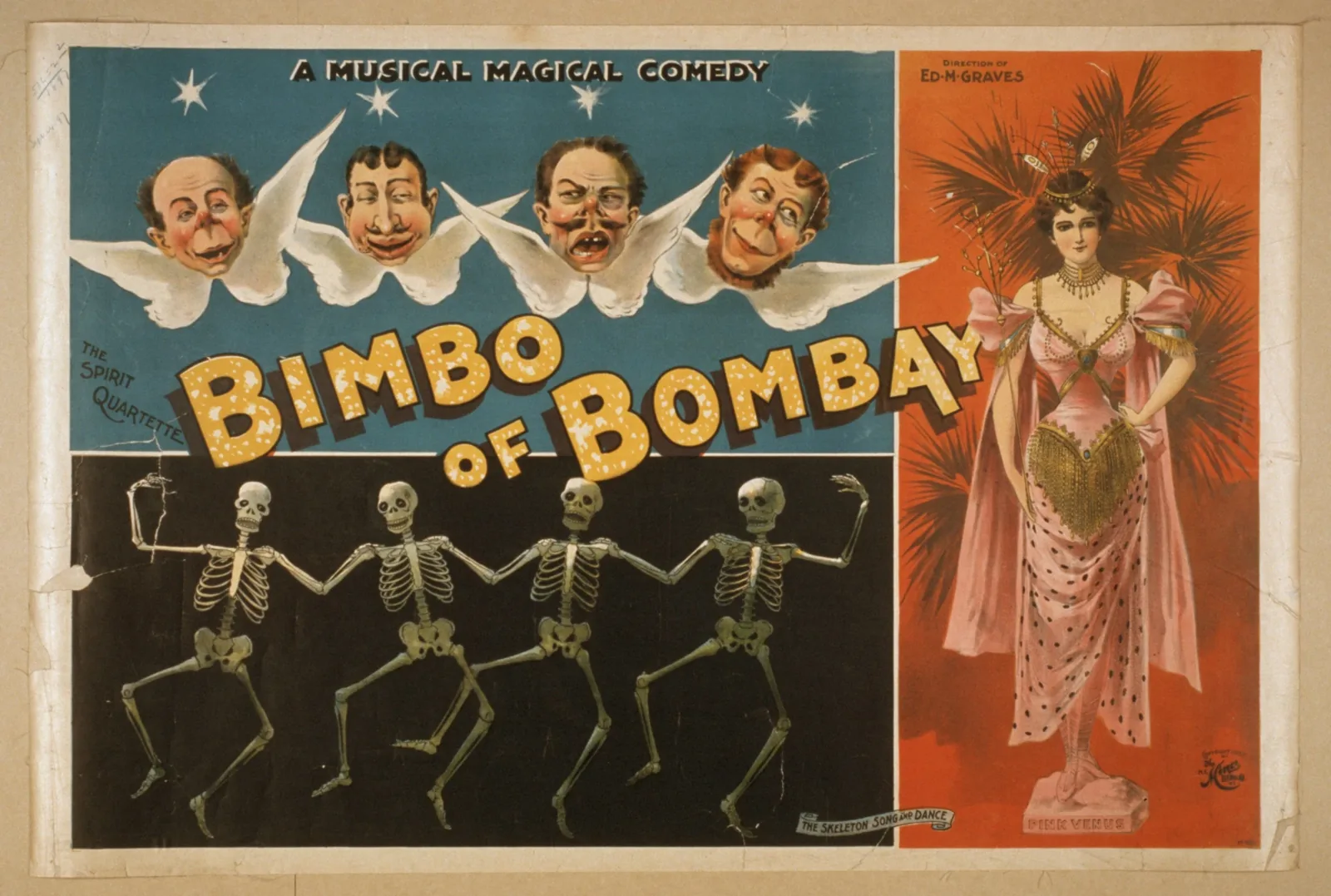
An 1897 vaudeville theatrical poster for Bimbo of Bombay, a musical comedy directed by Ed M. Graves. Along the bottom, four dancing skeletons advertise a performance titled The Skeleton Song and Dance, illustrating the popularity of animated death imagery in theatrical entertainment decades before Disney's The Skeleton Dance (1929).
ⓘ Image credit
H. C. Miner Litho. Co., A Magical Musical Comedy, Bimbo of Bombay, 1897. Lithograph. Library of Congress, Theatrical Poster Collection. U.S. public domain; no known restrictions on publication.
For centuries, European artists, poets, and performers had imagined the dead moving among the living.[7] They could be terrifying, mocking, theatrical, or darkly humorous, and they changed with their audiences as they passed through paintings, manuscripts, printed books, music, and eventually film.[7] Beneath each disguise lay the same unsettling notion, that death was not only something that happened to a person but something a person might meet.
Disney’s skeletons seemingly danced for their own amusement. But their medieval predecessors had a rather different purpose. They had come for the living.
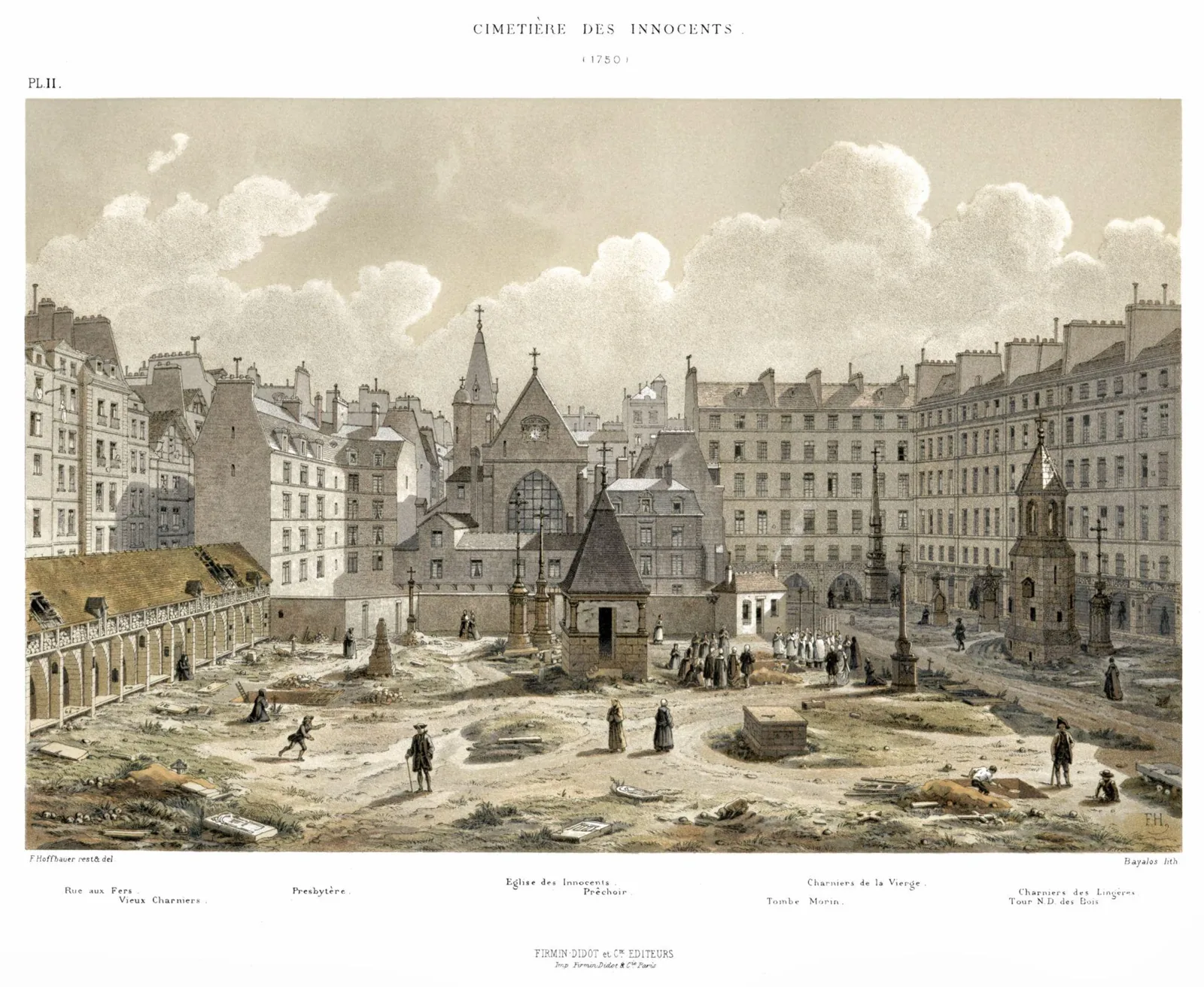
Fédor Hoffbauer's nineteenth-century reconstruction of the Cemetery of the Holy Innocents in Paris, depicting its appearance around 1750. Along the left, the covered charnel-house galleries recall a burial landscape in which the remains of the dead were stored above the activities of the living. The celebrated Danse Macabre of 1424–25 had occupied another gallery, the Charnier des Lingères, before its destruction in the seventeenth century.
ⓘ Image credit
Fédor Hoffbauer, Le Cimetière des Innocents en 1750, published in Paris à travers les âges (1875–1882), Plate II. Lithograph by A. Bayalos. Original drawing held by Musée Carnavalet, Paris, inv. D.7922. (CC0).
Original sourceIn 1424, the Cemetery of the Holy Innocents in Paris was already an old and crowded place. Situated near the busy commercial heart of the city, its burial grounds were anything but removed from ordinary urban life. People passed through, gathered, conducted business, and listened to sermons within its walls.[8] Beneath the ground lay generations of the dead. Above it, in the galleries that ringed the cemetery, their remains gradually accumulated. As burial space became increasingly sparse, older graves could be reopened, their occupants exhumed and their bones transferred to charnel houses.[9] Here, death was neither concealed from view nor confined to the moment of burial. Along the southern charnel-house gallery, beside the rue de la Ferronnerie, a wall was about to acquire some company.[10]
Between approximately August 1424 and Lent 1425, a painted procession took shape on this wall.[10] Its participants were far from an anonymous crowd. A pope appeared in the regalia of his office, an emperor and a king bore signs of their authority, and others represented the ranks and occupations of the society around them.[11] Each living participant was met by a decomposing counterpart, a corpse endowed with the power of gesture, speak, and summon.[6] Verses beneath the figures gave words to these encounters and turned the painted procession into a succession of unsettling dialogues.[12]
The wall was crowded on both sides. Above it, in the galleries, lay the bones of actual human beings lifted from the graves around them. Upon it, the dead had been given movement and voice. And before them stood the living, invited to contemplate a procession in which even the highest earthly dignities offered no exemption from the fate awaiting us all.[13]
This was the Danse Macabre, the Dance of Death.
Its message might appear somewhat simple. Kings and laborers, wealthy merchants and humble clerics, the powerful and the powerless would all die. Indeed, later commentators often read such imagery as the sign of a society consumed by thoughts of mortality. An illustrated edition of the Dance of Death published in London in 1825, for example, portrayed its medieval predecessors as having been consumed by religious superstition and an excessive fear of death.[14] But such explanations risk obscuring the incredible complexity of the images themselves. The order of the procession, the identities of its participants, and the words placed in their mouths point at something more than an undifferentiated warning about life’s inevitable end.[15] The dead might summon everyone, but the living were not represented without distinction. They belonged to a recognizable social world, within its hierarchies, privileges, obligations, and exclusions.[15]
Why, then, did medieval Europeans imagine the dead dancing with the living? And what might these strange processions reveal about the societies that created them?
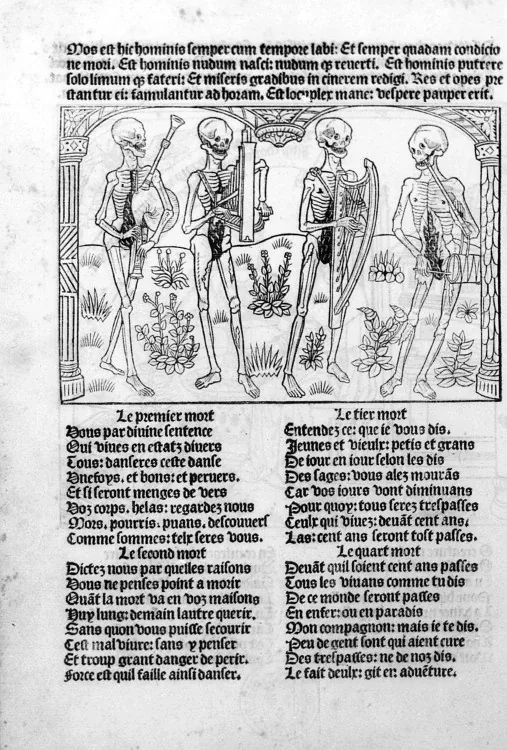
A page from Guy Marchant's La Danse macabre nouvelle, published in Paris in 1486. Marchant's illustrated editions helped transform the monumental Dance of Death associated with the Cemetery of the Holy Innocents into a portable printed work, allowing its imagery and verses to circulate beyond the cemetery walls.
ⓘ Image credit
Guy Marchant, La Danse macabre nouvelle (Paris, 1486). Bibliothèque nationale de France, Réserve des livres rares, Rés. Ye-189. Digitized by Gallica, BnF. View original. Source: https://gallica.bnf.fr/ark:/12148/btv1b2200008n/f2.item?__cf_chl_tk=Shkml2IT013Em4F1Eg7MLO01RL6 p8_tfbH1FjDFR7AA-1793395713-1.0.1.1-L0dKTk6aP617e5b_FPnKhca_7518J07t0kMQ3ISuxCE#
Original sourceIn 1921, plague arrived in Madagascar’s central highlands.[16] Within months, the disease had reached Tananarive, the island’s capital, then under French colonial rule.[16] As the epidemic spread, the authorities imposed increasingly intrusive measures intended to contain it. Houses were disinfected, suspected cases isolated, and the movements of inhabitants restricted.[17] Among the most contentious regulations, however, were those concerning the dead.
For many families in the region of Imerina, death did not sever the relationship between an individual and their community. The deceased remained bound to the living through obligations of kinship, remembrance, and ancestral belonging.[18] To die far from one’s ancestral tomb, or to be buried where one’s descendants could not eventually recover the remains, threatened a relationship extending well beyond the grave.[19] These relationships found particularly vivid expression in a ceremony known as famadihana.
Among Merina communities, famadihana could involve the transfer of remains into ancestral tombs or the ceremonial removal and rewrapping of ancestors already buried there.[20] The occasion might bring together relatives, neighbors, and musicians. Names were called, tombs were opened, and ancestral remains carefully brought into the presence of their descendants.[21] Wrapped in fresh cloth, the bodies could be carried around the tomb amid music, dancing, and communal celebration before being returned to their resting places.[21]
Yet it would be a mistake to treat the occasion as simple rejoicing. Ancestral relationships carried obligations, expectations, and sometimes fears.[22] The dead were not necessarily powerless figures of the past. Through memories, inherited restrictions, and their place within the family, they could continue to exercise considerable authority over the living.[22]
These ceremonies also belonged to a social world with its distinctions. A place in a particular ancestral tomb was not a universal right, but depended on kinship, membership, and inherited obligation.[23] Even in death, people did not necessarily cease to occupy their positions within society.
To French colonial authorities, the handling and exhumation of human remains presented an urgent problem. Plague could spread through contact with infected bodies, and officials sought to regulate burial and prevent the exhumation of those who had died from the disease.[24] Families were sometimes unable to recover their relatives or return them to ancestral burial places.[25] What appeared to administrators as an epidemic-control measure could therefore threaten an enduring obligation to the dead. The resistance that followed cannot be dismissed as hostility to medicine. As pointed out by historian Faranirina Esoavelomandroso, colonial sanitary measures operated within a system of deep political inequality, in which restrictions, exemptions, and punishments were not always applied equally.[26] For affected families, the dispute concerned not just disease but the authority to determine where their relatives belonged, who could handle their remains, and whether ancestral obligations might ever be fulfilled.
Missionaries added another voice to the quarrel. Christian missionary activity had introduced competing expectations concerning burial and relationships with ancestors, although Christian affiliation and participation in Malagasy mortuary customs were not necessarily mutually exclusive.[27] The precise relationship between missionary criticism, local religious practice, and colonial intervention varied considerably.
There is a historical irony here that is hard to ignore. The French administration sought to regulate ceremonies involving the physical remains of the dead, while the country it represented has once produced one of Europe’s most celebrated traditions of dancing corpses.
Still, the resemblance between famadihana and the Danse Macabre is largely a superficial one. In the Malagasy ceremonies, living descendants handled the remains of particular ancestors whose relationships with their families continued after death.[28] In the medieval European procession, painted corpses summoned representatives of the living to contemplate the impermanence of worldly status.[29] One tradition concerned the continuing place of the dead within society while the other confronted the living within the certainty that their earthly positions would eventually come to an end.
The comparison points not to a common origin but to the danger of assuming that similar encounters with the dead must express similar ideas. And plague, curiously enough, stands at the center of both histories.
Madagascar’s was far from the first epidemic to unsettle a society’s relationship with its dead. Between 1347 and 1353, the Black Death killed off a considerable portion of the Europe’s population, disrupting communities and transforming the circumstances in which Europeans experienced mortality.[30]
It is hardly surprising, then, that the Dance of Death has so frequently been associated with this catastrophe. A society had faced death on an almost unimaginable scale, and in the generations that followed came images of corpses leading every rank of humanity toward the grave.
The explanation seems almost irresistible.
But the chronology alone cannot establish causation. Medieval Europeans had been contemplating bodily decay, the instability of worldly possessions, and the inevitability of death long before the first great outbreak of plague reached the continent.[31] The literary and theological traditions from which the Danse Macabre drew its language and imagery had histories of their own, and the relationship between those traditions remains far from straightforward.[32]
The Black Death may have intensified the cultural significance of mortality, but it cannot explain why the dead were imagined dancing, why they addressed the living in verse, or why their partners appeared in such a carefully orchestrated procession. For those answers, we must look further back.
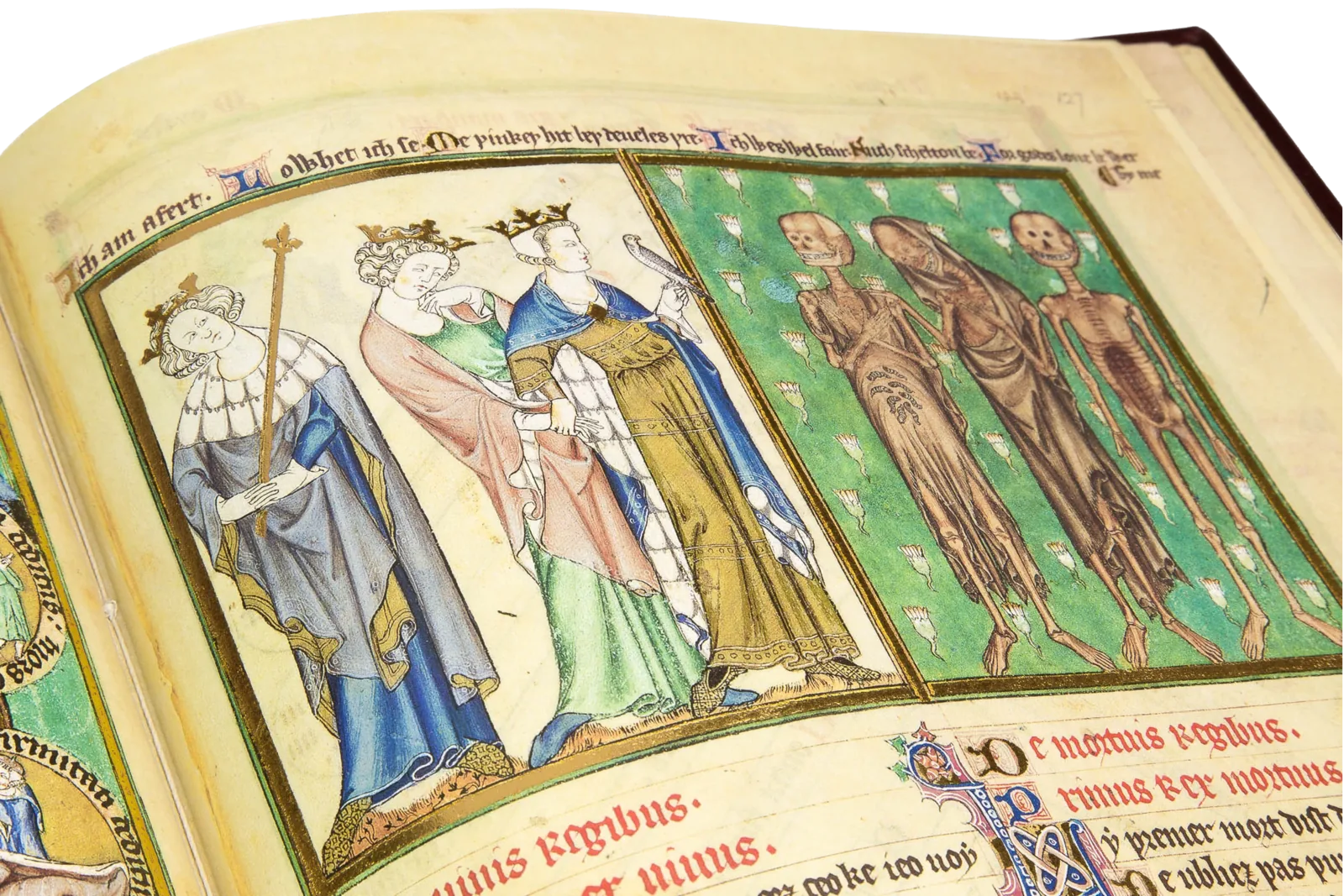
Three richly dressed kings confront three decomposing corpses in an illuminated manuscript dating to approximately 1310. The encounter, known as The Three Living and the Three Dead, warned that worldly splendour could offer no protection against bodily decay. Predating the Black Death, it provides evidence of the religious and visual traditions of mortality that existed before the monumental Danse Macabre of fifteenth-century Paris.
ⓘ Image credit
The Three Living and the Three Dead, Psalter of Robert de Lisle, c. 1310. British Library, Arundel MS 83, fol. 127r. Image reproduction rights to be confirmed for the selected digital file. Specific photo in use from: https://www.facsimilefinder.com/articles/de-lisle-psalter-facsimile-alumina/
Original sourceThe dead had been stopping kings in their tracks long before they reached the walls of the Holy Innocents.
In the Psalter of Robert de Lisle, produced sometime around 1310, three richly dressed figures confront three corpses, their bodies displaying successive stages of decay.[33] The contrast is unmistakable. The living wear the outward signs of privilege, their clothing and bearing announcing the status they occupy in the world. Before them stand the remains of men who have surrendered everything that once distinguished them. The dead offer no escape from the comparison. What the living are now, they themselves once were, and what they have become, the living must eventually be.[33] Known as The Three Living and the Three Dead, the encounter belongs to a well-established medieval tradition in which the deceased confronted their living counterparts with the impermanence of earthly existence.[33] Its warning was neither subtle nor particularly reassuring. Youth would vanish, beauty would decay, and the splendor of worldly possessions would eventually surrender to the physical corruption of the grave.
The disturbing imagery was not just an expression of an unusually morbid imagination. Long before the Black Death, Christian writers had urged believers to contemplate the instability of earthly life and the inevitable decomposition of the body. The tradition known as contemptus mundi, or contempt for the world, emphasized the fleeting character of worldly pleasures, honors, and attachments.[34]
In 1195, more than a century and a half before the plague struck Europe, Lotario dei Segni, the future Pope Innocent III, composed De Miseria Condicionis Humane (On the Misery of the Human Condition). Its reflections upon bodily corruption, human frailty, and the worthlessness of earthly distinctions belonged to a much older religious effort to direct attention away from the temporary world of the living and toward the fate awaiting the body and soul.[35]
Contemplating death was therefore not necessarily an indulgence in terror. It could be a spiritual exercise, meant to encourage repentance and prepare the individual for an existence beyond earthly life.[36]
But as these ideas circulated beyond their original theological settings, they acquired increasingly vivid literary and visual forms. Vernacular poetry made mortality accessible through memorable encounters, warnings, and personifications.[36] In the Vado Mori tradition, figures representing different positions in society voiced their recognition that death was approaching.[37] Their earthly identities remained recognizable, even as their words acknowledged a destiny from which none could claim exemption.
Something extremely important was beginning to take shape. The inevitability of death was no longer expressed solely through reflections upon the human body. It could be articulated through the individual voices of the society that would eventually perish.
By 1376, the expression associated with the Danse Macabre had appeared in Jehan le Fèvre's Le Respit de la mort, although the precise meaning of his reference remains disputed.[38] The surviving words cannot establish that fully developed Dance of Death already exited, much less that it possessed the arrangement familiar from later painted processions.[39] The relationships among the earlier poems, religious teachings, visual encounters, and eventual Dance of Death remain difficult to reconstruct. Their similarities do not necessarily demonstrate a single, uninterrupted line of descent.[40]
What distinguishes the later Danse Macabre, however, is the extraordinary dramatic character of its encounters.
The dead no longer merely demonstrate what will become of the living, nor do the living simply lament their approaching end. Instead, the two exchange words. A corpse issues its summons, and its living counterpart responds. Some protest the interruption of their earthly ambitions, while others confront the loss of their possessions, privileges, or authority.[41] Each exchange constitutes a miniature drama whose conclusion is already certain. The movements of the painted figures made these confrontations even more immediate. Corpses gesture, turn, and reach toward their unwilling companions, while the progression of bodies suggests an action unfolding beyond the boundaries of any single encounter.[41] The relationship between such imagery and actual medieval performances remains contested, but the theatrical qualities of the composition are difficult to overlook.[42]
The dead had acquired voices. They had acquired movement. And, most importantly, they had acquired an audience. Yet the Danse Macabre was not content to confront humanity as an undifferentiated whole. Its participants possessed names of office, recognizable occupations, distinctive clothing, and carefully ordered positions within society.[43]
Death might arrive for everyone, but it did not summon them at random.
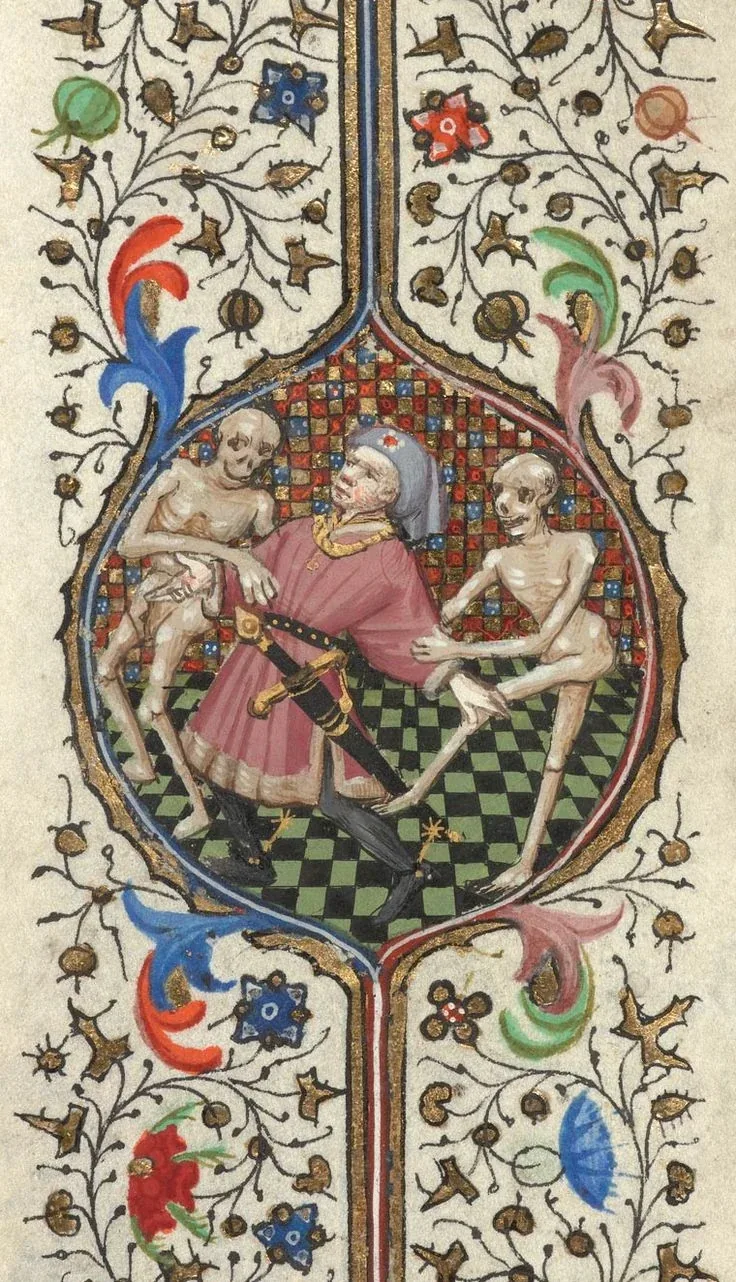
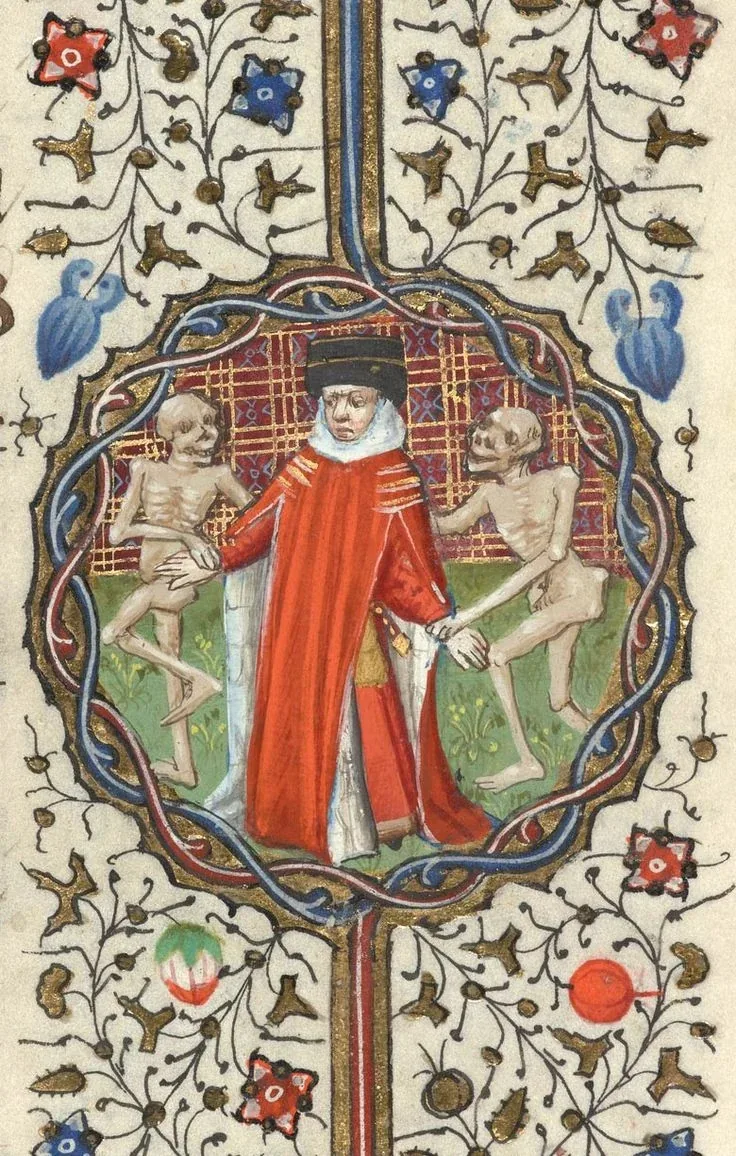
Two encounters from a Parisian Book of Hours, produced around 1430–1435. Left: A probable knight, wearing a chaperon hat with a badge, a gold collar, a sheathed sword, and spurs, stands with his arms extended as two skeletal figures grasp him on either side. The scene occupies a marginal medallion surrounded by elaborate foliage and vinescroll ornament. Right: A probable magistrate, distinguished by his long robes and hat, is similarly confronted by two skeletal figures. Although their clothing and attributes proclaim different positions within medieval society, neither can escape the summons of the dead.
ⓘ Image credit
Left: Dance of Death: Knight (?), Book of Hours, Paris, c. 1430–1435. Illuminated manuscript, MS M.359, fol. 129v. The Morgan Library & Museum, New York. Collection record. Right: Dance of Death: Magistrate (?), Book of Hours, Paris, c. 1430–1435. Illuminated manuscript, MS M.359, fol. 128r. The Morgan Library & Museum, New York. Collection record. Source: Folio 129v https://ica.themorgan.org/manuscript/page/255/76807; folio 128r https://ica.themorgan.org/manuscript/page/252/76807 Explore full manuscript: https://ica.themorgan.org/manuscript/page/1/76807
Original source · Folio 128r sourceThe pope came first.
In the French Danse Macabre, the procession opened with the highest representatives of ecclesiastical authority. The pope was followed by the emperor, the cardinal by the king, and the sequence continued, altering between the hierarchies of Church and society.[44] The arrangement was very much deliberate.
Their identities were proclaimed through clothing, insignia, and the objects associated with their offices. An emperor could be recognized by his crown and symbols of sovereignty, a bishop by his miter and vestments, a merchant by the attributes of his trade.[45] And yet beside each stood a figure whose appearance seemed to mock such distinctions. The dead gestured, grasped, and beckoned, apparently indifferent to the authority their companions had wielded in life.
The French poem gave each pairing its script. Each representative of the dead summoned their living counterpart, who responded with a brief reflection upon the approaching end of their earthly existence.[46] The emperor discovered that sovereign authority could not secure his survival, the king confronted the loss of his dominion, and others lamented the wealth, ambitions, responsibilities, or pleasures they were being forced to abandon.[47] These were not interchangeable expressions of fear. The dialogue was shaped by the identity of the person being addressed. Earthly occupations and privileges furnished their substance of the warning. The powerful were reminded of the impermanence of their authority, while individuals occupying other positions confronted the particular attachments and obligations associated with their lives.[48] The dance thus belonged to a wider tradition of medieval estates satire, in which the characteristic conduct and moral failings of different social groups became subjects of criticism.[49]
There was something quietly subversive about the spectacle. An emperor who commanded armies could not command a corpse to leave. A pope whose office represented the highest earthly authority of the Church could not obtain an exemption from his summons. The dead, stripped of the splendor that distinguished the living, seemed to hold an authority before which even the most prestigious were powerless.
But did this really make the Dance a declaration of equality?
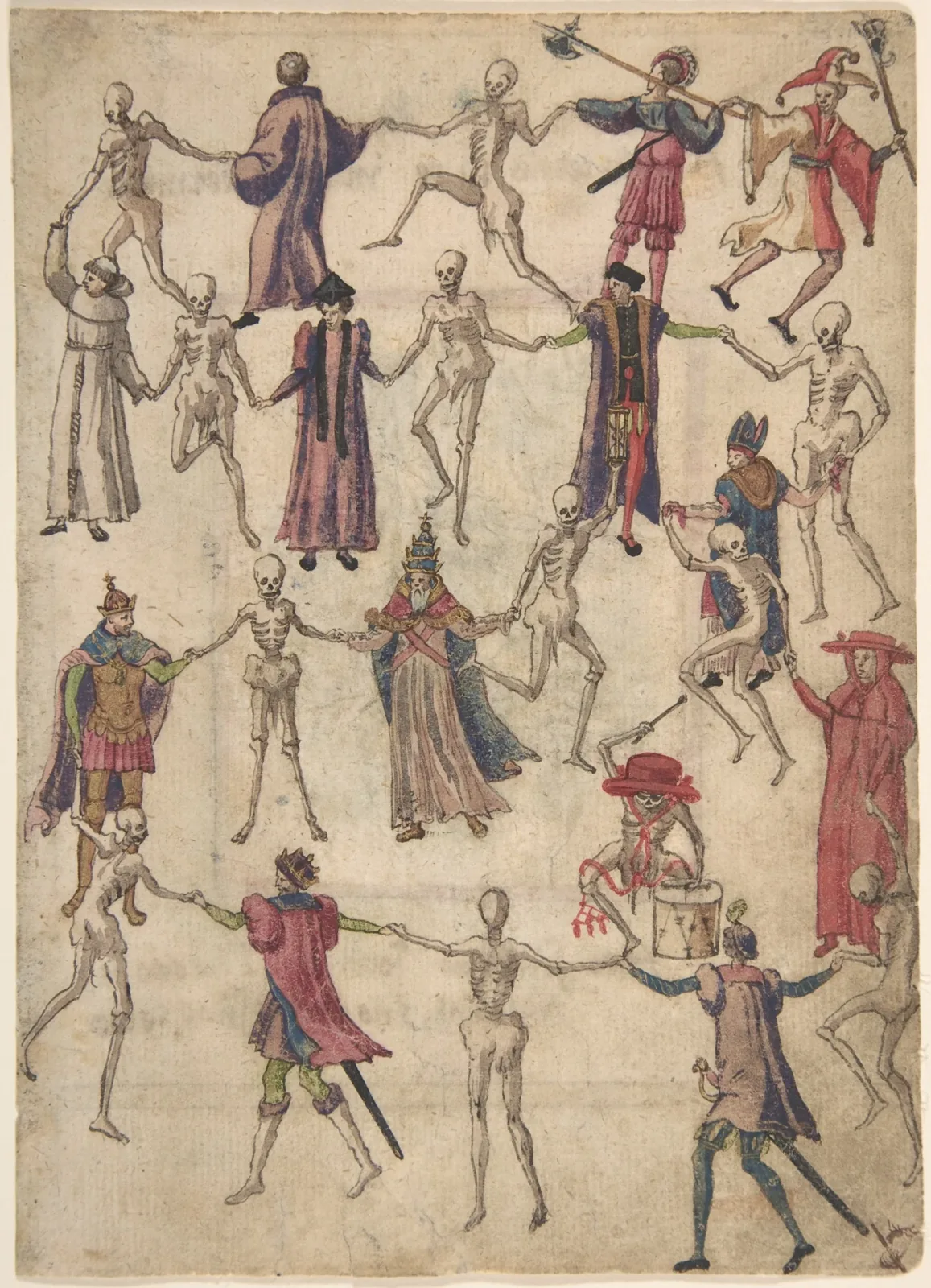
Ecclesiastical dignitaries, secular rulers, and other richly dressed figures join skeletal partners in this sixteenth-century German interpretation of the Dance of Death. Although the participants share a common fate, their clothing, attributes, and positions preserve the distinctions of the society they represent. The contrast between the animated skeletons and their living companions makes the procession's central paradox immediately visible: death comes for everyone, but the living are never quite anonymous.
ⓘ Image credit
Anonymous German artist, The Dance of Death, sixteenth century. Pen and brown ink, brush and brown ink, watercolor, gouache, and gold paint. The Metropolitan Museum of Art, New York, accession no. 1996.70. Public Domain. .
Original sourceThe answer is more complicated than it first appears. As observed by Johan Mackenbach, the Danse Macabre’s insistence upon universal mortality did not necessarily amount to a criticism of the social hierarchy itself.[50] Indeed, the procession depended upon that very hierarchy for its meaning. The pope appeared before the lesser cleric, the emperor before the ordinary laborer, and each was distinguished by precisely the privileges and positions that death would ultimately render temporary.
When the mural first appeared at the Cemetery of the Holy Innocents around 1425, Paris was a city of contested crowns. Following the Treaty of Troyes in 1420, the French succession had become entangled with English and Burgundian claims to authority. Henry V of England and Charles VI of France had both died in 1422, leaving the infant Henry VI recognized as heir to the French crown under the Anglo-Burgundian settlement, while the disinherited dauphin, the future Charles VII, maintained a rival claim.[51]
The painted procession nevertheless presented a seemingly familiar political and ecclesiastical order. It contained kings, emperors, and officers whose titles implied the continuity of institutions, even as the identities and legitimacy of those exercising authority were being contested beyond the cemetery walls.[52] For a Parisian spectator, the image of a monarch summoned by death might therefore have possessed a resonance considerably more immediate than an abstract warning about the vanity of worldly power. Sophie Oosterwijk has suggested that certain figures may even have evoked recognizable historical individuals. The king represented in an early Parisian Book of Hours, for example, possesses features and heraldic attributes that she compares with representations of Charles VI.[53] The identification remains uncertain. The original mural has long since disappeared, and the surviving manuscript cannot establish that its painted monarch was intended as a portrait.[53] Still, the possibility raises an important question. Could the Dace have addressed not only the transience of kingship, but the memory of particular kings?
Perhaps an even more revealing detail concerns someone who was apparently missing.
Among the ranks represented in the Parisian sequence, there was no duke.[54] This absence stands out because ducal figures appeared in other Dance of Death traditions, and Guy Marchant would eventually include one in his expanded printed edition of 1486.[54]
In early fifteenth-century France, the title carried particularly charged political associations. Louis of Orléans had been assassinated in 1407, John the Fearless, Duke of Burgundy, in 1419, and Charles of Orléans remained a prisoner in England. Philip the Good, meanwhile, held a position of considerable influence within the Anglo-Burgundian alliance.[55] Oosterwijk proposes that the omission might have reflected the political sensitivities surrounding these figures.[56] A duke humiliated by Death could perhaps have suggested rather more than a general warning concerning mortality.
Yet no surviving commission or contemporary explanation demonstrates that the omission was deliberate, much less politically motivated.[56] The absence may reflect an artistic convention, a textual choice, or some circumstance that the surviving evidence no longer allows us to recover.
Still, someone had to decide who would stand in that procession, and in what order. If those choices mattered in Paris, what happened when the Dance traveled elsewhere? Death might summon everyone. But who, ultimately, decided who would join the procession?
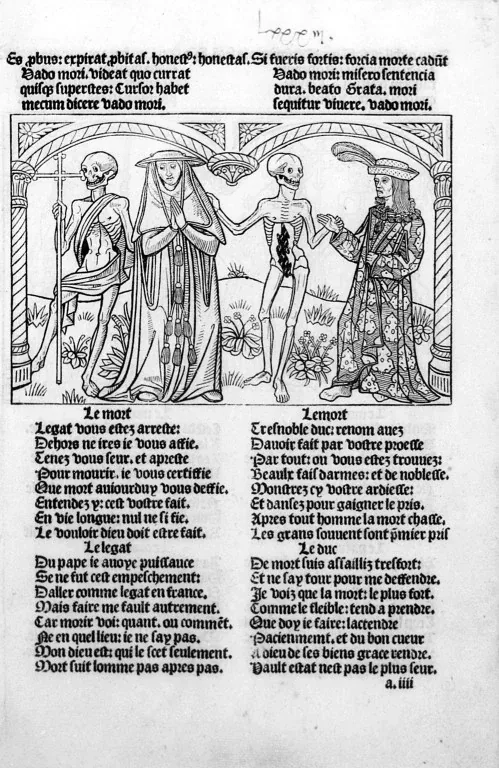
Guy Marchant’s printed Dance of Death pairs the papal legate and the duke with skeletal companions. The supplied image is labelled “Le legat” and “Le duc”.
ⓘ Image credit
Guy Marchant, Dance of Death, papal legate and duke. Public domain, via Wikimedia Commons. The supplied draft’s women’s Dance caption does not describe this image; final caption and edition require editorial review.
Original sourceFor more than sixty years after the Dance appeared on the walls of the Holy Innocents, one notable group was missing from its procession.
There were no women. Popes and emperors had been summoned, kings stripped of their authority, merchants of their possessions, and laborers of the lives they had spent working. Yet the women of medieval Paris were nowhere to be found among the living participants.[57] Death, it seemed, had overlooked half of humanity.
In 1486, the Parisian printer Guy Marchant published an expanded version of his illustrated Danse Macabre. Among its additions was an entirely separate procession of women. The dead now summoned queens and duchesses, wives and widows, young women and old.[58] The terms on which women entered the Dance, however, differed revealingly from those given to men.
Where the male procession emphasized ecclesiastical office, political authority, and occupation, many of the female participants were identified through marriage, family relationships, age, or sexual status. The widow, the newlywed, the pregnant woman, and the maiden appeared not only as individuals confronting death, but as representatives of particular expectations about women’s lives.[59] Their presence broadened the Dance's claim to represent humanity while exposing the distinctions through which its creators understood that humanity.
Nor was the separation a rule. Elsewhere in Europe, women could appear within the same procession as men, their places determined by local convention.[60] Wherever the Dance went, its artists and authors had to decide who counted as a recognizable member of society.
Those decisions became more visible as the Danse Macabre traveled beyond France.
Across the Channel, the English poet John Lydgate adapted the French Dance in the fifteenth century, translating its moral encounters into Middle English while altering the company of the living.[61] His versions introduced figures and adjustments absent from the French sequence, including female participants, and a later revision was associated with a painted Dance at St Paul’s in London.[62] The Dance didn’t just cross the Channel. It arrived with a different cast. Other versions widened the circle in another direction, toward religious difference. In the Castillan Dança general de la muerte, Death summons an alfaquí, a Muslim religious scholar, among the Christian authorities and other representatives of society.[63] His presence is telling. The procession acknowledges a world in which different religious communities lived side by side, yet inclusion did not mean even-handedness. The words and attributes assigned to such figures were shaped by the religious assumptions of the society that produced the poem.[64]
Farther east, on the Istrian peninsula, the Dance returned to the wall, this time in small village churches along the northern Adriatic.
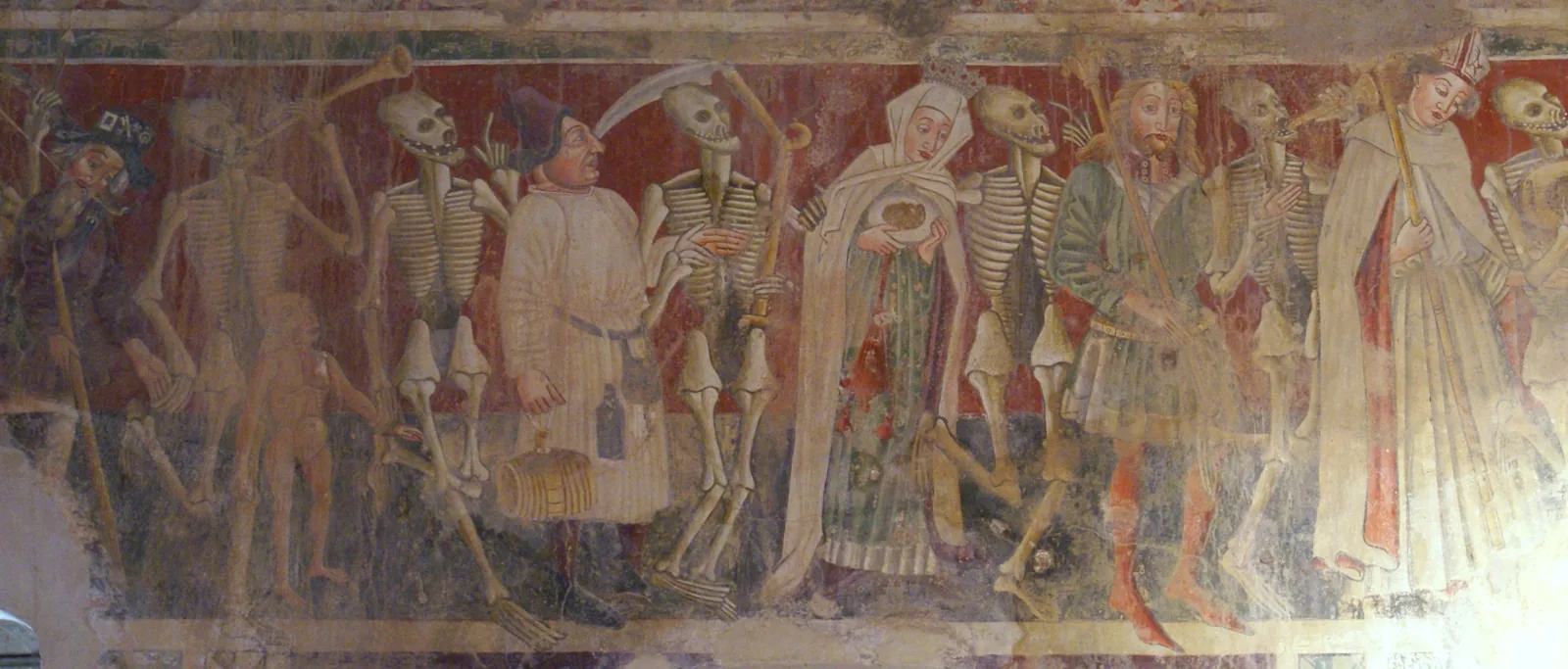
Painted in 1474, the Dance of Death at Beram transforms the inevitability of mortality into an animated and occasionally irreverent spectacle. Skeletons play music, gesture toward their living companions, and lead representatives of society toward an enthroned Death. Among the participants are figures who attempt to purchase their release, including a pope, queen, and merchant or moneylender. The fresco exposes the futility of wealth and status through gestures that are at once theatrical and unmistakably moralizing.
ⓘ Image credit
Vincent of Kastav, Dance of Death, 1474. Fresco, Church of St Mary on Škriline, Beram, Croatia. Photograph: Toffel, 2008, Wikimedia Commons, CC BY-SA 3.0.
Original sourceIn 1474, Vincent of Kastav painted a Dance of Death in the Church of St Mary on Škriline at Beram. Sixteen years later, John of Kastav produced another in the Church of the Holy Trinity at Hrastovlje.[65] Though painted only a short distance and a few years apart, the two frescoes approach the subject very differently. At Beram, the dead are anything but solemn. Skeletons gesture energetically, carry weapons, and play musical instruments as they escort ten living participants toward Death, who sits enthroned with a set of bagpipes.[66] The composition has an almost carnivalesque energy to it., yet beneath its apparent absurdity lies a pointed criticism of the attachments that bound individuals to the world.
Several participants try to buy their way out.
The pope offers money. So does a queen. A merchant or moneylender gestures toward the wealth displayed before him.[66] Their gestures make the procession’s warning almost comically literal. Even with Death standing before them, worldly privilege had not extinguished the hope that everything might still be negotiable. But Death was not interested in bargaining.
Beram also shows how hard it can be to recover the identities intended by medieval painters. One participant traditionally identified as a cardinal has been reinterpreted by Tomislav Vignjević as an abbess, based upon the figure’s appearance and clothing.[67] If correct, the identification would place a woman occupying religious authority within the procession itself. But without an inscription securely naming the figure, the proposal remains an interpretation rather than an established fact.
Hrastovlje offers a different setting. Its procession belongs to a longer painted program that includes imagery associated with the protection of the faithful and the inevitability of death.[68] The contrast is a reminder that these images were never isolated masterpieces. They belonged to the architecture and devotional life around them.
By the end of the fifteenth century, the Dance of Death had become far more than a single Parisian composition. It could be translated, expanded, illustrated, painted, and reorganized, and its participants changed with the languages, institutions, occupations, and assumptions of the societies that reproduced it. The warning remained recognizable, but there was no single, unchanging procession of humanity.
Soon, an artist working in the German-speaking world would transform the Dance further. Instead of leading the living through a continuous procession, Death would begin to interrupt them in the midst of their ordinary lives.
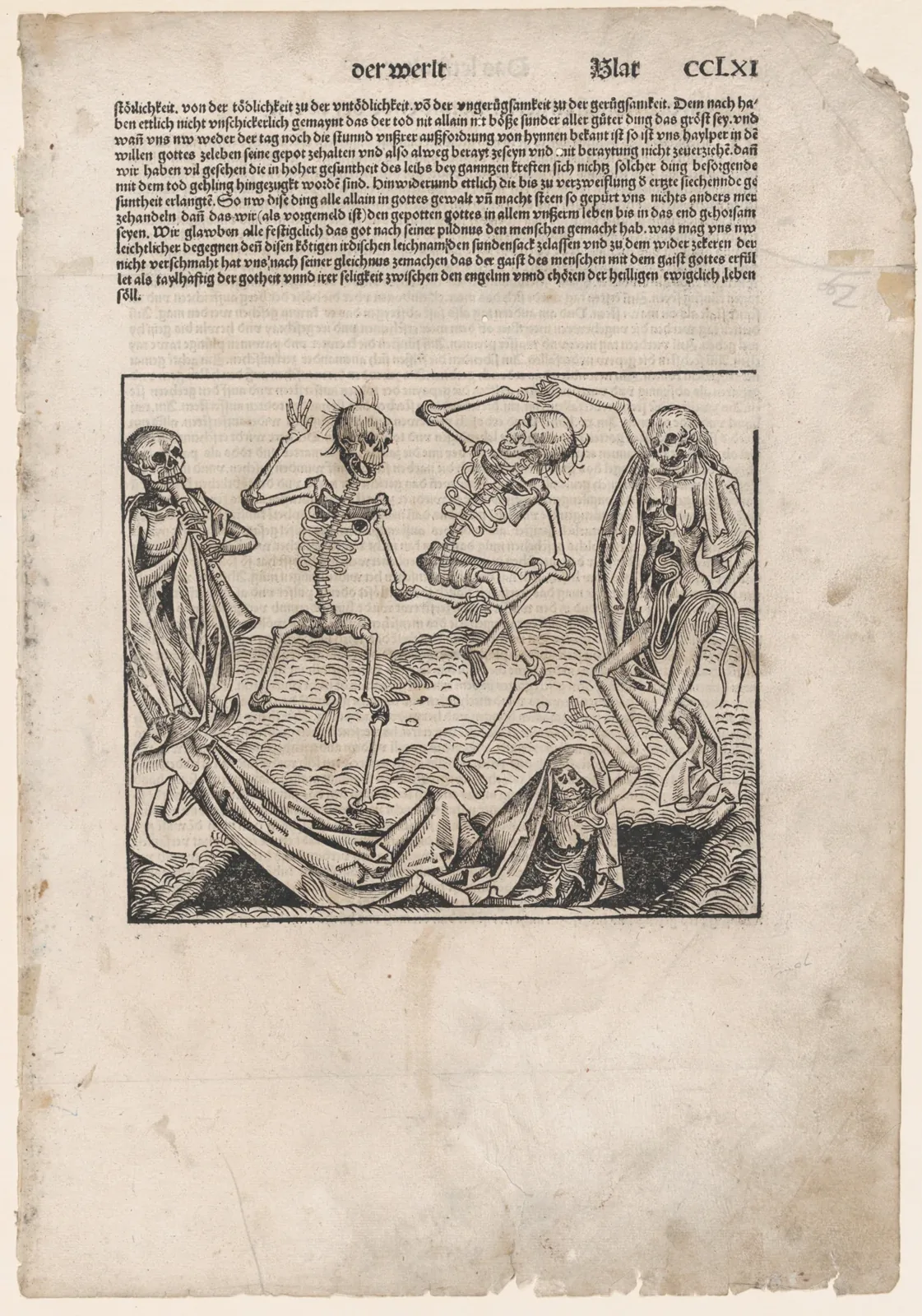
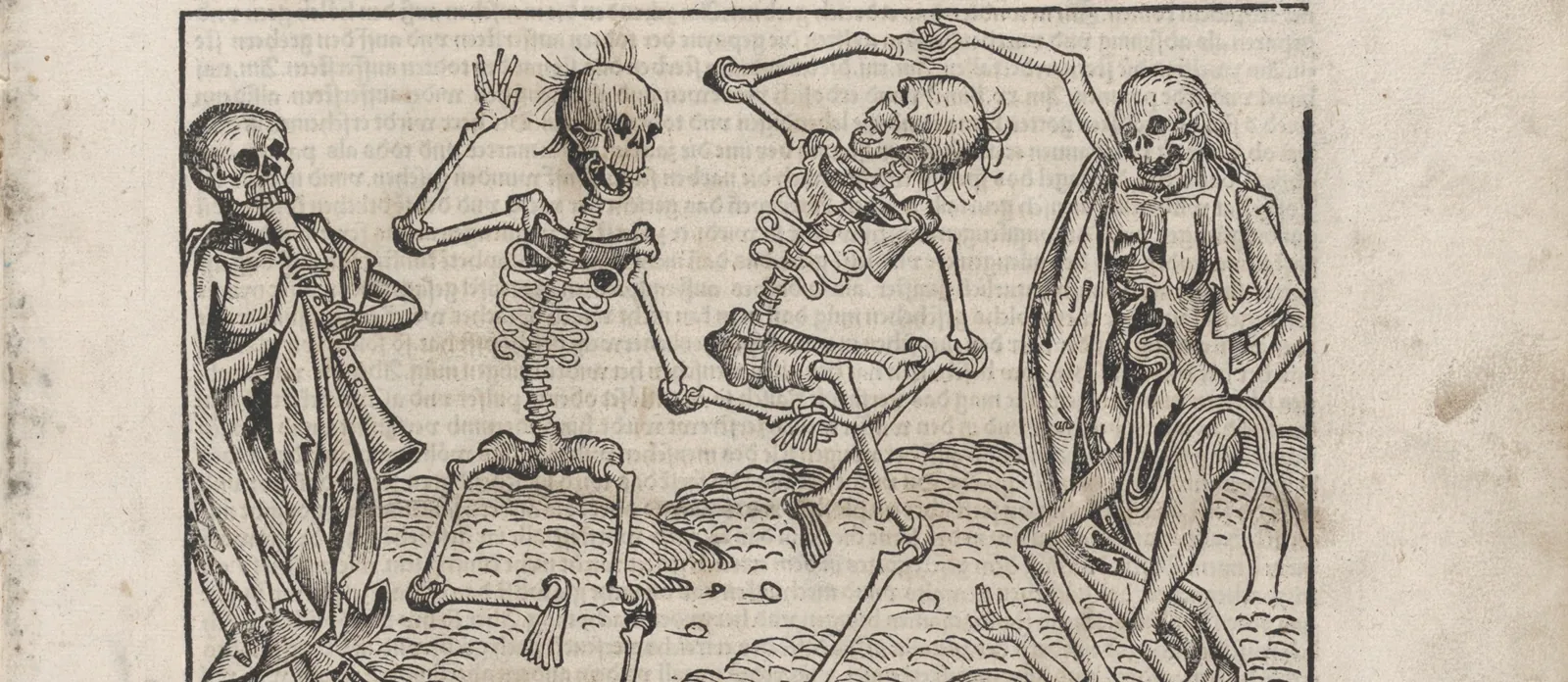
Skeletons join in a lively dance in this woodcut from the Nuremberg Chronicle, published in 1493. Their animated gestures demonstrate how the imagery of death could combine theatrical movement with the contemplation of mortality. Within a generation, Hans Holbein the Younger would transform the tradition further, placing Death directly into the everyday activities of the living.
ⓘ Image credit
Michael Wolgemut, Dance of Death, leaf from The Nuremberg Chronicle, 1493. Woodcut and letterpress text. The Metropolitan Museum of Art, New York. Bequest of Herbert Mitchell, 2008 (2018.839.160). Public Domain. Source: https://www.metmuseum.org/art/collection/search/390220
Original sourceIn 1893, the London bookbinder Joseph Zaehnsdorf wrote an unusual letter concerning a volume he had bound for a collector.
The book was an illustrated edition of Hans Holbein’s Dance of Death, published in 1816. Its subject was already macabre enough, but Zeehnsdorf’s choice of binding material transformed it into something more unsettling still. The volume, he explained, had been bound in human skin.[69]
There had apparently been a practical difficulty. The available skin was too small to cover the large book without being divided, which left different surfaces of the prepared material exposed on its front and back.[70] Zaehnsdorf described the problem with the practical attention of a craftsman. Zaehnsdorf described the problem as any craftsman would, as a matter of coverage and material. The material, however, had once been a person.
Such claims call for caution. Books supposedly bound in human skin have often gathered reputations through inscriptions, collectors’ stories, and booksellers’ descriptions, many of which have proved unreliable.[71] But this particular volume offers more than a sensational account. In 2015, scientific examination of the binding through peptide mass fingerprinting confirmed its human origin.[72]
The discovery raises questions that Zaehnsdorf’s letter cannot answer. Whose skin had been used? Under what circumstances had it been obtained? Had the person ever consented to such treatment? The surviving evidence does not establish their identity or wishes.[73]
More than three centuries after Holbein created his remarkable images of mortality, a collector could encounter those images within a book that physically incorporated human remains.
But to understand why Holbein’s illustrations continued to provoke such fascination, we need to return to the world in which they were created. In the 1520s, the German artist Hans Holbein the Younger was working in Basel, a city whose flourishing printing industry and humanist intellectual culture existed alongside increasingly bitter religious disagreement.[74] The Protestant Reformation was transforming the political and spiritual landscape of Europe, but the confessional divisions that would later characterize this upheaval had not yet fully crystallized.[74]
In that unsettled environment, Holbein designed a series of extraordinarily intricate woodcuts depicting encounters between Death and the living. The designs were cut into printing blocks by Hans Lützelburger, whose technical skill enabled astonishingly elaborate scenes to be reproduced at a remarkably small scale.[75]
The earliest surviving impressions probably date to around 1525–26, yet the celebrated print collection did not appear until 1538, when the images were published in Lyon under the title Les Simulachres & historiées faces de la mort.[76] The familiar medieval subject now took a form far removed from processions painted on church walls.
Holbein’s dead no longer needed to lead their companions toward the grave. Instead, they entered the world of the living.
In one scene, Death interrupts a wealthy man and takes his money. In another, it snuffs out a candle beside a nun distracted from her religious duties. Elsewhere, it guides a plow beside a farmer engaged in the ordinary work of earning his living.[77] The encounters are brief, but each is now a self-contained story whose meaning emerges from the setting, occupation, gestures, and possessions of the person confronted.
Earlier Dances of Death had arranged humanity in a sequence of recognizable social identities, each receiving summons from the dead. Holbein kept those identities but placed his figures within the very activities that defined their lives.[78] Death no longer waited at the end of a procession. It had moved into daily life.
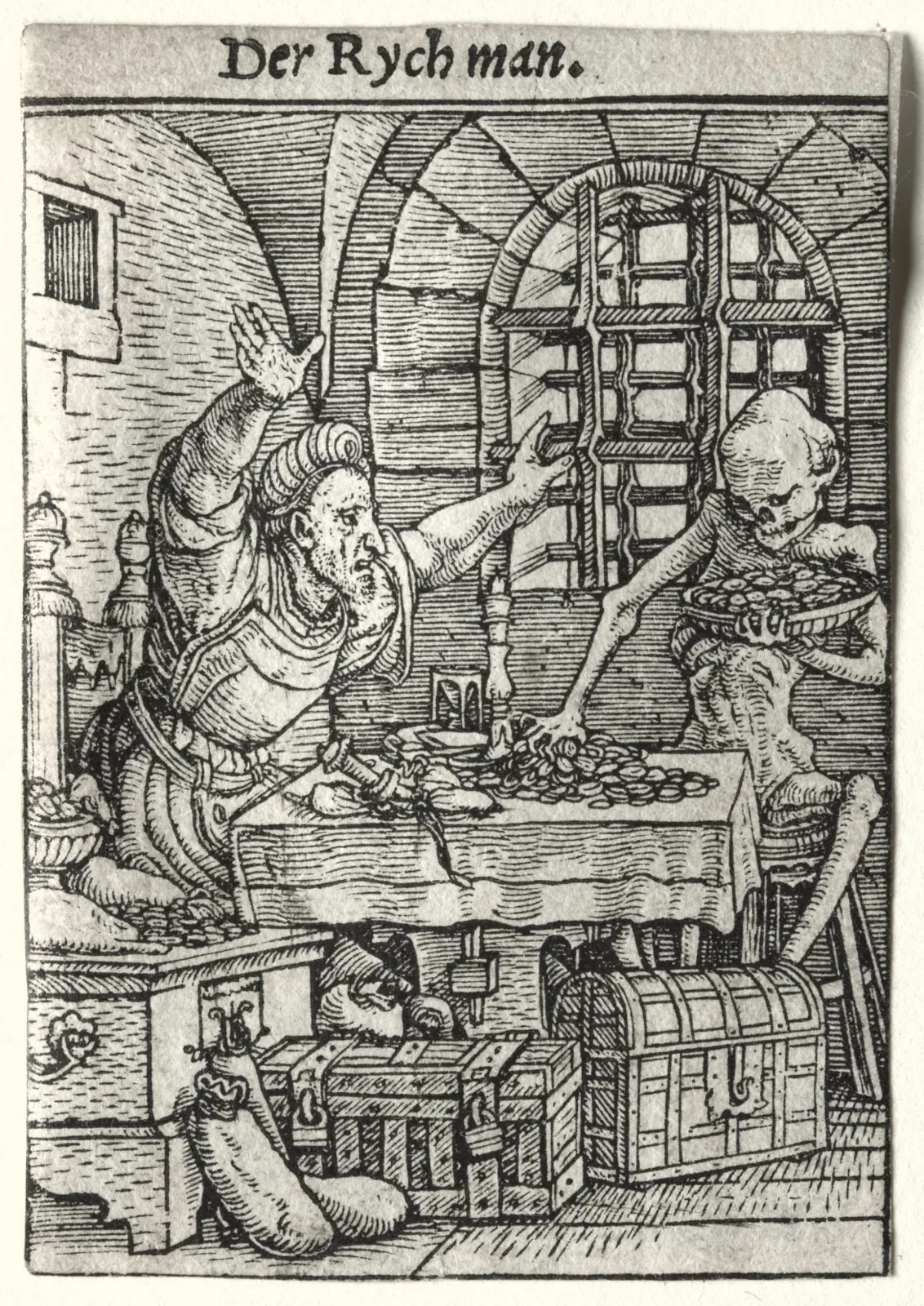
A wealthy man yells as Death reaches for the coins piled upon his table. Chests and money bags crowd the foreground, surrounding him with the possessions he can no longer protect. In Holbein's Dance of Death, the familiar medieval procession gives way to individual encounters, exposing the fragility of wealth and worldly security.
ⓘ Image credit
Hans Holbein the Younger (designer), Dance of Death: The Miser, c. 1526. Woodcut, engraved by Hans Lützelburger. Cleveland Museum of Art, Gift of The Print Club of Cleveland, accession no. 1929.161. Image: Cleveland Museum of Art, Open Access, CC0 (public domain). Source: https://www.clevelandart.org/art/1929.161
Original source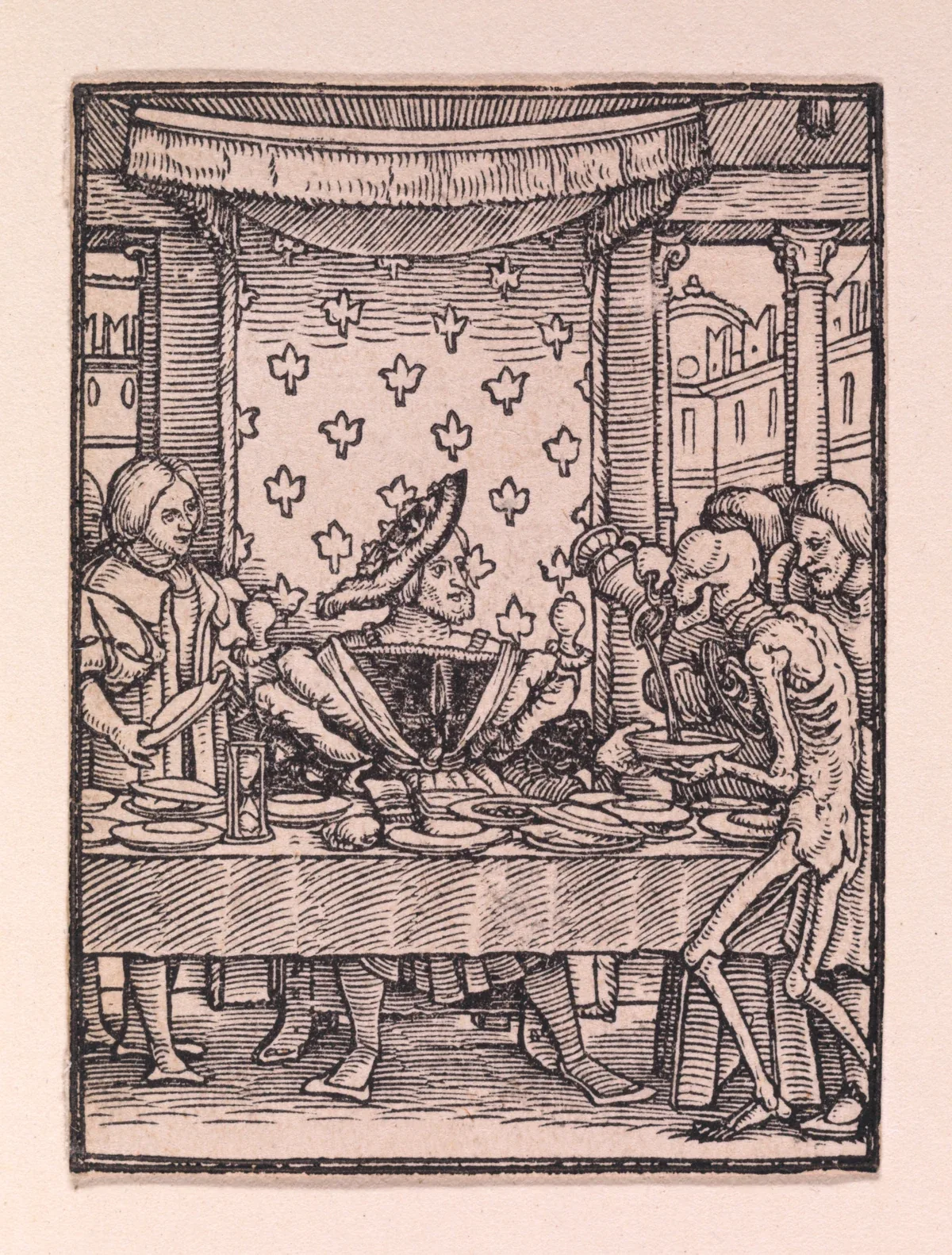
When Death Comes Calling
Four Encounters in Holbein’s Dance of Death
Four small woodcuts. Four encounters with Death. Examine the details of Holbein’s banquet, religious chamber, farmer’s field, and family hearth—and explore why each encounter invites a different interpretation.
Explore the four encounters →The scene of Death and the rich man offers a telling example. Holbein does not merely depict a corpse dragging a wealthy individual toward his inevitable fate. Instead, Death seizes his money, so that the loss of possessions and the loss of life become inseparable.[79] The image suggests how thoroughly worldly identity could become entangled with wealth, and how completely death could unravel that attachment.
It would be tempting to read the entire series in this way, as a collection of punishments directed against human vanity, greed, and misconduct. But Holbein’s images resist such a simple explanation.
Consider the plowman. Death accompanies him as he works the soil, an activity neither obviously sinful nor unnecessary. Agricultural labor sustains life, but even this indispensable work unfolds under the certainty of mortality.[80] Or consider the child, whose encounter with Death can hardly be interpreted as punishment for some personal moral failing.[81]
Peter Parshall has argued that this pairing of immediately recognizable action with interpretive ambiguity lies at the heart of Holbein’s achievement.[82] The viewer understands what happens in each picture without necessarily arriving at a single, definitive explanation of what it means.
Even the religious character of the series remained open to reinterpretation. Although Holbein's images emerged during the Reformation, their subsequent publication histories were shaped by both Catholic and Protestant interests. The texts accompanying later editions could direct readers toward different theological conclusions, without demonstrating that Holbein himself had intended any one of them.[83]
Over the following centuries, Holbein’s images circulated through new editions, translations, adaptations, and collections. The nineteenth century, with its antiquarian fascination for the medieval past, continued to reinterpret the Dance through its own religious assumptions and artistic tastes.[84]
Zaehnsdorf’s binding belongs to that later world of collectors. It was not alone. Another edition of Holbein's Dance of Death, published in 1898 and subsequently bound by Alfred Cox, was likewise identified as having a human-skin binding. Scientific analysis confirmed the material of both volumes.[85]
There is a disturbing irony here, but it would be a mistake to treat it merely as one more macabre curiosity. The skin belonged to actual people whose identities and circumstances have largely vanished from the historical record. Their remains became materials in objects valued and collected by others, while the images those objects contained continued to proclaim the importance of worldly possessions and vulnerability of every human life.[86]
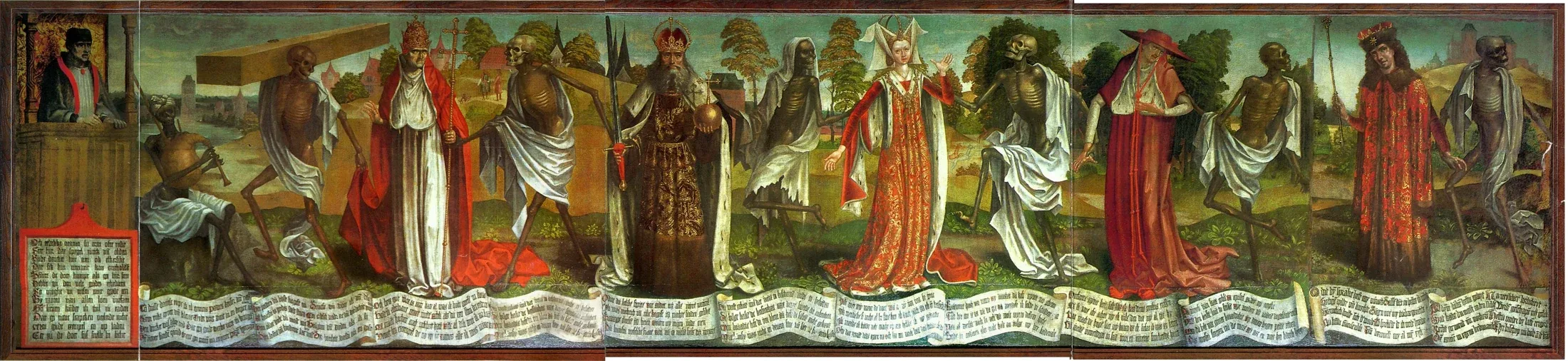
Thirteen figures remain from a monumental Dance of Death painted in the late fifteenth century. A preacher introduces a procession of skeletal figures and representatives of earthly authority, accompanied by dialogue in Low German. The surviving canvas extends approximately 7.5 metres, but the original composition was probably considerably longer. Its abrupt ending offers a reminder of how much of the medieval Dance of Death has disappeared and how carefully its surviving evidence must be interpreted.
ⓘ Image credit
Workshop of Bernt Notke, Dance of Death (Surmatants), late fifteenth century. Oil and tempera on canvas, 163 × 750 cm. Art Museum of Estonia, Niguliste Museum, Tallinn, accession no. EKM j 18761 N 153. Source: BerntNotke, Public domain, via Wikimedia Commons
Original sourceIn Tallinn’s old town, a medieval church stands among the narrow streets and historic buildings of the former Hanseatic city. Its Gothic walls once enclosed the ceremonies of a prosperous merchant community, and today, the Church of St Nicholas houses a branch of the Art Museum of Estonia.
Inside, a visitor passes beneath high vaults, and among artworks that once belonged to the religious life of the Estonian capital. But it is within St Anthony’s Chapel that one of the church’s most greatest treasures awaits.[87]
Across a long stretch of painted canvas, the dead are dancing.
A preacher stands in his pulpit, addressing an audience now separated from him by centuries. Beside him, a skeletal figure plays the bagpipes, while another carries a coffin. Then the living begin to appear. A pope in his tiara, an emperor with his sword and orb, an empress, a cardinal, and a king. Their clothing and insignia announce the positions they hold in society. The dead seem entirely unconcerned by such distinctions.[88]
Beneath their feet, a winding band of Low German verse preserves the words of the encounter.[88] The painted figures are silent, but their voices have not entirely disappeared. For a moment, the scene seems familiar, the same hierarchy of the living confronted by the inevitability of death that we met in Paris. Then, as the visitor follows the painting toward its right-hand edge, the Dance abruptly stops.
Only the first edge of a bishop’s robe is visible. Beyond it, the procession is gone.[89]
What survives is just seven and a half meters of a work that may have once stretched nearly thirty. Its thirteen remaining figures offer an amazing glimpse into a late-medieval representation of mortality, but most of the painting has been lost.[89]
And the missing figures are only the first of its mysteries. The painting is generally attributed to Bernt Notke, a prominent late-medieval artist working primarily in the Hanseatic city of Lübeck. His workshop produced another monumental Dance of Death for St Mary’s Church there in 1463.[90] The two compositions were closely related, sharing recognizable figures and elements of their poetic structure, although their backgrounds and accompanying verses differed.[91]
Even so, the relationship between them has long provoked disagreement. Was the Tallinn painting an independent commission? A later copy? Or might it have been a surviving fragment removed from the larger Lübeck composition? Throughout the twentieth century, scholars proposed competing explanations, sometimes drawing confident conclusions from similarities in painted techniques, materials, and style.[92]
Even the painting’s original location is uncertain. Its present display in St Anthony’s Chapel has encouraged the suggestion that it was commissioned for that space in the late fifteenth century, when the chapel was being rebuilt. But the earliest surviving written reference dates only to 1603, and no document names the original patron.[93]
Between 1962 and 1965, the canvas underwent an extensive restoration in Moscow. Conservators investigating its surface discovered that much of the medieval painting lay beneath later interventions. Layers of overpainting, including substantial nineteenth-century additions, had altered the appearance upon which earlier scholars had based some of their interpretations.[94]
The investigation combined technical examination alongside the careful removal of secondary paint layers, exposing elements of the original composition and revealing evidence of its construction.[95] Traces that had been hidden for generations could be seen again.
The restoration contributed important evidence against the idea that Tallinn held a piece physically cut from the Lübeck composition. Still, the technical findings could not conclusively identify the artist, reconstruct the missing procession, or establish the exact circumstances of the commission.[96]
St Nicholas’ Church was also a place where the living kept their rank in the presence of the dead. It was also a place where the social divisions of the living continued to shape the treatment and commemoration of the dead. Burial inside the church was a privilege that required money, and the placement of graves and memorials followed gradations of prestige. Wealthy merchants, guilds, and other corporate associations maintained burial spaces for their members.[97]
A painting that warned of universal death thus hung in a building where status followed people into the ground. The painting did not necessarily challenge those arrangements, and we cannot say that those who commissioned or viewed it saw the contrast in these exact terms. But the funerary evidence is a reminder that medieval attitudes toward death were expressed not only in paintings and poetry but in the ground itself, in where bodies were buried, remembered, and ranked. Elina Gertsman has argued that the Tallinn Dance may be understood as an encounter between a painted preacher and the spectators standing before him. The opening figure addresses the audience, while the procession and its accompanying dialogue invite viewers to recognize their own eventual place among the dead.[98]
Yet its historical audience remains hard to reconstruct. We do not know precisely where every part of the original painting was displayed, who commissioned it, or how individual spectators responded.[99] The visitor standing before the fragment today meets a medieval artwork whose survival has preserved its warning without preserving all the circumstances that once gave it meaning.
In Paris, the original composition disappeared. Elsewhere, its figures survived through manuscripts, printed books, altered frescoes, and later reproductions. In Tallinn, the dead remain painted upon the canvas itself, even as much of the world that surrounded them has vanished.
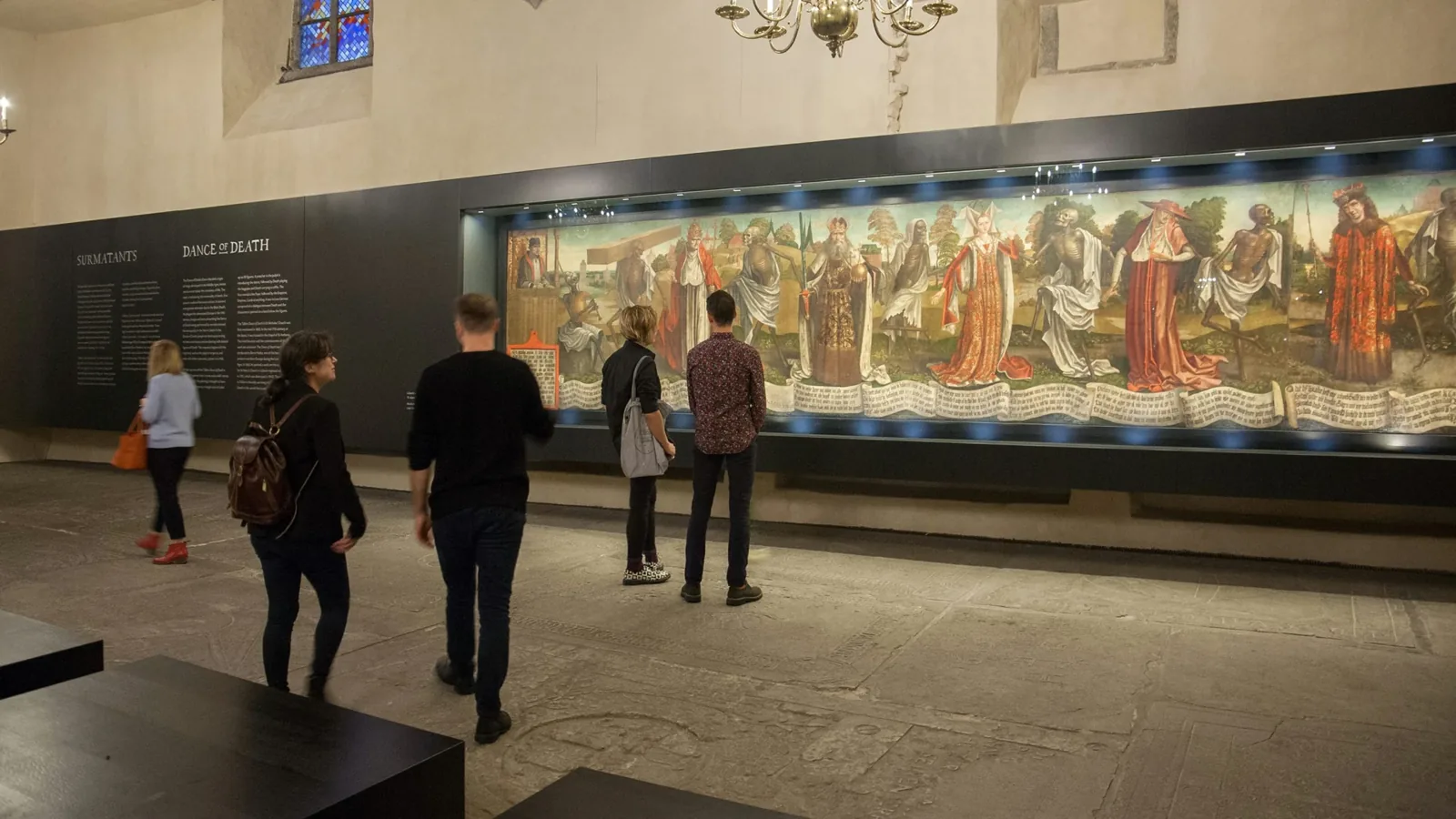
The surviving Dance of Death displayed in St Anthony's Chapel of the Niguliste Museum, Tallinn. Centuries after its creation, the monumental painting continues to confront visitors with a procession whose original extent, location, and audience remain incompletely understood. Its medieval spectators have disappeared, but the encounter between the living and the painted dead continues.
ⓘ Image credit
Attributed to the workshop of Bernt Notke, Dance of Death, late fifteenth century. Art Museum of Estonia, Niguliste Museum, Tallinn. Source: https://nigulistemuuseum.ekm.ee/en/dance-of-death/
Original sourceNearly five centuries after the first figures appeared upon the walls of the Cemetery of the Holy Innocents, Walt Disney sent his own skeletons dancing through a moonlit graveyard. Much had changed. The solemn warnings of medieval preachers had become the material of comedy, artistic invention, and entertainment. Still, the dancing dead had proved remarkably difficult to lay to rest.
They had travelled across church walls and manuscript pages, entered the workshops of printers, and found themselves among the possessions of collectors. Along the way, they acquired new companions, new gestures, and new meanings. Some were painted over, some destroyed, and others survived in forms their original creators would hardly recognize.
In Tallinn, a handful of them are still dancing.
The visitors who stand before them today inhabit a world very different from the one in which they were painted. The offices, garments, and conventions that once made their living companions immediately recognizable now require explanation. Even the words beneath their feet belong to a language unfamiliar to most who pass before them.
And yet the encounter remains strangely intelligible. The dead extend their hands. The living hesitate. Somewhere beyond the surviving edge of the canvas, the procession continues.
We can no longer see where it leads.
Happy Halloween everyone.
Image credits
I The Skeleton Song and Dance H. C. Miner Litho. Co., A Magical Musical Comedy, Bimbo of Bombay, 1897. Lithograph. Library of Congress, Theatrical Poster Collection. U.S. public domain; no known restrictions on publication.
II The Cemetery of the Holy Innocents Fédor Hoffbauer, Le Cimetière des Innocents en 1750, published in Paris à travers les âges (1875–1882), Plate II. Lithograph by A. Bayalos. Original drawing held by Musée Carnavalet, Paris, inv. D.7922. (CC0). Source
III A Portable Procession Guy Marchant, La Danse macabre nouvelle (Paris, 1486). Bibliothèque nationale de France, Réserve des livres rares, Rés. Ye-189. Digitized by Gallica, BnF. View original. Source: https://gallica.bnf.fr/ark:/12148/btv1b2200008n/f2.item?__cf_chl_tk=Shkml2IT013Em4F1Eg7MLO01RL6 p8_tfbH1FjDFR7AA-1793395713-1.0.1.1-L0dKTk6aP617e5b_FPnKhca_7518J07t0kMQ3ISuxCE# Source
IV Before the Dead Danced The Three Living and the Three Dead, Psalter of Robert de Lisle, c. 1310. British Library, Arundel MS 83, fol. 127r. Image reproduction rights to be confirmed for the selected digital file. Specific photo in use from: https://www.facsimilefinder.com/articles/de-lisle-psalter-facsimile-alumina/ Source
V Two Encounters Left: Dance of Death: Knight (?), Book of Hours, Paris, c. 1430–1435. Illuminated manuscript, MS M.359, fol. 129v. The Morgan Library & Museum, New York. Collection record. Right: Dance of Death: Magistrate (?), Book of Hours, Paris, c. 1430–1435. Illuminated manuscript, MS M.359, fol. 128r. The Morgan Library & Museum, New York. Collection record. Source: Folio 129v https://ica.themorgan.org/manuscript/page/255/76807; folio 128r https://ica.themorgan.org/manuscript/page/252/76807 Explore full manuscript: https://ica.themorgan.org/manuscript/page/1/76807 Source
VI Society and Death Anonymous German artist, The Dance of Death, sixteenth century. Pen and brown ink, brush and brown ink, watercolor, gouache, and gold paint. The Metropolitan Museum of Art, New York, accession no. 1996.70. Public Domain. . Source
VII The Papal Legate and the Duke Guy Marchant, Dance of Death, papal legate and duke. Public domain, via Wikimedia Commons. The supplied draft’s women’s Dance caption does not describe this image; final caption and edition require editorial review. Source
VIII Two Dances, Two Churches Vincent of Kastav, Dance of Death, 1474. Fresco, Church of St Mary on Škriline, Beram, Croatia. Photograph: Toffel, 2008, Wikimedia Commons, CC BY-SA 3.0. Source
IX The Nuremberg Chronicle Michael Wolgemut, Dance of Death, leaf from The Nuremberg Chronicle, 1493. Woodcut and letterpress text. The Metropolitan Museum of Art, New York. Bequest of Herbert Mitchell, 2008 (2018.839.160). Public Domain. Source: https://www.metmuseum.org/art/collection/search/390220 Source
X The Price of Possession Hans Holbein the Younger (designer), Dance of Death: The Miser, c. 1526. Woodcut, engraved by Hans Lützelburger. Cleveland Museum of Art, Gift of The Print Club of Cleveland, accession no. 1929.161. Image: Cleveland Museum of Art, Open Access, CC0 (public domain). Source: https://www.clevelandart.org/art/1929.161 Source
XI The Unfinished Dance Workshop of Bernt Notke, Dance of Death (Surmatants), late fifteenth century. Oil and tempera on canvas, 163 × 750 cm. Art Museum of Estonia, Niguliste Museum, Tallinn, accession no. EKM j 18761 N 153. Source: BerntNotke, Public domain, via Wikimedia Commons Source
XII The Living Before the Dead Attributed to the workshop of Bernt Notke, Dance of Death, late fifteenth century. Art Museum of Estonia, Niguliste Museum, Tallinn. Source: https://nigulistemuuseum.ekm.ee/en/dance-of-death/ Source
Beram Vincent of Kastav, Dance of Death, 1474. Fresco, Church of St Mary on Škriline, Beram, Croatia. Photograph: Toffel, 2008, Wikimedia Commons, CC BY-SA 3.0. Source
Hrastovlje John of Kastav, Dance of Death, 1490. Fresco, Church of the Holy Trinity, Hrastovlje, Slovenia. Photograph: János Korom Dr., 2009, Wikimedia Commons, CC BY-SA 2.0. Source
References
[1] Walt Disney Productions, The Skeleton Dance, directed by Walt Disney, animation principally by Ub Iwerks, music by Carl Stalling (1929); American Film Institute, “The Skeleton Dance,” AFI Catalog, https://catalog.afi.com/Film/70418-THE-SKELETON-DANCE.
[2] Russell Merritt and J. B. Kaufman, “The Skeleton of an Idea,” Walt Disney Family Museum, October 25, 2011, https://www.waltdisney.org/blog/skeleton-idea.
[3] Merritt and Kaufman, “The Skeleton of an Idea.”
[4] Garry Apgar, A Mickey Mouse Reader (Jackson: University Press of Mississippi, 2014), discussion of the contemporary New York Times report “Danes Ban ‘Mickey Mouse’” [exact page and newspaper date not verified].
[5] Ross Care, “Composing Walt Disney’s Silly Symphonies with Historian Ross Care: Stalling After Mickey,” Walt Disney Family Museum, August 19, 2019; American Film Institute, “The Skeleton Dance.”
[6] Jim Korkis, “The Spooky Story of ‘The Skeleton Dance,’” Cartoon Research, October 23, 2020, https://cartoonresearch.com/index.php/the-spooky-story-of-the-skeleton-dance/.
[7] Elina Gertsman, “Pleyinge and Peyntynge: Performing the Dance of Death,” Studies in Iconography 27 (2006); James M. Clark, The Dance of Death in the Middle Ages and the Renaissance (Glasgow: Jackson, Son & Company, 1950).
[8] Sophie Oosterwijk, “Of Dead Kings, Dukes and Constables: The Historical Context of the Danse Macabre in Late Medieval Paris,” Journal of the British Archaeological Association 161 (2008): 132–36, https://doi.org/10.1179/174767008x330563; Caitlin John, “Urban Space, Power and People through the Optic of Cemeteries in Late Medieval Cairo and Paris,” Urban History 50 (2023): 641–42, 647, https://doi.org/10.1017/S0963926822000360.
[9] Oosterwijk, “Of Dead Kings,” 132–36; Maja Dujakovic, “Dancing with the Dance of the Dead: Cemetery of the Innocents and the Ramifications of the Macabre” (MA thesis, University of British Columbia, 2004), 33–45; John, “Urban Space,” 641–42.
[10] Oosterwijk, “Of Dead Kings,” 131–36.
[11] Oosterwijk, “Of Dead Kings,” 139–42, 145–47.
[12] Oosterwijk, “Of Dead Kings,” 139–42; Megan L. Cook and Elizaveta Strakhov, eds., John Lydgate’s Dance of Death and Related Works (Kalamazoo, MI: Medieval Institute Publications, 2019), French Danse macabre.
[13] Oosterwijk, “Of Dead Kings,” 132–36, 139–42; Dujakovic, “Dancing with the Dance of the Dead,” 33–45.
[14] The Dance of Death, of the Celebrated Hans Holbein; in a Series of Fifty-Two Engravings on Wood by Mr. Bewick: With Letter-Press Illustrations (London: William Charlton Wright, 1825), introductory commentary [exact page not verified].
[15] Oosterwijk, “Of Dead Kings,” 139–47; Cook and Strakhov, John Lydgate’s Dance of Death, French Danse macabre.
[16] Faranirina Esoavelomandroso, “Résistance à la médecine en situation coloniale: La peste à Madagascar,” Annales. Histoire, Sciences Sociales 36, no. 2 (1981): 168–69, https://www.jstor.org/stable/27581256.
[17] Esoavelomandroso, “Résistance à la médecine,” 171–76.
[18] David Graeber, “Dancing with Corpses Reconsidered: An Interpretation of Famadihana (in Arivonimamo, Madagascar),” American Ethnologist 22, no. 2 (1995): 261–63, https://www.jstor.org/stable/646702.
[19] Susan McGeorge, “Imerina Famadihana as a Secondary Burial,” Archipel 7 (1974): 29–34, https://doi.org/10.3406/arch.1974.1155; Esoavelomandroso, “Résistance à la médecine,” 177–81.
[20] Graeber, “Dancing with Corpses Reconsidered,” 259–60.
[21] Graeber, “Dancing with Corpses Reconsidered,” 260–61.
[22] Graeber, “Dancing with Corpses Reconsidered,” 264–66, 271–74.
[23] McGeorge, “Imerina Famadihana,” 31–34; Graeber, “Dancing with Corpses Reconsidered,” 262–63.
[24] Esoavelomandroso, “Résistance à la médecine,” 176–78.
[25] Esoavelomandroso, “Résistance à la médecine,” 177–80.
[26] Esoavelomandroso, “Résistance à la médecine,” 172–76, 181–84.
[27] McGeorge, “Imerina Famadihana,” 38–39 [general discussion of changing funerary practices; does not fully document the article’s statement about missionary criticism].
[28] Graeber, “Dancing with Corpses Reconsidered,” 260–63.
[29] Oosterwijk, “Of Dead Kings,” 139–47.
[30] Dujakovic, “Dancing with the Dance of the Dead,” 8–18.
[31] Dujakovic, “Dancing with the Dance of the Dead,” 8–22.
[32] Clark, The Dance of Death in the Middle Ages and the Renaissance, discussion of origins; Dujakovic, “Dancing with the Dance of the Dead,” 14–32.
[33] Dujakovic, “Dancing with the Dance of the Dead,” 23–32.
[34] Dujakovic, “Dancing with the Dance of the Dead,” 8–18.
[35] Dujakovic, “Dancing with the Dance of the Dead,” 10–18.
[36] Dujakovic, “Dancing with the Dance of the Dead,” 14–22.
[37] Cook and Strakhov, John Lydgate’s Dance of Death, introduction, 1–4.
[38] Cook and Strakhov, John Lydgate’s Dance of Death, introduction, 3–4.
[39] Oosterwijk, “Of Dead Kings,” 131–32.
[40] Clark, The Dance of Death in the Middle Ages and the Renaissance, 340–42.
[41] Gertsman, “Pleyinge and Peyntynge,” discussion of dramatic dialogue [exact page not verified].
[42] Gertsman, “Pleyinge and Peyntynge,” discussion of performance and theatrical interpretation [exact page not verified]; Clark, The Dance of Death in the Middle Ages and the Renaissance, 340–42.
[43] Oosterwijk, “Of Dead Kings,” 139–47; Cook and Strakhov, John Lydgate’s Dance of Death, introduction, 3–4.
[44] Oosterwijk, “Of Dead Kings,” 139–42.
[45] Oosterwijk, “Of Dead Kings,” 139–42, 147–52.
[46] Cook and Strakhov, John Lydgate’s Dance of Death, French Danse macabre, edited dialogues [edition-specific line locator not verified].
[47] Cook and Strakhov, John Lydgate’s Dance of Death, French Danse macabre, dialogues of the emperor and king; Oosterwijk, “Of Dead Kings,” 139–42.
[48] Cook and Strakhov, John Lydgate’s Dance of Death, introduction, 3–4, and edited French poem.
[49] Oosterwijk, “Of Dead Kings,” 145–47; Dujakovic, “Dancing with the Dance of the Dead,” 56–75.
[50] Johan P. Mackenbach, “Social Inequality and Death as Illustrated in Late-Medieval Death Dances,” American Journal of Public Health 85, no. 9 (1995): 1287–89, https://doi.org/10.2105/AJPH.85.9.1285.
[51] Oosterwijk, “Of Dead Kings,” 137–38.
[52] Oosterwijk, “Of Dead Kings,” 137–39.
[53] Oosterwijk, “Of Dead Kings,” 147–52.
[54] Oosterwijk, “Of Dead Kings,” 145–47, especially table 1.
[55] Oosterwijk, “Of Dead Kings,” 137–38, 145–47.
[56] Oosterwijk, “Of Dead Kings,” 145–47.
[57] Mackenbach, “Social Inequality and Death,” 1287–89.
[58] Mackenbach, “Social Inequality and Death,” 1288–89, especially table 3.
[59] Mackenbach, “Social Inequality and Death,” 1288–89.
[60] Mackenbach, “Social Inequality and Death,” 1287–89.
[61] Cook and Strakhov, John Lydgate’s Dance of Death, introduction and edited Lydgate texts [exact passage locator not verified].
[62] Cook and Strakhov, John Lydgate’s Dance of Death, introduction, discussion of the A and B versions and St Paul’s Pardon Churchyard [exact page not verified].
[63] L. P. Harvey, “The Alfaquí in La Dança General de la Muerte,” Hispanic Review 41, no. 3 (1973): 498–510, https://doi.org/10.2307/472228 [exact passage page not verified].
[64] Harvey, “The Alfaquí in La Dança General de la Muerte,” 498–510 [exact passage page not verified]; J. M. Solà-Solé, “En torno a la Dança general de la Muerte,” Hispanic Review 36, no. 4 (1968): 303–27.
[65] Tomislav Vignjević, “Beram, Hrastovlje and Their Dances of Death,” in “Vergine madre figlia del tuo figlio”: Itinerari orientali attorno all’opera di Dante. Percorsi di studio mitteleuropei, ed. Federico Guariglia and Matteo Parodi (Wrocław: Società Dante Alighieri Wrocław, 2025), 213–14, 217–18, https://doi.org/10.53248/SDA215122.
[66] Vignjević, “Beram, Hrastovlje,” 215–17.
[67] Vignjević, “Beram, Hrastovlje,” 216.
[68] Vignjević, “Beram, Hrastovlje,” 218–19.
[69] Jacob Gordon, “In the Flesh? Anthropodermic Bibliopegy Verification and Its Implications,” RBM: A Journal of Rare Books, Manuscripts, and Cultural Heritage 17, no. 2 (2016): 129, https://doi.org/10.5860/rbm.17.2.9664.
[70] Gordon, “In the Flesh?,” 129.
[71] Gordon, “In the Flesh?,” 118, 121–28.
[72] Gordon, “In the Flesh?,” 128–30.
[73] Gordon, “In the Flesh?,” 129–30.
[74] Peter Parshall, “Hans Holbein’s ‘Pictures of Death,’” Studies in the History of Art 60 (2001): 83–84, https://www.jstor.org/stable/42622763.
[75] Parshall, “Hans Holbein’s ‘Pictures of Death,’” 84–85.
[76] Parshall, “Hans Holbein’s ‘Pictures of Death,’” 84–85.
[77] Parshall, “Hans Holbein’s ‘Pictures of Death,’” 85–86.
[78] Parshall, “Hans Holbein’s ‘Pictures of Death,’” 85.
[79] Parshall, “Hans Holbein’s ‘Pictures of Death,’” 85–86.
[80] Parshall, “Hans Holbein’s ‘Pictures of Death,’” 85–86.
[81] Parshall, “Hans Holbein’s ‘Pictures of Death,’” 86.
[82] Parshall, “Hans Holbein’s ‘Pictures of Death,’” 87–88, 90–92.
[83] Parshall, “Hans Holbein’s ‘Pictures of Death,’” 87, 89–92.
[84] The Dance of Death, of the Celebrated Hans Holbein; in a Series of Fifty-Two Engravings on Wood by Mr. Bewick: With Letter-Press Illustrations (London: William Charlton Wright, 1825), introductory commentary [exact page not verified].
[85] Gordon, “In the Flesh?,” 128–30.
[86] Gordon, “In the Flesh?,” 129–30, 133.
[87] Niguliste Museum, “Dance of Death,” Art Museum of Estonia, https://nigulistemuuseum.ekm.ee/en/dance-of-death/.
[88] Niguliste Museum, “Dance of Death”; Elina Gertsman, “The Dance of Death in Reval (Tallinn): The Preacher and His Audience,” Gesta 42, no. 2 (2003): 143–59, https://doi.org/10.2307/25067083.
[89] Niguliste Museum, “Dance of Death.”
[90] Niguliste Museum, “Dance of Death”; Krista Andreson, “Research on Tallinn’s Dance of Death and Mai Lumiste—Questions and Possibilities in the 20th Century,” Kunstiteaduslikke Uurimusi / Studies on Art and Architecture 22, nos. 3–4 (2013): 96–99.
[91] Niguliste Museum, “Dance of Death”; Andreson, “Research on Tallinn’s Dance of Death,” 96–100.
[92] Andreson, “Research on Tallinn’s Dance of Death,” 98–101.
[93] Niguliste Museum, “Dance of Death”; Andreson, “Research on Tallinn’s Dance of Death,” 98–99, 104.
[94] Andreson, “Research on Tallinn’s Dance of Death,” 100–101.
[95] Andreson, “Research on Tallinn’s Dance of Death,” 100–101.
[96] Andreson, “Research on Tallinn’s Dance of Death,” 101, 108–9.
[97] Merike Kurisoo, “Patching Together a Thousand Pieces: Tombstones of Tallinn’s St Nicholas’ Church: History, Restoration and Layout in the Exposition of the Niguliste Museum in the 1970s,” Kunstiteaduslikke Uurimusi / Studies on Art and Architecture 22, nos. 3–4 (2013): 156–57.
[98] Gertsman, “The Dance of Death in Reval (Tallinn),” 143–59 [exact passage page not verified].
[99] Andreson, “Research on Tallinn’s Dance of Death,” 98–99, 104–9; Gertsman, “The Dance of Death in Reval (Tallinn),” 143–59 [exact passage page not verified].