
5 June 1968. Poseidonia’s Archaic necropolis. Excavators reach the fourth tomb of the season: five slabs of local travertine, their joints sealed with white stucco against earth and groundwater. A familiar type. A plain stone box. Nothing announces a masterpiece.
Then the covering slab is carefully raised.
For the first time since the early fifth century BCE, daylight floods the chamber, and the darkness gives up its colour. The underside of the lid is painted. So are all four walls. Men recline on couches, wine in hand. They play music. They play kottabos. They touch, and they watch one another. On the short walls, attendants stand and figures move, caught mid-gesture.
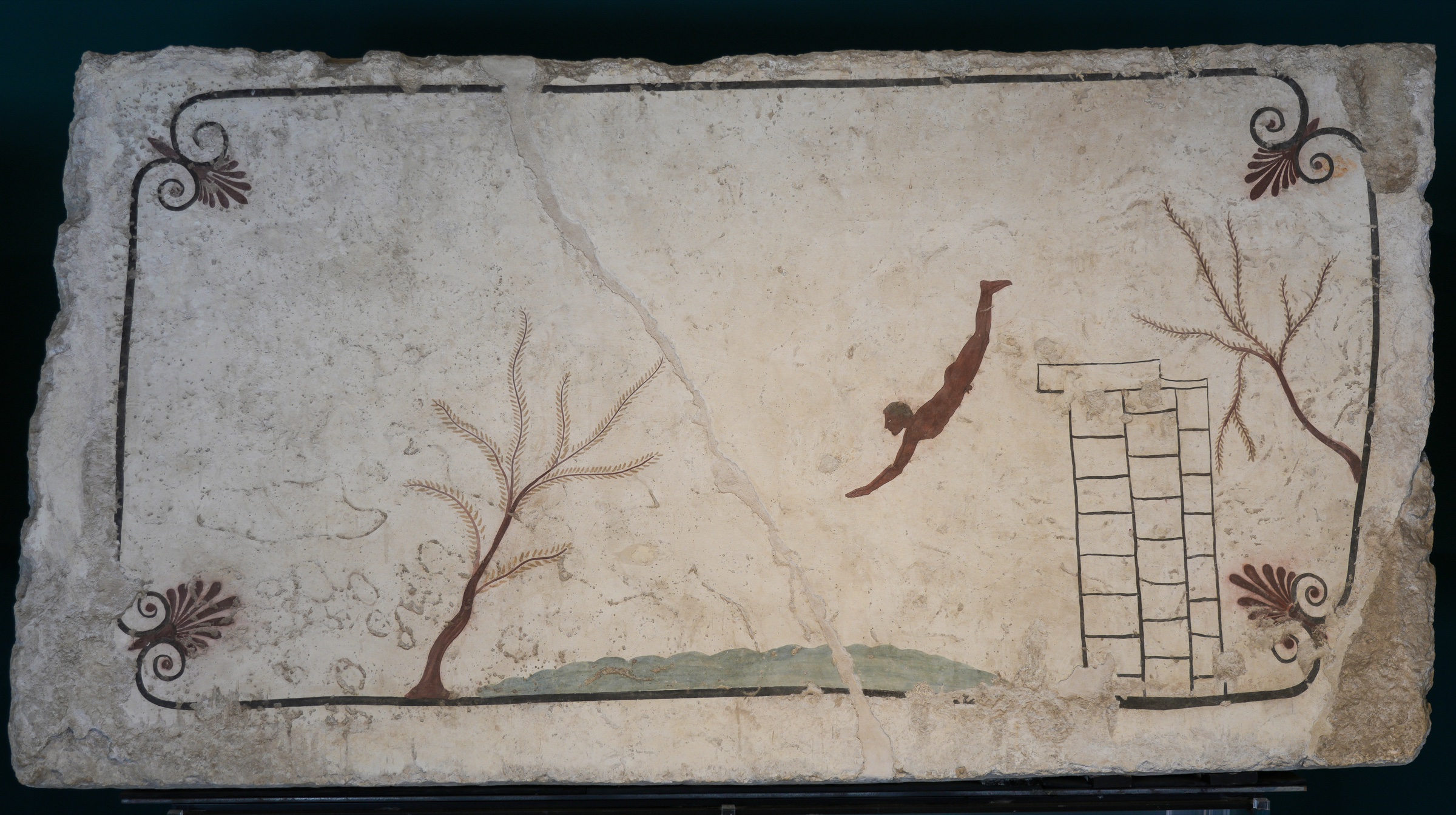
And above it all, on the ceiling, a naked youth hangs in mid-descent, falling forever towards a narrow band of blue-green water.
The tomb that emerged from the earth that day was architecturally modest. Four slabs of local travertine formed a rectangular cist, while a fifth covered it. A black-glazed lekythos dated the burial to the opening decades of the fifth century BCE. Only fragmentary human remains survived. What transformed the monument was its painted interior. Every inward-facing stone carried colour. The two long walls held a symposium of ten reclining men; the short walls continued that social world through service and movement; above them, the solitary Diver crossed an empty landscape.1
The paintings invite explanation, but they do not preserve one. Their imagery strongly supports conclusions about funerary commemoration, elite social identity and the movement of artistic practices across the Greek and Italic worlds. More specific claims require more caution. The Diver has been described as a soul entering the afterlife, a Pythagorean initiate, a Dionysian figure, an adolescent performing an elite rite of passage, and a young man engaged in an athletic act. Each reading begins from evidence; none is written transparently in the pigment.
What, then, can archaeology recover about the Tomb of the Diver, and what happens when interpretation becomes part of the monument’s modern memory? The tomb demonstrates both the power and the limits of archaeological reasoning. More than half a century of research has not simply disclosed its meaning. It has produced successive accounts of what the monument is, and those accounts now belong to its history.
A tomb unlike and less unlike any other
The Tomb of the Diver was extraordinary within its immediate burial landscape. Early Greek graves at Poseidonia were generally restrained: slab-built cists with limited or absent assemblages and undecorated interiors. Painted tombs became conspicuous much later, especially under Lucanian rule in the fourth century BCE. Against that background, a fully painted early fifth-century chamber with human figures appeared almost without precedent.2
Mario Napoli’s team had not encountered it by chance. The excavation formed part of a broader investigation into contact between the Greek cities of southern Italy and the Etruscan-Latial world. Campania, with the Sele River conventionally marking a boundary between cultural zones, offered a place to examine how forms and practices moved between them. The Tomb of the Diver was the fourth burial opened during work in the Archaic necropolis. Its ordinary exterior sharpened the shock of its interior.3
Napoli understood the paintings as a rare original from the largely lost tradition of Greek monumental painting. Ancient authors preserved the names and reputations of Greek painters, while vase painting and later copies offered indirect evidence of their art. Here, by contrast, was a complete ensemble painted on architectural surfaces. The combination of figured walls and a decorated ceiling seemed unprecedented. The tomb entered scholarship as an almost singular survival, capable of filling a conspicuous absence in the history of Greek art.4
Figure 1
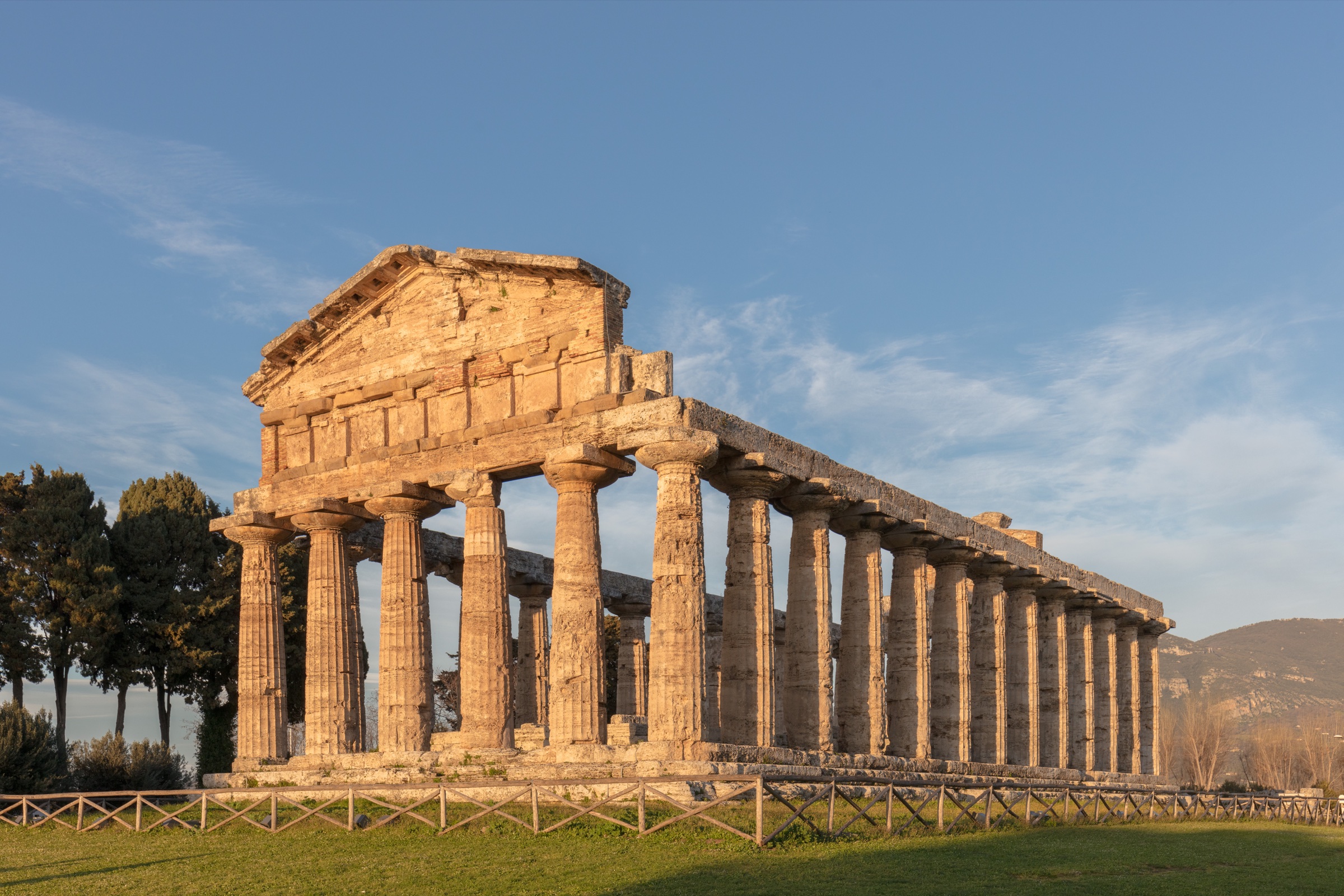
Later excavation altered that picture. Other fifth-century frescoed burials were identified around Paestum. The Tomb of the Palmettes offered a particularly important comparison: its painted lid also used a framed ceiling scheme with corner palmettes. These tombs remained rare—Gabriel Zuchtriegel counts roughly ten frescoed examples among more than 800 sixth- and fifth-century burials—but they showed that painting a grave interior belonged to a local practice rather than an isolated foreign intrusion.5
Technical analysis reinforced that change in perspective. Comparisons among the Tomb of the Diver, the Tomb of the Palmettes and architectural plasters at Paestum identified similarities in mortar, pigments, palette and execution. Because a burial demanded work within a short interval and frescoed tombs were too uncommon to sustain a specialist industry, local craftspeople accustomed to architectural decoration are plausible candidates for the commission. Chemistry cannot identify the deceased’s ethnicity or determine the paintings’ meaning. It can, however, make an imported workshop less necessary.6
The discovery therefore became less isolated as the archaeological record expanded. Napoli encountered what looked like a unique survival of Greek painting. Later scholarship placed the same object within a local network of workshops, elite burials and Mediterranean exchange. The tomb had not become less remarkable. It had become remarkable for different reasons.
The world around the dead
Interpretation begins with the room itself. The two long walls establish its dominant social environment. Three couches extend across each wall above a broad red dado. Five men occupy either side: one figure reclines alone, followed by two pairs. All wear wreaths; more wreaths rest on the small tables beside them. Their bodies continually turn towards other bodies. Hands raise cups, hold instruments and touch companions. The scene is ordered without being still.7
Figure 2
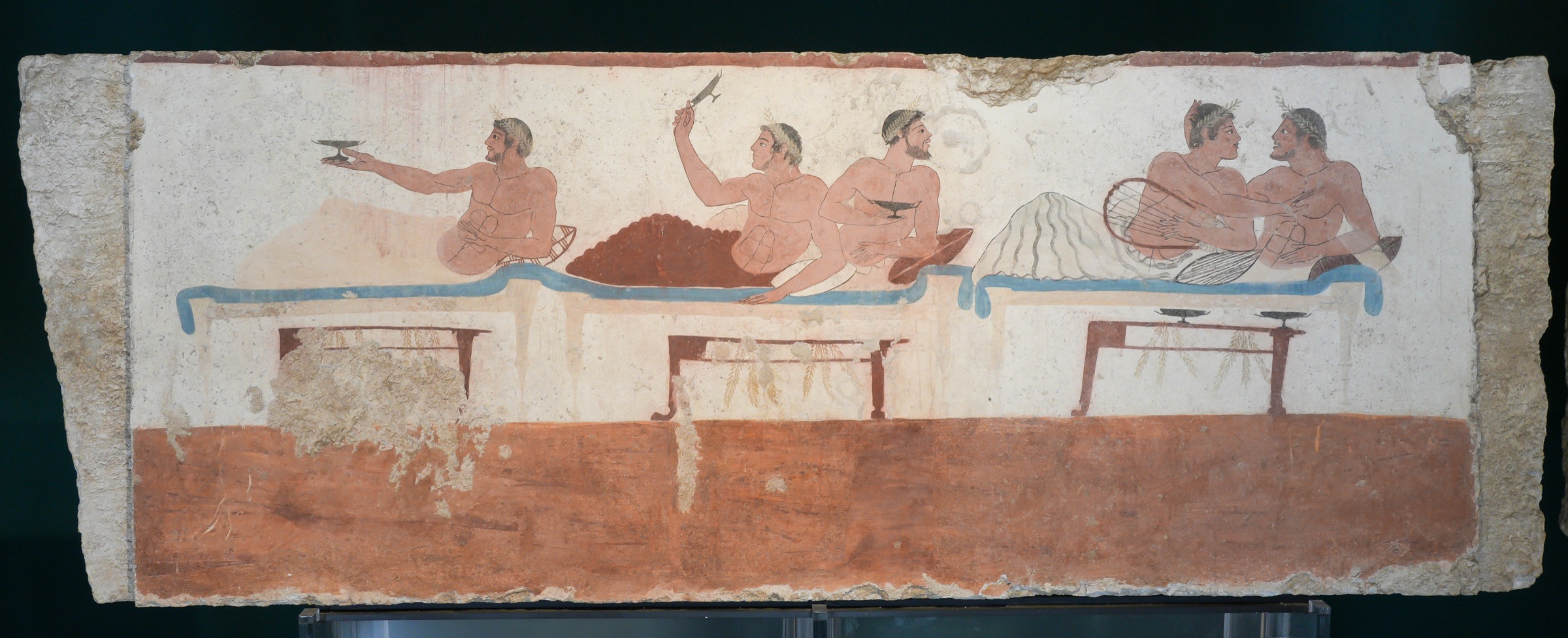
On the north wall, the solitary symposiast prepares a kottabos throw, watching the wine lees in his kylix. Another player appears to have just flicked his cup. At the far end, a youth holds a lyre against his chest while an older companion reaches towards his head; the younger figure’s gesture has commonly been read as resistance or refusal. The actions resemble motifs on contemporary Attic red-figure pottery, but their arrangement creates a sustained environment rather than a sequence of isolated quotations.8
Figure 3
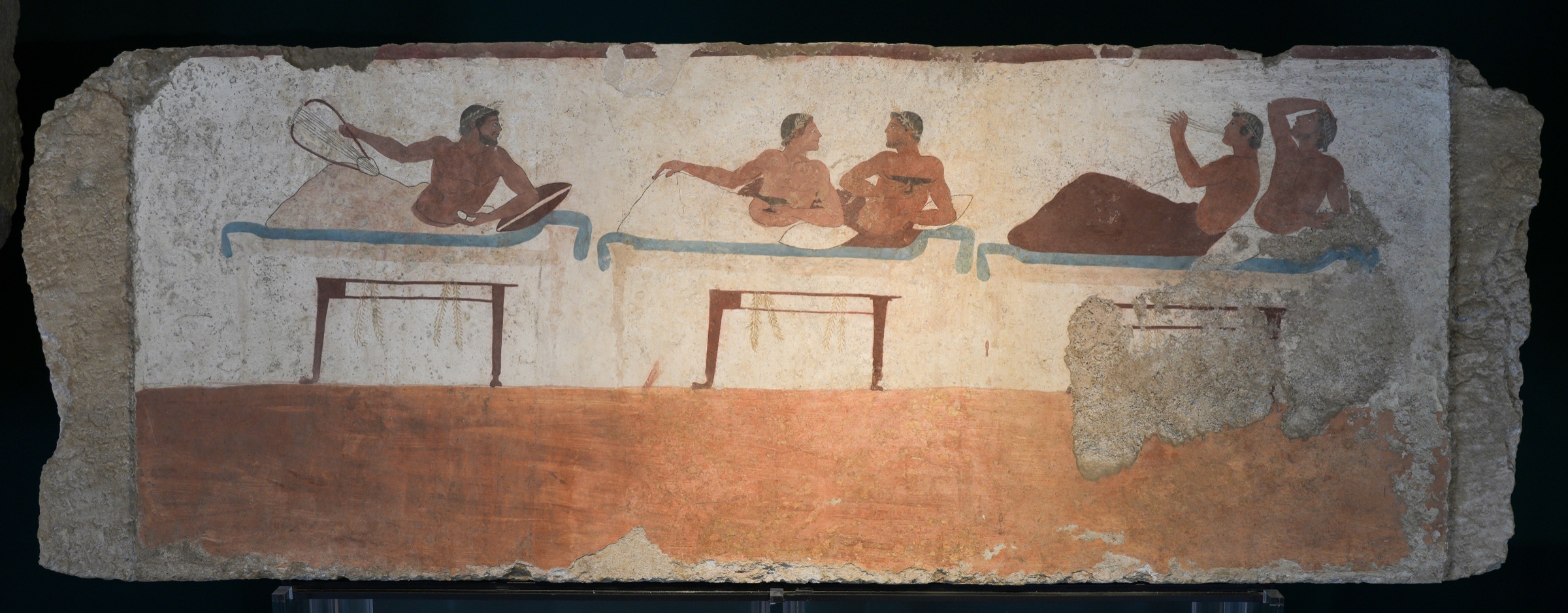
The south wall has a different rhythm. A solitary lyre player looks back towards his companions. The central pair converse. On the last couch, a youth plays the double flute while the man beside him tips back his head in song. Music, wine, games, wreaths and erotic attention define the symposium as a particular form of male social life. The images do more than record a meal. They construct a community of cultivated leisure around the person placed in the grave.9
The short walls extend this room while changing its tempo. On the east, a nude, wreathed serving boy stands beside a table and krater. Wreaths encircle the vessel and rest on the table. On the west, three figures move: a flute girl leads, a nearly nude youth follows with a stole over his arms, and an older man in a himation advances with a staff. Unlike the reclining men, they are not settled into the chamber. They are passing through it.
Figures 4 and 5
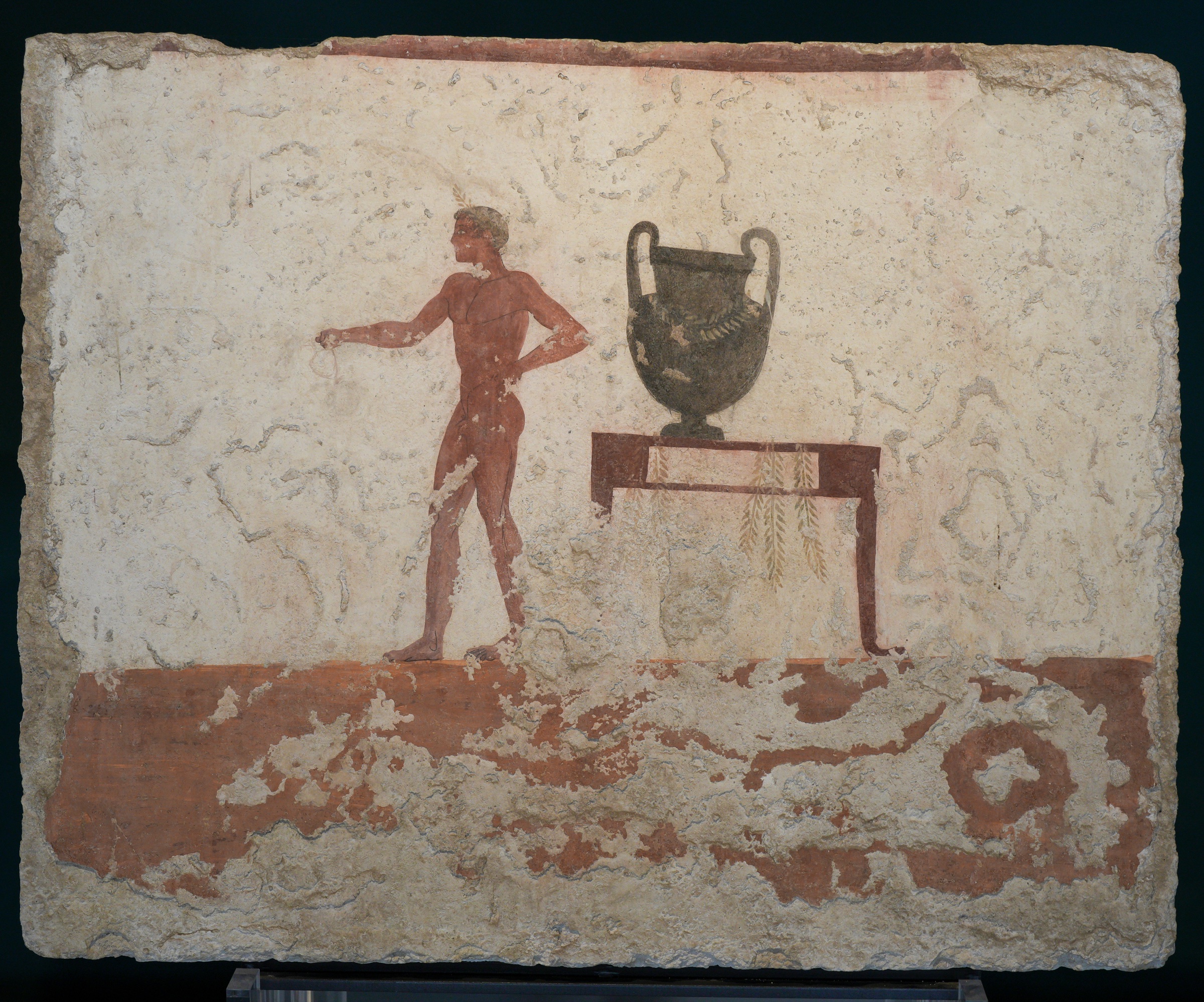
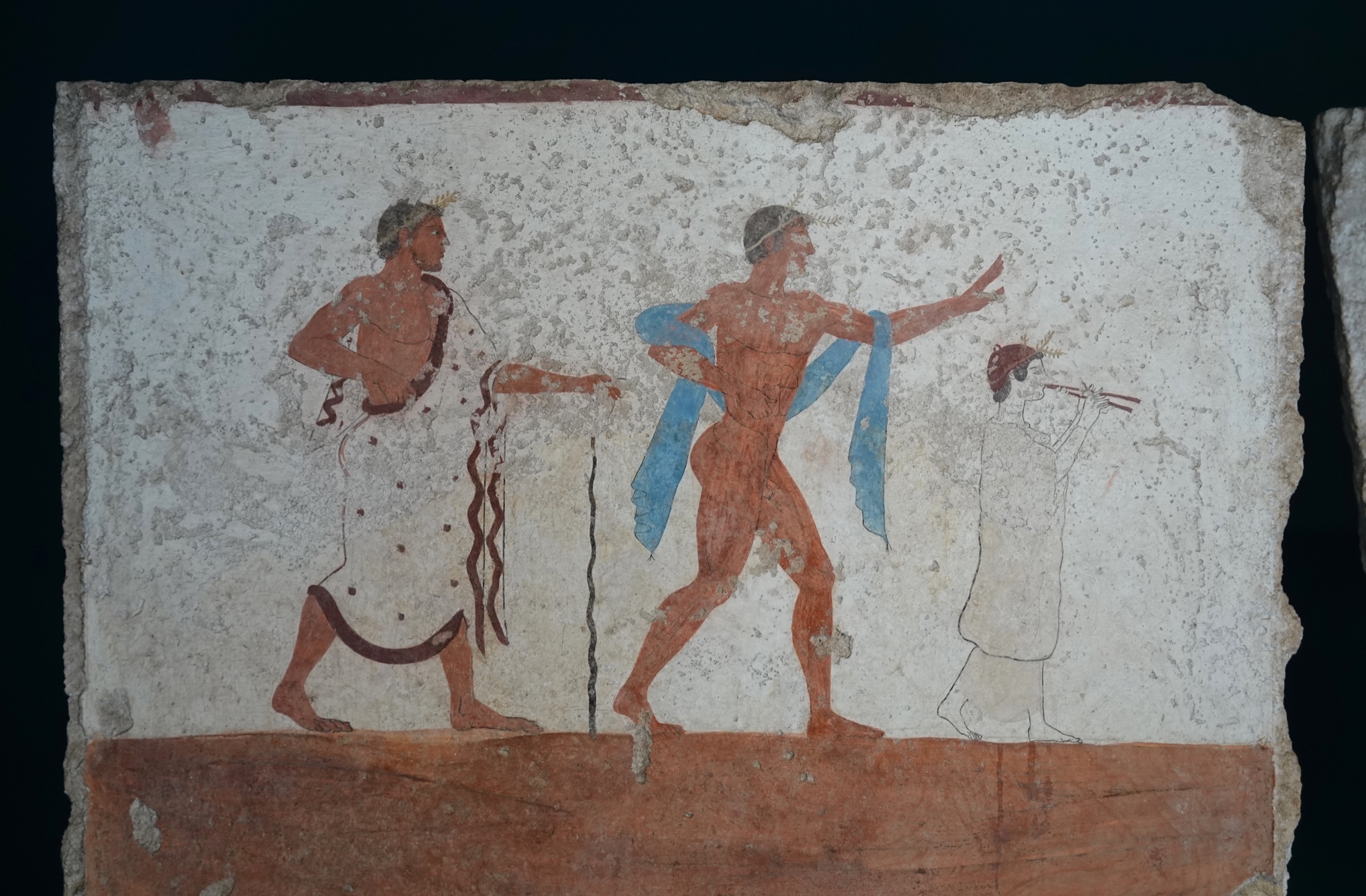
Napoli understood the west-wall youth as the deceased leaving the banquet for the afterlife. Other readings have treated the group as a komos, an athletic scene or a transition in social status. The surviving forms do not settle the matter. Before assigning a destination, it is worth retaining the simpler visual fact: this is the point at which the painted cycle begins to move somewhere.
Then the room changes. Above the crowded symposium, the ceiling opens into landscape. Couches, cups, instruments and companions disappear. A narrow band of blue-green water crosses the scene. Two trees stand apart, and a block-built structure rises beside the shore. Between them the Diver falls. The walls are filled with reciprocal looks and gestures; the lid isolates a single body on a single trajectory.
Below: wine, music, touch and conversation.
Above: one body, one trajectory, one crossing.
Most individual elements below have parallels in Greek visual culture. The difficult question concerns their combination. Why surround the dead with this social world? Why place the Diver above it? Were the walls and ceiling intended as parts of one argument, or does the desire for a unified programme belong partly to modern interpreters?
A body suspended between worlds
The ceiling painting is striking not only because the figure dives, but because of the instant selected. He has left solid ground and has not reached the water. His arms stretch before him, his body forms a controlled arc, and his feet retain the final extension of the leap. The composition fixes the interval between departure and arrival.
That observation does not prove that the image represents death. It explains why interpretations of transition have proved persuasive. Loredana Mancini and Jesper Svenbro have connected the ancient Greek semantic field of plunging and immersion with descent, disappearance and entry into Hades. Ritual and mythical traditions of leaping into water could also mark crisis, separation or transformation. Such evidence makes a funerary association plausible without identifying a particular doctrine or establishing that the figure is literally a soul.10
The location of the image matters. The Diver appeared above a body enclosed in a tomb, not on an object intended for ordinary circulation. The painting was also destined to disappear when the covering slab was lowered. Funerary context does not automatically turn every action into an allegory of death, but it changes the conditions under which an otherwise familiar action was selected and seen.
The walls intensify the possibility of passage. They create a dense social world of wine, music and desire, while the lid removes the figure from it. The west wall introduces movement out of the static symposium; the ceiling carries movement into an emptied landscape. A connection between those transitions is reasonable. The surviving evidence cannot tell us whether viewers once named that connection as death, initiation, heroic transformation or something less doctrinal.
This distinction sets a useful limit. The composition supports a broad reading of crossing and altered state. It does not, by itself, demonstrate Pythagorean membership, an Orphic initiation or a precise map of the afterlife. Those arguments require further evidence, and each additional link introduces another possibility of error.
Interpreting an image without an exact parallel
Archaeological interpretation often proceeds through comparison. An unfamiliar image becomes more intelligible beside objects from the same period, region or visual tradition. The Diver frustrates this method. Ancient images exist for diving, water, funerary activity and elements of its landscape, but no surviving example reproduces the Poseidonian composition as a whole. The problem is therefore an excess of incomplete analogies rather than a total absence of evidence.
Bruno d’Agostino constructed one of the most ambitious readings through convergence. He associated the water with the western Ocean and the setting of the sun, drew on literary geography surrounding the entrance to Hades, and compared the masonry structure with architectural forms connected to death and Sirens. Within that network, the Diver becomes a traveller crossing the boundary of life, while the structure marks the gates of the underworld. The argument is cumulative: no single detail proves it, but the details are asked to reinforce one another.11
R. Ross Holloway objected that the masonry feature looks more like a solid tower than a gate. The disagreement exposes two methods. D’Agostino gives priority to iconographic context; Holloway gives priority to formal identification. Holloway weakens the claim that the structure has been demonstrated as the Gates of Hades, although his alternative—reading the tower through metaphors of safety—also moves from literary language to visual symbolism.12
Other proposals find doctrine in the symposium. The egg held by a south-wall symposiast has been connected with rebirth and Orphic belief; the ten reclining men have been related to Pythagorean number symbolism; repeated groups of seven in trees, masonry and strings have also attracted attention. These details are real, but their doctrinal specificity is difficult to sustain. Eggs appear widely in Greek and Etruscan ritual and funerary settings, and numbers did not belong exclusively to one school. Holloway further noted that the prominent double flute sits awkwardly beside reported Pythagorean suspicion of the instrument’s emotional force.13
A different approach begins with ordinary visual culture. A diving youth on an amphora from Monte Abetone shows that the action itself was available as a genre motif. On this account, the Paestan workshop adapted a recognisable scene and changed its force through isolation, placement and funerary context. The absence of an exact parallel need not point to lost esoteric iconography. It may record artistic invention.14
Figure 6
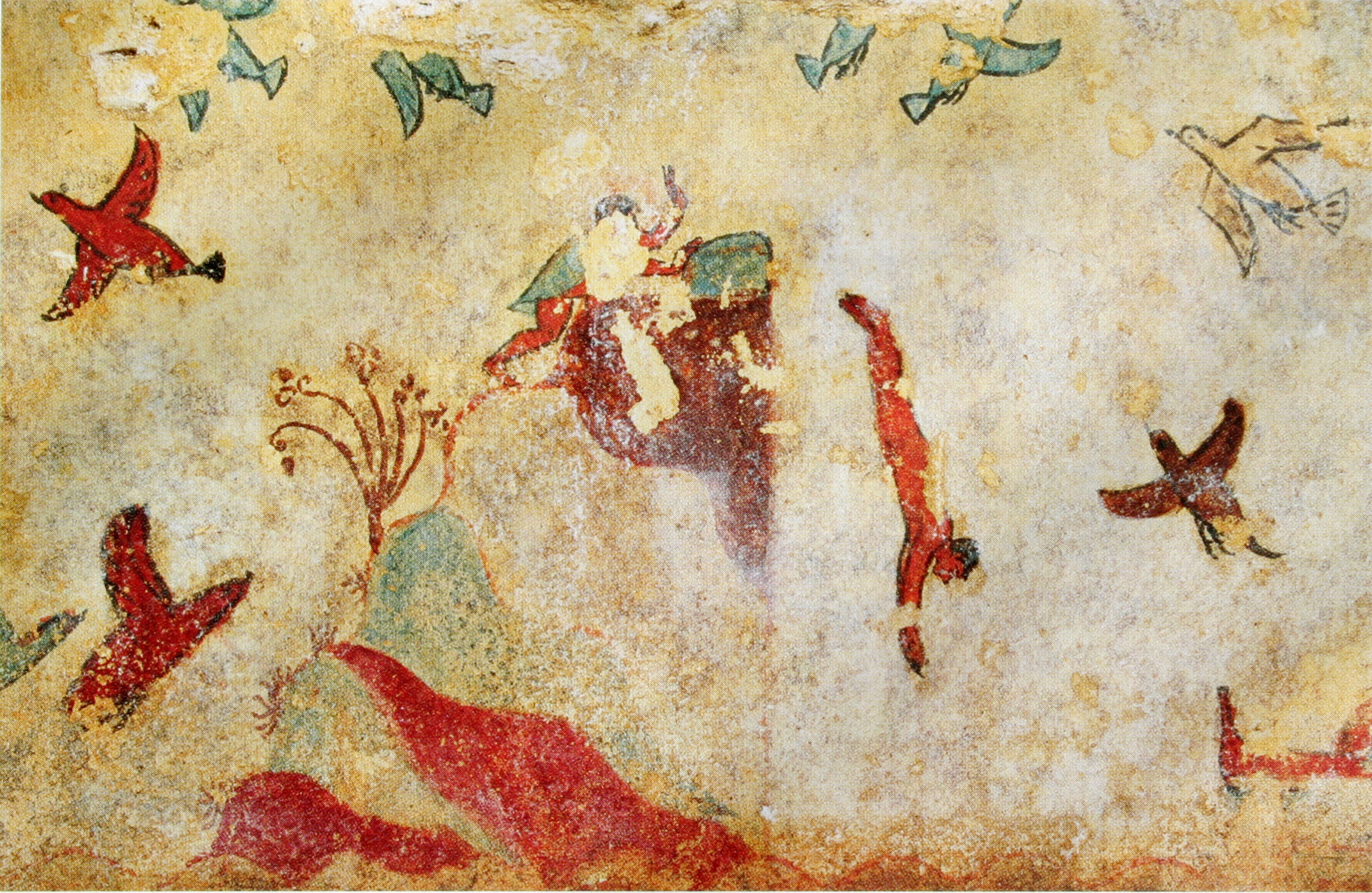
Tonio Hölscher presses the literal possibility further. He warns against a “temptation of symbolism”: exceptional monuments can encourage exceptional explanations simply because they occur in tombs. The Tomb of Hunting and Fishing at Tarquinia places a diver among fishing, bird hunting and coastal activity. A late-Archaic skyphos from Rhitsona also depicts a nude youth diving. Hölscher relates such imagery to elite adolescent practice, homoerotic social environments and age transition rather than to the journey of a soul.15
This challenge is valuable even if one remains persuaded that the Poseidonian image had funerary force. A grave can contain imagery drawn from social life. Yet literalism has its own burden of explanation. A real dive accounts for the action depicted; it does not fully explain why this action was selected for this burial, isolated above the deceased and placed against the symposium below.
Zuchtriegel treats the absence of a duplicate differently. His model of “glocalisation” describes Mediterranean forms and religious ideas as material that communities continually adapted rather than imported intact. He rejects the specific identification of the masonry structure as the Gates of Hades, yet considers an eschatological reading of the dive probable. Its unusual form may be the result of local invention rather than evidence against funerary meaning.16
The incomplete parallels have therefore produced contrary responses. Some scholars reconstruct a symbolic vocabulary whose other examples are lost. Others limit interpretation because the image is singular. Still others treat singularity as evidence of a workshop’s creative agency. None escapes inference. Each chooses a different point at which comparison ends and reconstruction begins.
Greek Etruscan or Poseidonian
The question of cultural identity appeared almost as soon as the tomb was opened. Its imagery is recognisably Greek: an all-male symposium, kottabos, music, erotic courtship and formulas familiar from Attic pottery. The decision to paint the interior of a grave had much stronger contemporary parallels in Etruria and elsewhere in Italy. Early discussion therefore asked whether the monument was fundamentally Greek or the product of Italic and Etruscan influence.17
That opposition imposes stable categories on a colonial city where objects, craftspeople and practices moved. Mancini instead describes the tomb through cultural osmosis. The symposium locates the deceased within a Greek social and visual world, while the painted chamber participates in funerary practices circulating across the peninsula. Neither feature determines ethnicity. Together they show how identity could be constructed through inherited forms and selective borrowing.
The burial landscape once seemed to support an outsider. The Tempa del Prete necropolis lay about 1.5 kilometres south of Poseidonia in a relatively small and peripheral zone. Emanuele Greco proposed that it may have served metics or residents who took part in Greek cultural life without full civic integration. The spatial evidence securely establishes a marginal location. The social identity of the people buried there remains an inference.18
Luca Cerchiai offered another explanation: deviation from ordinary burial practice could express elite distinction rather than exclusion. In his reading, the symposium belonged to a funerary language shared among aristocratic groups across Greek and Etruscan settings. The unusual tomb allowed a restricted social group to distinguish itself from the wider community. Its most important boundary may have been social rather than ethnic.19
Subsequent discoveries strengthened that possibility. Other frescoed fifth-century tombs occurred in prestigious burial groups around Paestum, making painted decoration difficult to explain as the custom of marginal foreigners alone. Zuchtriegel consequently treats the Diver as an elite local burial while leaving the deceased’s ethnic background unresolved. The technical evidence also points towards artisans based at Poseidonia.
“Poseidonian” is therefore more than a compromise between Greek and Etruscan. It names the archaeological setting in which these forms acquired a particular relationship: Greek sympotic imagery, an Italian practice of painted burial, a local workshop and an elite commission. The label does not solve the deceased’s identity. It prevents an uncertain identity from being treated as the explanation of the monument.
The second life of the Diver
The Tomb of the Diver became a public image almost immediately. Reviewing Napoli’s monograph in 1972, P. E. Arias observed that the discovery had attracted art lovers, illustrated magazines and the daily press as well as specialists. He was already uneasy with Napoli’s description of the find as the recovery of “great Greek painting”, preferring the more cautious attribution of a skilled artisan working in a peripheral Greek environment.20
The disagreement shows that the tomb’s modern identity was constructed from the beginning. Napoli presented a revelation in the history of Greek art; others questioned how “great”, how isolated and how exclusively Greek it was. Once removed from the ground, the monument circulated through books, journalism, museums and photography. Archaeological description and public memory developed together.
Joseph Bennett’s 1972 essay captures this transformation. Bennett absorbs several early interpretations into a continuous story. The deceased becomes an exceptional mystic, the symposium a coherent funerary world, and the Diver the soul released from the body. These propositions no longer appear as competing hypotheses. They form an account of the tomb’s meaning.21
Bennett’s wider essay also places the discovery against his anxiety about modern Italy. Roads, tourism, pollution and development appear as forces eroding traditional landscapes and communities. The tomb then enters as a recovered survival from a Mediterranean past that seemed to be disappearing. Its ancient imagery acquires meanings shaped partly by 1968: authenticity, cultural loss and the hope that archaeology can restore continuity.
Later research complicated much of that narrative. The tomb became less isolated; local workshop practice became clearer; the Greek-Etruscan opposition weakened; specific Orphic and Pythagorean interpretations became harder to defend; Hölscher challenged the assumption that the dive must be symbolic at all. Public explanations did not reset when scholarship changed. Older readings persisted beneath newer evidence.
This is interpretive sedimentation. A specialist hypothesis becomes a museum caption or educational summary. Repetition gives the summary the tone of fact. Contemporary accounts may acknowledge uncertainty while still organising the discussion around the afterlife, initiation or rebirth. Such compression is often necessary when scholarship moves into public forms, but it changes the apparent confidence of a claim.
The process is especially visible in the egg. A small object held by one symposiast becomes a “symbol of rebirth” in many accessible accounts. That statement condenses a complex distribution of eggs in funerary, ritual and social settings, as well as disagreement over whether the object is even central to the programme. The shorthand is not invented from nothing, but it hides the interpretive steps that produced it.22
Archaeologists cannot control the afterlives of their interpretations. Once an explanation enters museums, classrooms and the internet, it becomes part of what audiences remember. Later scholarship must address two inheritances: the ancient evidence and the accumulated authority of what generations have already learned to see.
The image that was never meant to be seen
For almost all its existence, the Diver was invisible. Once the covering slab was lowered, the youth disappeared with the dead. The symposium, music and movement vanished into darkness. Zuchtriegel compares this condition with esoteric funerary objects whose efficacy did not depend on continuing public display. Whatever the precise belief, the image was made for a sealed environment.23
Today it exists under the opposite condition. The Diver is enlarged in books, projected in lecture halls, displayed in a museum and circulated online. The most private image in the chamber has become its public face. Archaeology did more than recover the painting in 1968. It changed the conditions under which the painting existed.
Visibility made the image available to interpretation. The Diver became a soul, an initiate, a Dionysian figure, an elite adolescent, an example of Greek painting, evidence of cultural hybridity and a local Poseidonian invention. Some readings remain plausible; others have weakened. None is contained transparently within the pigment. They arose from comparisons, excavation histories, new discoveries and changing archaeological methods.
The monument consequently preserves two histories. The first belongs to early fifth-century Poseidonia: a burial, a workshop, a symposium, a solitary diver, and the associations that commissioners and painters brought to them. The second began in 1968, when archaeologists attempted to reconstruct the first. More than half a century of interpretation has made the histories inseparable.
What can archaeology recover? It can establish construction and chronology, study pigments and plaster, reconstruct workshop practice, examine the burial landscape, identify visual prototypes and trace the social forms of the symposium. It can test inherited explanations against later discoveries. It can distinguish a plausible association between diving and death from the stronger claim that the painting encodes a particular eschatological doctrine.
It cannot restore the lost explanation that once made every element immediately intelligible to the people who commissioned the tomb. That limit is not a failure. It is where interpretation begins. The task is to distinguish what survives, what comparison makes plausible and what remains beyond recovery.
The painter held the Diver at the instant when one state gives way to another: no longer on land, not yet beneath the water. The tomb now occupies a similar interval. It survives between an ancient meaning that archaeology can approach but never completely recover and a modern history of meanings created around it.
In 1968, daylight entered the chamber. The darkness gave up its colour. It did not give up all its secrets.
Notes
Bibliography
Arias, P. E. Review of La Tomba del Tuffatore: La scoperta della grande pittura greca, by Mario Napoli. Annali della Scuola Normale Superiore di Pisa. Classe di Lettere e Filosofia 2, no. 2 (1972): 916–18. http://www.jstor.org/stable/24301489.
Bellia, Angela. “Images of Music in Magna Graecia: The Tomb of the Diver at Poseidonia (5th Century BCE).”
Bennett, Joseph. “The Tomb of the Diver.” The Hudson Review 25, no. 4 (1972): 543–67. https://doi.org/10.2307/3850060.
Cerchiai, Luca. “La Tomba del Tuffatore e la pittura tombale degli Etruschi.”
d’Agostino, Bruno. “Le Sirene, il Tuffatore e le Porte dell’Ade.” 1982.
Greco, Emanuele. “Non morire in città: annotazioni sulla necropoli del ‘Tuffatore’ di Poseidonia.” AION.
Holloway, R. Ross. “The Tomb of the Diver.” American Journal of Archaeology 110, no. 3 (2006): 365–88. http://www.jstor.org/stable/40024548.
Hölscher, Tonio. “Troppo bello per essere reale? Per un’interpretazione sociologica antropologica del Tuffatore.”
Mancini, Loredana. “Poseidonia e la Tomba del Tuffatore.” Treccani.
Napoli, Mario. “La Tomba del Tuffatore.” Rassegna Storica dei Comuni 2 (1970): 190–93.
Pieraccini, Lisa C. “The Ever Elusive Etruscan Egg.” Etruscan Studies 17, no. 2 (2014). https://doi.org/10.1515/etst-2014-0015.
Zuchtriegel, Gabriel. “Bringing the Diver Home: Local Elites, Artisans, and Esotericism in Late Archaic Paestum.” Archeologia Classica 69 (2018): 1–36. https://www.jstor.org/stable/26600526.
Figure Sources and Credits
The opening and closing plates use Tomb of the Diver in Paestum – Cover. Figures 2–5 use the corresponding Wikimedia Commons records for the north wall, south wall, east wall and west wall. Figure 1 uses Paestum, Italia, 2023-03-26, DD 61. Figure 6 uses Tomb of Hunting and Fishing, Monterozzi necropolis. Creator and licence information is recorded on each linked source page.


Selected Sources and Further Reading
For the monument and its imagery: R. Ross Holloway’s “The Tomb of the Diver” supplies a detailed formal and iconographic study, records the earliest debates and argues for restraint in several esoteric interpretations.
For the local context: Gabriel Zuchtriegel’s “Bringing the Diver Home” reassesses the tomb through later discoveries at Paestum, local workshop practice and the concept of glocalisation.
For early reception: Joseph Bennett’s “The Tomb of the Diver” is a literary response written soon after the discovery. It shows how early archaeological interpretations entered public memory.
For the discovery: Mario Napoli’s “La Tomba del Tuffatore” presents the early account of the excavation, physical structure and significance of the paintings within the history of Greek art.
-
R. Ross Holloway, “The Tomb of the Diver,” American Journal of Archaeology 110, no. 3 (2006): 365–73. ↩
-
Loredana Mancini, “Poseidonia e la Tomba del Tuffatore,” Treccani; Gabriel Zuchtriegel, “Bringing the Diver Home: Local Elites, Artisans, and Esotericism in Late Archaic Paestum,” Archeologia Classica 69 (2018): 1–36. ↩
-
Mario Napoli, “La Tomba del Tuffatore,” Rassegna Storica dei Comuni 2 (1970): 190–93. ↩
-
Napoli, “La Tomba del Tuffatore”; P. E. Arias, review of La Tomba del Tuffatore: La scoperta della grande pittura greca, by Mario Napoli, Annali della Scuola Normale Superiore di Pisa 2, no. 2 (1972): 916–18. ↩
-
Zuchtriegel, “Bringing the Diver Home,” 1–36. ↩
-
Zuchtriegel, “Bringing the Diver Home.” ↩
-
Holloway, “Tomb of the Diver,” 365–73. ↩
-
Holloway, “Tomb of the Diver,” 367–77. ↩
-
Angela Bellia, “Images of Music in Magna Graecia: The Tomb of the Diver at Poseidonia (5th Century BCE).” ↩
-
Mancini, “Poseidonia e la Tomba del Tuffatore.” ↩
-
Bruno d’Agostino, “Le Sirene, il Tuffatore e le Porte dell’Ade” (1982), 44–50. ↩
-
Holloway, “Tomb of the Diver,” 380–83. ↩
-
Holloway, “Tomb of the Diver,” 378–80; Lisa C. Pieraccini, “The Ever Elusive Etruscan Egg.” ↩
-
Holloway, “Tomb of the Diver,” 380–86. ↩
-
Tonio Hölscher, “Troppo bello per essere reale? Per un’interpretazione sociologica antropologica del Tuffatore.” ↩
-
Zuchtriegel, “Bringing the Diver Home,” 1–36. ↩
-
Holloway, “Tomb of the Diver,” 373–77; Napoli, “La Tomba del Tuffatore.” ↩
-
Emanuele Greco, “Non morire in città: annotazioni sulla necropoli del ‘Tuffatore’ di Poseidonia,” AION. ↩
-
Luca Cerchiai, “La Tomba del Tuffatore e la pittura tombale degli Etruschi.” ↩
-
Arias, review of La Tomba del Tuffatore, 916–18. ↩
-
Joseph Bennett, “The Tomb of the Diver,” The Hudson Review 25, no. 4 (1972): 543–67, https://doi.org/10.2307/3850060. ↩
-
Pieraccini, “Ever Elusive Etruscan Egg.” ↩
-
Zuchtriegel, “Bringing the Diver Home,” 1–36. ↩