

Prologue
The inspiration for this article began during a recent field season in western Uganda, where I found myself surrounded by rolling hills blanketed in banana groves. At the research station, matooke appeared regularly on the table, and some form of banana seemed to accompany almost every meal. The fruit was utterly familiar and, at the same time, strangely mysterious. How had it come to occupy such an important place here? How had it become a staple across landscapes so far from the forests in which its wild relatives evolved? And where, for that matter, had the banana itself come from? I began looking for answers and quickly discovered that there was no simple origin story waiting to be told, but instead an extraordinarily tangled history of plants, people, migration, selection and memory stretching across thousands of years and half the world. This article grew out of that curiosity. I hope you enjoy following that journey as much as I have enjoyed trying to unravel it.
During the first half of the twentieth century, the banana industry began losing a war beneath the soil.
Across the plantations of Latin America and the Caribbean, plants that had appeared healthy began to yellow. The oldest leaves wilted first, collapsing around the pseudostem as the tissues carrying water through the plant turned from pale green to streaks of red and brown. Eventually the canopy folded in on itself and the plant died. Digging it out accomplished little. Replanting could be worse. The fungus responsible—Fusarium oxysporum f. sp. cubense, the cause of Panama Disease—persisted in contaminated ground, waiting for the next susceptible banana to take its place.1
For an export industry overwhelmingly dependent upon a single cultivar, the consequences were extraordinary. That cultivar was Gros Michel, the large, sweet and remarkably transportable banana that dominated international markets from the late nineteenth century into the middle of the twentieth. Its commercial success had helped shape enormous plantation landscapes around a fruit that could survive harvesting, rail transport, loading, shipping and sale while still arriving in distant markets in acceptable condition. But Gros Michel was also highly susceptible to Panama Disease. As the pathogen moved through the American tropics, plantations were abandoned and companies searched for uncontaminated land. In Honduras’s Ulúa Valley alone, some 30,000 hectares were lost between 1940 and 1960; elsewhere, entire operations collapsed within little more than a decade.1 The epidemic did not just kill plants. It accelerated the clearing of tropical forest, destabilized plantation economies and displaced the people whose livelihoods depended upon them.2
The industry eventually found an answer. Rather than defeating the pathogen, it changed the banana.
Beginning in the mid-twentieth century, Gros Michel was replaced across much of the export trade by cultivars belonging to the Cavendish subgroup. Cavendish fruit was more delicate and required new systems of harvesting, washing, packing and transport, making the conversion a vast logistical as well as agricultural undertaking.3 But the plants possessed the quality that mattered most: they were resistant to the strain of Fusarium devastating Gros Michel. Plantations were replanted, packing systems redesigned and the global banana trade continued. What had looked increasingly like an existential crisis for the export industry appeared to have been solved.
For several decades, that solution held.
Then Cavendish began dying too.
During the late twentieth century, a different strain of the pathogen—Tropical Race 4, or TR4—began causing severe disease in Cavendish plantations in Southeast Asia. It subsequently continued outward. By 2024, TR4 had been reported in twenty-three countries, including Colombia, Peru and Venezuela, bringing the disease into the heart of the modern Latin American export industry.4 Cavendish, the cultivar that had rescued commercial banana production from the Gros Michel epidemic, proved extremely susceptible to the new strain. Once contaminated, soils can remain dangerous to susceptible bananas for decades.4
It is tempting to treat this as a peculiarity of the export trade: a warning about what happens when industrial agriculture plants too much of one crop over too much land. There is truth in that. Gros Michel and Cavendish plantations represent spectacular examples of monoculture, and the twentieth-century banana trade demonstrates how commercial demands can narrow biological diversity until an entire industry rests upon a dangerously restricted foundation.2 But the problem reaches much deeper than the plantations that made the banana a global commodity.
That matters because the banana is far more than a commodity.
The yellow Cavendish fruit stacked in supermarkets across Europe and North America represents only one corner of a much larger banana world. Dessert bananas are joined by plantains, cooking bananas, beer bananas and hundreds of locally named cultivars selected for different tastes, textures, colors, ripening patterns and uses.
Many never enter international commerce at all. Recent estimates suggest that exports account for only about sixteen percent of global banana production; the remaining eighty-four percent is consumed through domestic markets and smallholder systems.4 Cavendish itself may account for nearly half of world production, but beyond it lies an enormous diversity of bananas grown as food and sources of income across the tropics.4
In some regions, calling the banana a “fruit” almost understates its place in everyday life. Around the African Great Lakes, East African Highland bananas are cooked as staple foods, fermented into beer and juice, roasted, fried, sold for income and maintained in gardens that form enduring parts of the agricultural landscape. In Uganda, matooke refers not simply to a fruit eaten occasionally after a meal but to green cooking bananas prepared as a staple food. Different cultivars are maintained for cooking, brewing, roasting and dessert, and their value extends into medicine, household economies and wider cultural life.5 Similar stories, although involving very different bananas, can be found throughout tropical Africa, Asia and the Pacific. The banana has become food, livelihood, technology, inheritance and memory.
Behind all of them lies Musa.
Musa is the genus to which bananas belong, part of the family Musaceae and the same broader botanical order, Zingiberales, that includes plants such as ginger and turmeric.6 Wild Musa populations occupy an immense Asian and western Pacific range extending broadly from the Indian subcontinent and southern China through mainland and Island Southeast Asia to New Guinea and northeastern Australia.7 Africa and the Americas, despite becoming some of the great banana-growing regions of the modern world, possess no native wild Musa populations.7 The familiar fruit emerged from this much larger botanical world.
The modern disease crisis begins to look different once we consider how cultivated bananas reproduce. Most commercial bananas are propagated clonally rather than raised anew from genetically variable seed. This allows desirable plants to be copied faithfully, but it also allows susceptibility to be copied with them. Modern monoculture magnifies that weakness enormously. Yet clonality is not simply an unfortunate feature of industrial agriculture. It reaches into the deep history of banana domestication itself.67
That is what makes the banana’s early history so important.
The best-known histories of the fruit tend to focus on plantations, corporations, labor, colonialism and the modern commodity trade. Those stories matter enormously, but they begin late. Long before Gros Michel, Cavendish or Panama Disease, humans had already spent thousands of years cultivating, transporting and selecting bananas across the Pacific, Asia, the Indian Ocean and Africa. By the time the fruit entered the modern plantation world, its biology and geography had already been repeatedly transformed by people.
Archaeology allows us to recover those earlier chapters, although the evidence is often fragmentary. Bananas preserve poorly, so their past has had to be reconstructed from microscopic plant traces, living genomes, language, historical records and the occasional exceptional survival.78 Together, these fragments reveal a history in which domestication did not occur once and then end. Bananas continued to change as they moved into new landscapes and new human communities.
The banana was not invented once and then distributed around the world. It was repeatedly made and remade as it moved.
This article follows that earlier history, from wild Musa and the first known landscapes of cultivation to the banana’s dispersal across oceans and continents, ending at the threshold of the Atlantic world. Because the question raised by Panama Disease is ultimately much older than Panama Disease: how did one of the world’s most important crops come to depend upon a reproductive system capable of making entire populations so vulnerable?
The answer begins before there was anything we would comfortably recognize as a banana.
Before the Banana
Cut open a wild banana and the resemblance is almost insulting.
The fruit is there: elongated, fleshy, recognizably Musa. But where the supermarket banana offers soft, uninterrupted pulp, its wild relative is crowded with hard black seeds, with comparatively little flesh between them. Eating one is less like peeling a delicious Cavendish than trying to negotiate a mouthful of pebbles.9
This is the banana before the banana.
Or, more precisely, one of the plants from which the modern banana would eventually emerge.
The plant itself is just as deceptive. What looks like a tree trunk is not a trunk at all. Bananas are enormous perennial herbs, and their apparent stem is a pseudostem: a rigid column formed from leaf sheaths wrapped tightly around one another.10 The plant’s true stem, or rhizome, lies below ground in a compact structure called the corm. From it grow the roots, the leaves above, and, most importantly for our story, new shoots known as suckers.10
Figure 1
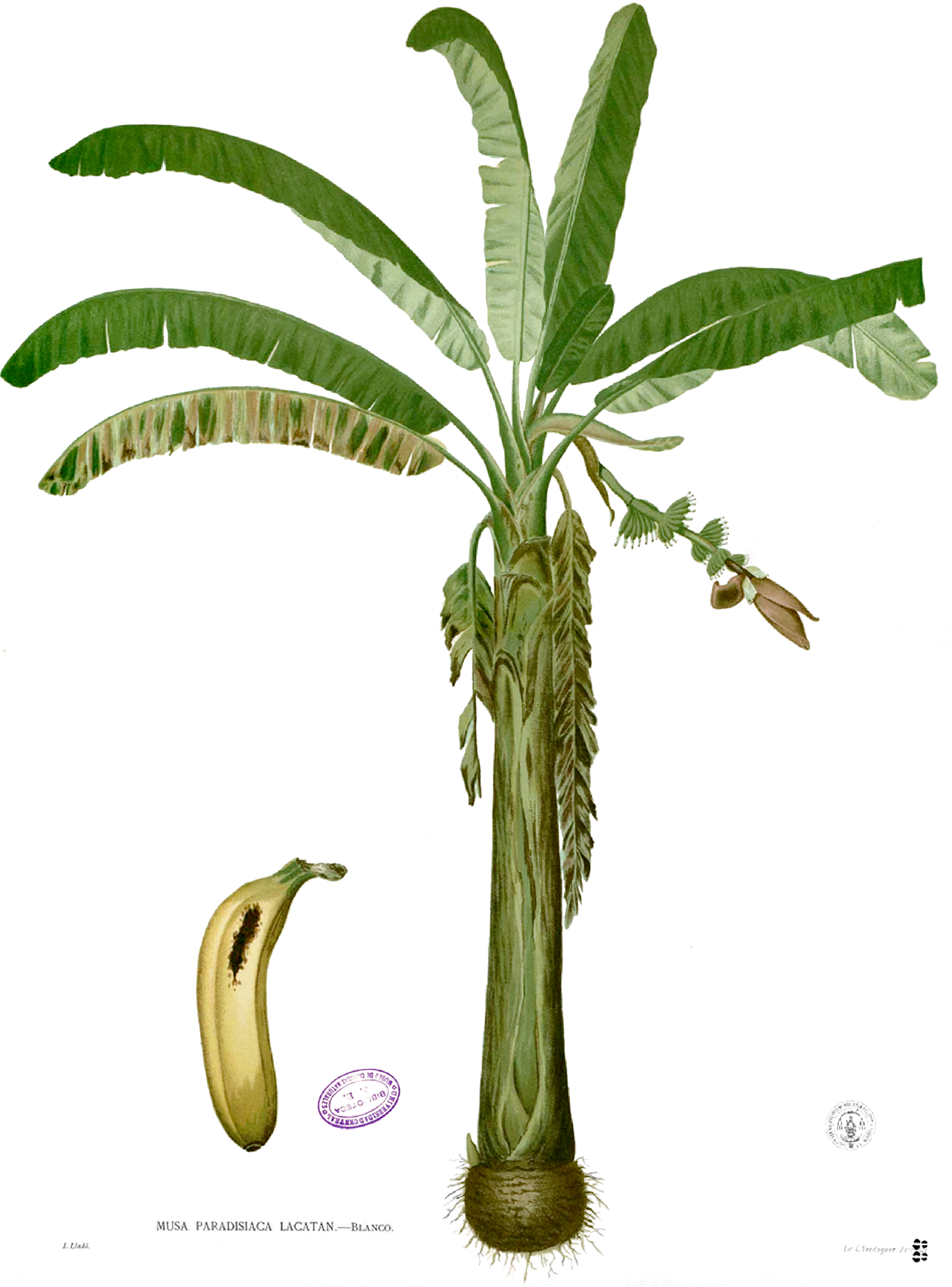
This distinction matters because an individual banana shoot has a surprisingly brief career. It grows, produces its great crown of leaves, flowers, fruits once and dies. The plant itself persists. New suckers emerge from buds on the corm and succeed the old shoot, allowing the same underground organism to continue producing new growth.10 What appears above ground as a single banana “tree” is therefore only the temporary expression of something more enduring below.
That ability to renew itself without starting again from seed will become important. Because seeds are where the story turns.
Wild bananas reproduce sexually. Their flowers can be pollinated and fertilized, producing fruits packed with viable seeds. Many cultivated bananas operate very differently. Their fruits can develop through parthenocarpy, the formation of fruit without successful fertilization, and the bananas familiar to us are generally characterized by greatly reduced fertility or sterility.911 The tiny dark flecks visible in the center of a supermarket banana are not the hard, mature seeds of its wild relatives; the fruit has developed while functional seed production has largely disappeared.10
That presents an obvious paradox. A fruit without viable seeds may be considerably more pleasant to eat, but from the plant’s perspective it has lost one of the basic mechanisms by which plants reproduce.
Yet bananas have another route available to them. A sucker growing from the corm can be separated and replanted, producing another plant genetically derived from the same stock. In biological terms this is vegetative propagation: reproduction not through seed, but through pieces of the living plant itself.109 For now, it is enough to remember the distinction. Wild bananas can reproduce through seed. Many edible bananas cannot reliably do so. Their biology makes another form of continuity possible.
That brings us to two names.
They will appear repeatedly throughout the rest of this story, and understanding them now will save us from having to stop later in the middle of an archaeological argument to explain banana genetics.
The first is Musa acuminata. The second is Musa balbisiana.
Both are wild bananas, and both contributed genetic material to many of the edible bananas cultivated today. Geneticists conventionally refer to the contribution of M. acuminata as the A genome, and that of M. balbisiana as the B genome.911 A banana described as AA therefore carries two sets derived predominantly from acuminata ancestry; AAA has three. Hybrids incorporating balbisiana ancestry produce combinations such as AAB and ABB. We do not have to follow every combination here. The important point is simpler: “banana” is not a single domesticated genetic lineage.
For a time, however, the story could be made to look deceptively neat. Two wild species supplied the principal genomes. Their descendants hybridized. Diploid forms carried two chromosome sets, triploid forms three, and from these combinations emerged much of the extraordinary diversity of cultivated bananas.911
The landscape from which those ancestors came was anything but neat.
Wild Musa occupies a vast arc extending from northeastern India across mainland and island Southeast Asia, through New Guinea and into northeastern Australia.12 Even within that enormous region, diversity is uneven. Modern surveys record particularly rich concentrations of wild banana species in northeastern India, around the borderlands of southern China and northern Vietnam, on the Malay Peninsula, in Borneo and in parts of New Guinea.12 These were not populations spread uniformly across one continuous tropical garden.
They belonged to different environments, islands, mountain systems and forest regions, sometimes separated from one another by considerable distances.
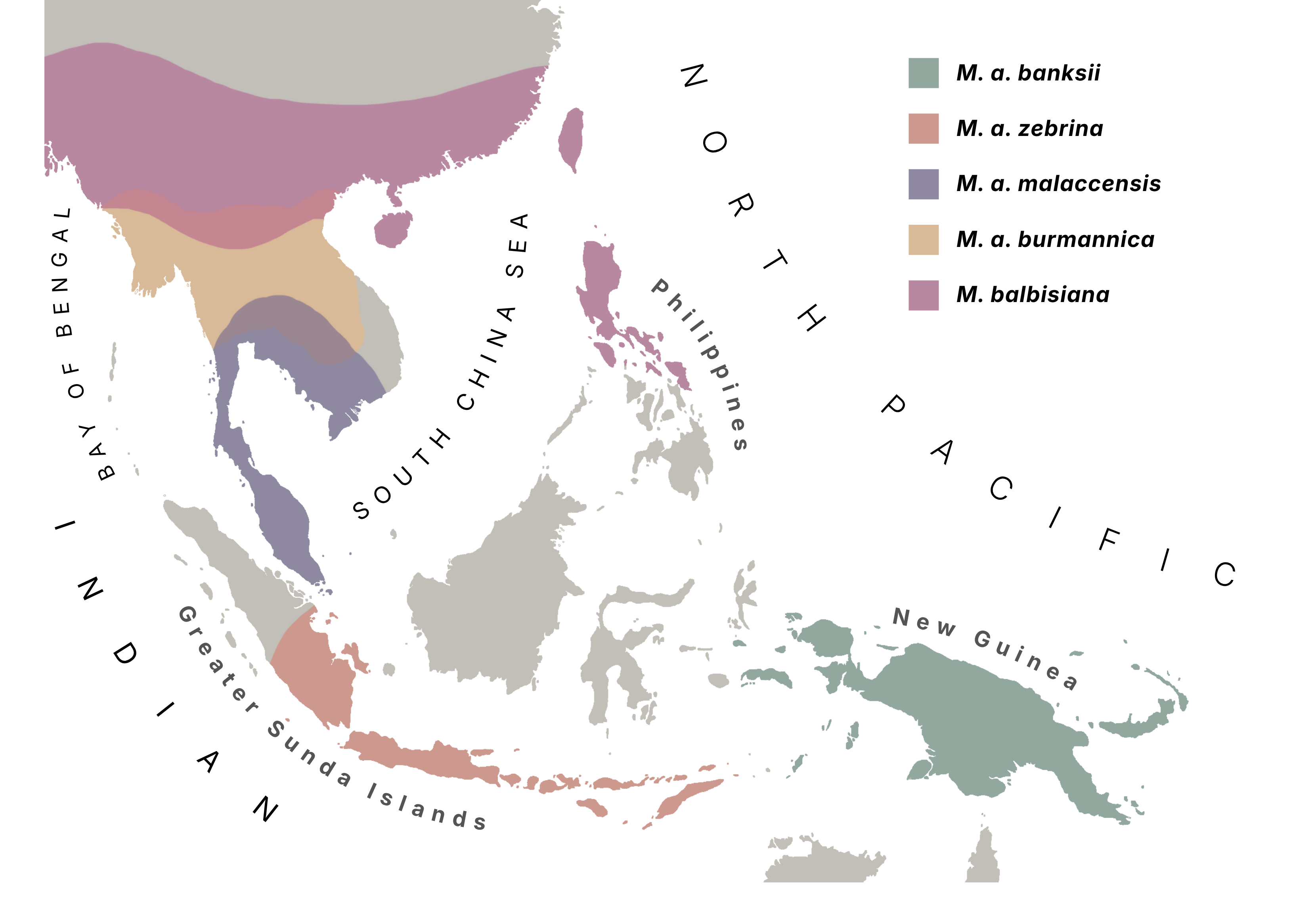
That geography matters particularly for Musa acuminata. What had once been treated relatively comfortably as one ancestral species turns out to contain substantial geographical structure of its own. Different acuminata populations and subspecies contributed differently to later cultivated bananas, and genetic studies increasingly revealed that edible forms could not be explained as descendants of a single wild population expanding outward from one point.11
Perrier and colleagues described the result as geodomestication: a domestication history distributed across space, involving different populations coming into contact and contributing to new lineages rather than a single clean transition at one geographical origin.11 Their reconstruction identified multiple regions of contact across Island Southeast Asia and western Melanesia and placed repeated hybridization at the heart of cultivated banana diversity.
More recent genomic work has made the picture stranger still. When Julie Sardos and colleagues compared the genomes of cultivated diploid bananas with known wild M. acuminata populations, they found cultivars to be profoundly admixed. Some portions of their ancestry could be traced to known wild populations. Others appeared to derive from ancestral genepools for which no corresponding wild population has yet been identified.13
In other words, even the wild ancestors we know do not entirely explain the bananas we have.
That does not mean the older A-and-B framework is wrong. Musa acuminata and Musa balbisiana remain fundamental to understanding cultivated banana ancestry.911 It means that the framework is only the beginning. Beneath those two names lies a network of geographically separated populations, hybridization, different chromosome combinations and genetic contributions that are still being reconstructed.
There was no single ancestral banana waiting somewhere in the forests of Southeast Asia to become the fruit we know today.
There were bananas.
Different populations, growing across an immense and fragmented tropical world, carrying different pieces of what would eventually become the cultivated crop.
And at some point, those pieces began to move.
A Plant Worth Keeping
In East Java, a banana plant does not need to produce anything resembling a supermarket banana to earn its place beside a home. Musa balbisiana, known locally as Pisang Klutuk, bears the hard seeds we have learned to associate with wild bananas. Yet it is deliberately cultivated. Its broad leaves are valued for wrapping; its immature fruits and male flower buds can be prepared as food. Other parts of the plant enter an equally surprising range of activities: pseudostems can supply fiber, wrapping material and fertilizer, while in wayang kulit performances their soft tissue provides a convenient support into which the rods of leather puppets can be planted.14 None of this requires a sweet, seedless fruit.
We tend to ask how people transformed a wild banana into something worth eating. That may be the wrong first question. The plant may already have been worth keeping.
That possibility sits at the heart of Jean Kennedy’s study of bananas and people in the homeland of Musa. Modern commercial familiarity encourages us to reduce the banana plant to the fruit hanging beneath its leaves, but ethnobotanical records from South and Southeast Asia and the western Pacific reveal something much larger. Leaves can wrap food, line ovens, form temporary shelter or serve as plates. Petioles and pseudostems can yield fiber and cordage. Corms, shoots, flower buds and other tissues can provide starch or food, while saps and fibers enter medicinal, craft and ceremonial practices.15 A seeded banana, in other words, is not necessarily a useless banana. Nor does a plant retaining apparently “wild” characteristics necessarily stand outside human management.
That matters because humans entered the banana’s world long before anything resembling the modern cultivated fruit appears in the archaeological record. By the Late Pleistocene, people were established across much of South and Southeast Asia and had reached Sahul, the landmass that once joined Australia, New Guinea and Tasmania.1617 Surviving plant remains are sparse, but what we have shows communities exploiting a broad range of tropical resources, from Pandanus and aroids to roots, fruits and seeds.17 The banana belonged within this wider world of flexible plant use.
Wild bananas were also unusually well suited to some of the landscapes humans were beginning to create. Kennedy describes many Musa species as plants of disturbance: rather than flourishing beneath an uninterrupted rainforest canopy, they thrive in forest gaps, unstable slopes and other openings.15 Burning, clearing and repeated occupation could generate precisely those conditions. Human activity may therefore have encouraged wild bananas around places people already used, making them easier to encounter, harvest and eventually maintain.
We should not turn this immediately into cultivation. No garden is required. People altering a forest edge may have changed the distribution of useful plants long before they consciously set out to domesticate them. But once a desirable banana grew close to a settlement, another possibility opened. A sucker could be separated from its parent clump and replanted somewhere more convenient. A useful plant could be protected, moved or encouraged without first becoming genetically or morphologically “domesticated.”
Kennedy uses a particularly useful word for plants occupying this gray area: cultiwilds.15 A cultiwild may remain seeded and capable of sexual reproduction. It may resemble a wild population far more closely than a later cultivar. Yet its survival or geography has already begun to depend partly upon people who protect it, transplant it or repeatedly reproduce individuals they value. The boundary between wild and cultivated, in other words, did not have to be crossed all at once.
However these early relationships began, they reach much deeper into the human past than the history of the domesticated banana.
In the humid rainforests of southwestern Sri Lanka, Fahien Rock Shelter offers a rare glimpse of that older world.
People were occupying the shelter by roughly 45–48,000 years ago, and wild Musa formed part of the landscape they knew. Among the traces left behind are hearths, stone tools, animal remains and evidence for the use of plants such as breadfruit and Canarium.18 The sediments also preserve abundant phytoliths—microscopic silica bodies formed within plant tissues—from wild bananas. Seed and leaf phytoliths resembling those of Musa acuminata and Musa balbisiana occur from the earliest occupation deposits onward.18 Premathilake and Hunt considered several ways this material might have reached the shelter, including water, wind, animals and plants growing nearby, but argued that much of it was most plausibly transported there through human activity.18
Exactly what people were doing with those bananas is harder to recover. Some phytoliths were burned and occur alongside hearth material, raising the possibility that parts of the plant were processed around fires, but the evidence does not allow us to reconstruct a particular recipe or even identify confidently which tissues were being sought.18 Fruit may have been eaten. Starchy tissues may have been processed. Leaves may have been carried for purposes that left almost no trace beyond their phytoliths. Modern ethnobotany shows that each possibility is plausible; archaeology cannot yet tell us which one occurred at Fahien.
That uncertainty is part of the lesson. When wild banana remains appear in a human occupation deposit, our first question should not automatically be whether people were eating the fruit. The plant offered too many other possibilities for that assumption to be safe.
The first bananas in the human story may not have been fruits at all.
The First Cultivated Bananas
At 1,560 meters above sea level, Kuk Swamp is not an obvious place to begin the history of the cultivated banana. It lies in the Upper Wahgi Valley of New Guinea, in a cool, humid highland environment far removed from the steamy lowland forests we instinctively associate with Musa. Even today, the altitude is unusually high for wild Eumusa bananas to occur naturally.19 Yet beneath the wetland soils at Kuk are traces of people repeatedly reshaping this landscape: cutting into the swamp margin, clearing vegetation, managing water and eventually raising earth into cultivation mounds.
Among the plants growing within that altered landscape was Musa.
This is where most histories of the banana finally begin.
Not, however, with a single moment of invention.
Kuk preserves something less convenient and much more interesting: a long sequence in which the boundary between exploiting plants and cultivating them becomes progressively harder to draw. During the earliest major phase of activity, around 10,220–9,910 calibrated years before present, people were already modifying the wetland margin. Archaeologists found pits, stakeholes, postholes and small channels or runnels, together with evidence for the use of plants including taro and bananas.20 Whether this should already be called agriculture remains debated. Tim Denham has treated the earliest phase cautiously: it demonstrates intensive plant use and landscape manipulation, but not yet the more unmistakable cultivation systems that appear later.
Several millennia further into the sequence, the picture sharpens. Between roughly 6,950 and 6,440 cal BP, people at Kuk were constructing raised mounds, repeatedly burning and clearing vegetation, placing stakes and reorganizing the wetland margin into an increasingly managed landscape.20 Musaceae phytoliths occur within these agricultural contexts, and their abundance, combined with the mounds, stakeholes, burning and the site’s exceptional altitude, provides strong evidence that bananas were being deliberately cultivated by around 7,000–6,500 years ago.19
The distinction is important. Kuk does not preserve a first seedless banana conveniently labeled domesticated. What it preserves is a convergence of evidence: microscopic traces of Musa appearing within a landscape that people were actively reorganizing for cultivation.
That ambiguity troubled archaeologists almost from the beginning of research at the site. Samuel Wilson’s early phytolith study identified Musaceae remains within the agricultural sequence but explicitly asked whether they represented cultivated bananas or wild disturbance plants exploiting newly opened ground.21 His work suggested that many of the archaeological phytoliths resembled Eumusa-type bananas, but the comparative method was still developing and could not reliably distinguish them from all indigenous New Guinea Musa.21
Later work improved the picture considerably. Carol Lentfer expanded the reference collections and identified diagnostic seed phytoliths from Eumusa bananas in deposits dating to around 10,000 cal BP.19 Yet even improved identification did not eliminate the central problem. Inside a region where wild bananas naturally occur, presence alone cannot demonstrate cultivation. The argument depends on context: altitude, repeated landscape modification, agricultural features and the increasing association of banana remains with managed ground.
Kuk therefore gives us something slightly different from a birthday for the banana.
It gives us a minimum date for cultivation.
Domestication itself may already have been underway.
To understand which bananas were involved, we need to return to one of the names introduced earlier: Musa acuminata.
More specifically, Musa acuminata subsp. banksii.
Wild banksii is native to New Guinea, and modern genetic reconstructions repeatedly place it near the center of the ancestry of many cultivated bananas. New Guinea also retains extraordinary diversity among cultivated diploid AA bananas, while genomic studies continue to identify banksii as one of the most important ancestral contributors to edible forms.2223 Martin and colleagues, for example, reconstructed modern cultivars as mosaics assembled from several differentiated M. acuminata populations, with banksii contributing especially strongly to cultivated groups in New Guinea and eastern Indonesia.23
That does not mean Kuk was the birthplace of a single domesticated banana.
The genomes of modern cultivars make such a story increasingly difficult to sustain. Cultivated bananas preserve ancestry from several geographically differentiated M. acuminata populations, including banksii, zebrina, malaccensis and burmannica/siamea, along with genetic contributions whose wild sources have not yet been identified.2324 The plants eventually produced by domestication were therefore not descendants of one isolated New Guinea population moving outward unchanged.
What Kuk gives us is something more useful.
It places people cultivating bananas in New Guinea thousands of years ago, within one of the regions that would contribute fundamentally to the ancestry of later cultivated forms. Here, bananas were already growing within landscapes that humans burned, drained, planted and repeatedly reorganized. Elsewhere, other Musa populations remained separated by forests, islands and distance. As people began moving useful plants between those landscapes, populations that had evolved apart could be brought into contact, hybridize and produce new variation.
Domestication, in other words, was not something that had to be completed before bananas began to move.
Kuk offers one of the clearest archaeological windows onto the beginning of that longer process: a world in which bananas had already entered cultivation, but the crop itself was still being made.
The biological consequences of that relationship would prove extraordinary.
Because once a banana began producing fruit while becoming less capable of reproducing through seed, cultivation changed what survival meant.
The Mutation Humans Couldn’t Let Die
Imagine a banana plant growing among hundreds of others at the edge of a garden. Its leaves are familiar, its pseudostem rises from the same dark soil, and from a distance there is nothing remarkable about it. Then the fruit ripens and the difference becomes apparent. Where the fruits of its wild relatives are crowded with hard black seeds, this one contains more uninterrupted flesh. The seeds are fewer, perhaps poorly developed, and the fruit is softer, easier to eat and more rewarding for the effort involved in harvesting it. To a human hand, it is the better banana; to the plant, however, its declining ability to reproduce sexually presents a serious problem.
In the forest, that might have ended the lineage. A plant producing few viable descendants normally leaves little genetic legacy behind. But this banana no longer lives in a world governed entirely by its own reproductive success. Someone can dig around its base, separate one of the suckers rising beside it, carry that shoot elsewhere and plant it again. The parent may die, but the lineage continues, turning what would otherwise have been a biological weakness into a human advantage.
“Mutation” is convenient shorthand for this turning point, but the transformation was almost certainly more complicated than one fortunate genetic accident. Modern cultivated bananas preserve the signatures of repeated hybridization between different Musa populations, accompanied by changes in fertility, parthenocarpy and generations of vegetative propagation. Humans did not simply discover one perfect seedless banana; they repeatedly selected useful plants from a biological process already producing variation.25
To understand why that mattered, we need to separate several changes that often collapse into the single idea of a “seedless banana.” The first is parthenocarpy. Under ordinary circumstances, fruit development follows pollination and fertilization, which initiate a developmental process in which the ovary enlarges, seeds form and the tissues surrounding them become fruit. Parthenocarpy loosens that connection by allowing fruit to develop even when successful fertilization has not occurred.26
The second is reduced fertility or sterility. Hybridization and subsequent reproductive irregularities can leave a banana increasingly poor at producing viable seed. That may contribute to seedlessness, but it is not identical to parthenocarpy: one concerns the development of fruit without successful fertilization, while the other concerns the declining ability of the plant to reproduce sexually. A third process belongs as much to human behavior as to plant biology: vegetative propagation, through which cultivators reproduce a desirable plant directly from its suckers rather than depending upon seed.
Together, these changes altered the logic of banana reproduction. Fruit normally participates directly in a plant’s reproductive cycle: pollination leads to fertilization, fertilization produces seed, and the fruit develops around that next generation. In a wild banana, the pulp surrounds what ultimately matters to the plant, its viable offspring. Parthenocarpy begins to separate those functions. The fruit can still swell and its flesh can still develop even when successful fertilization no longer comes first, allowing the part of the plant that humans value most to become increasingly detached from the sexual reproduction for which fruit ordinarily exists.
Joldersma and Liu’s comparison between seeded wild Musa acuminata and a domesticated parthenocarpic banana makes that transformation almost brutally visible. One fruit is crowded with the hard structures required for sexual reproduction; the other is dominated by edible flesh.26
Figure 3
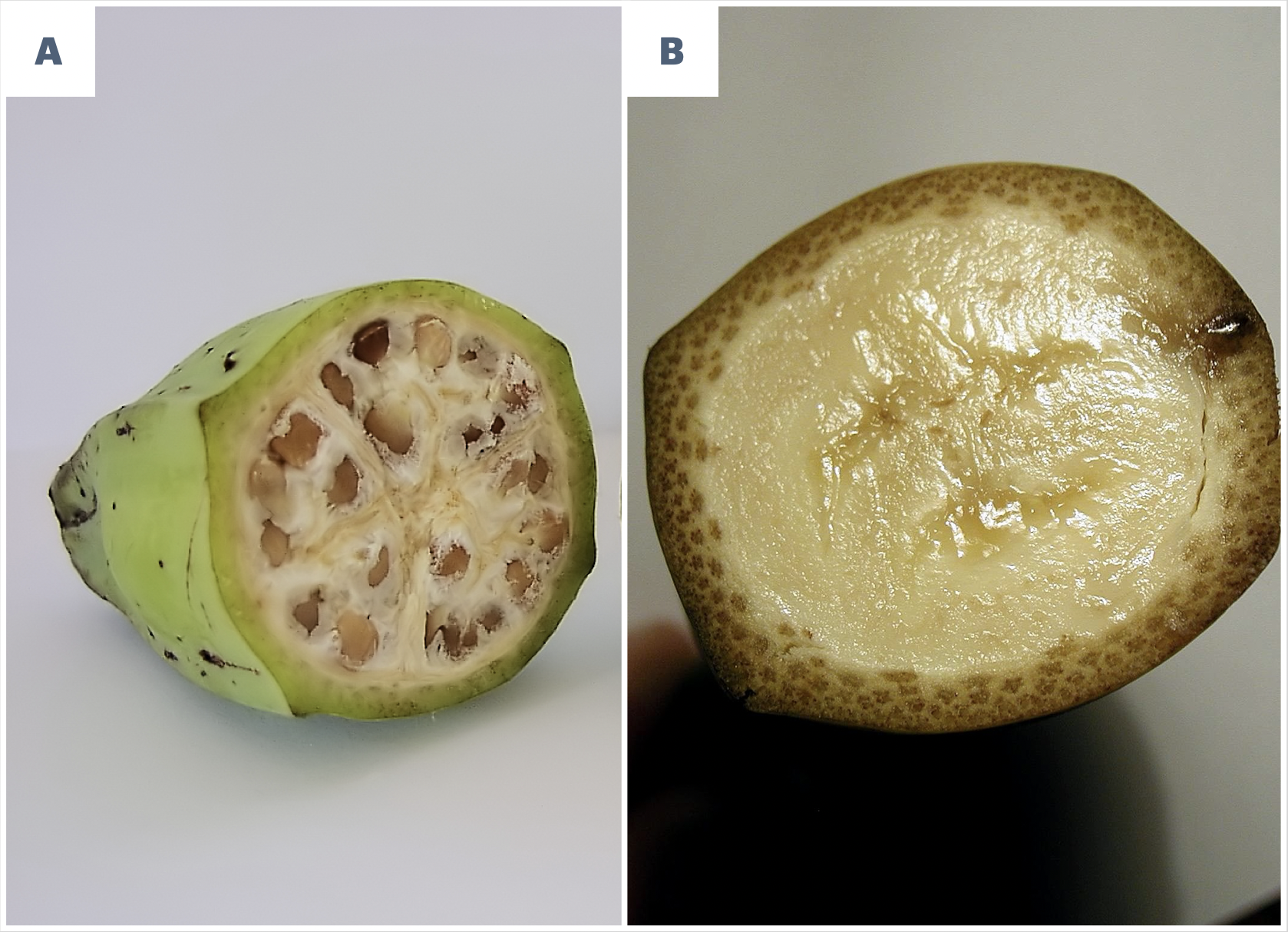
The image looks like a simple before-and-after, but the biological history behind it was anything but simple. Parthenocarpy occurs naturally in flowering plants and can arise through changes in the developmental signals that normally connect fertilization with fruit growth. Experimental work in other species has shown that changes to hormonal pathways, particularly those involving auxin and gibberellins, can activate fruit development in the absence of fertilization.26 We cannot reconstruct the precise molecular pathway responsible for the earliest edible bananas, nor should we assume that parthenocarpy emerged through one identical event in every cultivated lineage. What matters is that the biological possibility existed and that cultivation fundamentally altered what happened to it.
Picarella and Mazzucato describe seedlessness as a biological paradox because a plant may invest resources in producing fruit that contributes little or nothing directly to its own sexual reproduction.27 Yet parthenocarpy occurs repeatedly among domesticated fruit crops, suggesting that humans have repeatedly favored precisely the kinds of plants for which this apparent disadvantage becomes useful.27 Bananas possessed an especially effective way out of that paradox because they already produced suckers. Once cultivators were willing to reproduce a plant vegetatively, seed production was no longer its only route into the future: a banana did not need to reproduce itself successfully if people were willing to reproduce it.
No prehistoric cultivator needed to understand chromosome pairing, plant hormones or developmental genetics for this process to work. They needed only to notice difference. One plant produced more flesh, another contained fewer hard seeds, another ripened well, yielded heavily or possessed some other quality worth preserving. If its suckers were replanted while those of less desirable plants were not, the difference survived. Repeated over generations, human preference became part of the banana’s reproductive system.
The process was not a straight line from seeded wild fruit to the sterile bananas familiar today. Lentfer emphasizes the persistence of partially domesticated forms, including cultivated diploid bananas that continued to produce seed.28 Early cultivated populations are better imagined as a gradient: plants with many seeds and plants with fewer; plants still capable of regular sexual reproduction and others becoming increasingly dependent on clonal propagation.
Hybridization added still more variation. As people moved Musa populations beyond the places where they had evolved, previously separated lineages could meet and cross. Some resulting hybrids experienced reduced fertility; others differed in fruit quality, growth form or other useful traits. Cultivators could preserve promising individuals directly through their suckers rather than losing those combinations in the genetic reshuffling of another sexual generation.25 Sterility was therefore not necessarily the goal; what mattered was that, under cultivation, it no longer had to be fatal.
A plant poorly equipped to reproduce by seed could nevertheless leave thousands of descendants if people continued to divide and replant it. An individual combination that might have disappeared after a single generation in the wild could persist for centuries as a clone, and that altered more than the fruit. It changed the geography available to the plant.
Seeds can move without people. They can fall, float, pass through animals, lie dormant and germinate somewhere new. A highly sterile cultivated banana cannot cross an archipelago that way. It travels as a living plant, as a sucker or corm that must be selected, cut, carried, kept alive and planted again. From this point onward, every cultivated banana found beyond the world of its wild ancestors begins to mark not only the movement of a plant, but the movement of people.
Bananas Begin to Move
In 2020, Guillaume Martin and his colleagues set out to solve what seemed like a fairly contained genetic problem. Cultivated bananas were already known to have mixed ancestry, but knowing that a plant was a hybrid was not the same as knowing how those ancestries were arranged inside its genome. By tracing different ancestral contributions along the chromosomes of cultivated bananas, the team uncovered something much less orderly than a family tree. Individual cultivars carried ancestry from three, four, even five different populations, while some components could not be matched to any known wild population at all.29
That changed the question. The problem was no longer simply where the cultivated banana had originated, but how plants with different evolutionary histories had ended up inside the same genome.
The answer begins with movement.
Wild banana populations could remain separated for thousands of years by sea, mountains, forest and distance. Human transport weakened those boundaries. A sucker taken from one population could be carried into the range of another, planted there, exchanged again and eventually grown beside bananas with which its ancestors had rarely, if ever, reproduced. Geography had once kept those populations apart; cultivation brought them together.
Why people chose to carry bananas is harder to reconstruct than the fact that they did. By this point Musa could provide food, fiber, leaves and other useful materials, while linguistic evidence from the Philippines even hints that some early banana terminology may have been associated with fiber-producing plants rather than fruit alone.30 A transported sucker therefore represented more than the promise of a future bunch of bananas. It carried an entire useful plant—and, with it, a particular genetic lineage.
Movement consequently did more than spread cultivated bananas across the map. It changed which bananas could meet.
Musa acuminata was not one uniform wild population. Its subspecies and regional populations had become geographically differentiated across a broad zone stretching from mainland Southeast Asia through Island Southeast Asia to New Guinea, producing forms such as malaccensis, zebrina, banksii and burmannica/siamea.29 Once people began transporting planting material between those regions, the isolation that had helped create those differences could begin to break down.
A banksii -derived plant carried westward, for example, might suddenly grow beside another M. acuminata population with which its ancestors had shared little contact. If flowering overlapped and fertilization occurred, new hybrids could result. Cultivators did not need to intend that outcome. They needed only to move the plants, allow them to grow within new botanical communities, and continue propagating the individuals they found useful.
This is why hybridization cannot be treated as a genetic footnote to the banana story. It was one of the processes through which cultivated bananas continued to change. Martin and colleagues found modern genomes assembled from several ancestral populations, while broader reconstructions similarly suggest that human transport repeatedly brought geographically differentiated Musa into contact and allowed inter-subspecific and interspecific crosses to occur.2931 Denham describes the same process historically: banksii -derived cultivars moved westward from New Guinea into Island Southeast Asia, where contact with other banana populations generated new forms that would themselves continue to travel.32
The genetics quickly become complicated, but the historical process is straightforward. Transport one cultivated lineage into the range of another, and combinations become possible that geography had previously prevented. Some offspring may be less fertile; others may differ in fruit quality, growth form or resilience. If cultivators preserve a useful plant vegetatively, that new combination can survive and spread. Transport thus becomes another stage of selection rather than simply what happens after domestication is complete.
That distinction changes how we should imagine the early dispersal of bananas. The crop was not perfected in one homeland and then copied unchanged across the tropics. Domestication continued as the plant moved. New populations met, hybrids appeared, promising clones were preserved, and communities in different regions continued selecting plants suited to their own needs and environments.
Perrier and colleagues’ geodomestication model captures this geographically extended process.31 More recent genomic work has strengthened that picture. As cultivated bananas spread through Southeast Asia, they encountered and hybridized with additional Musa populations, including zebrina, malaccensis, burmannica, halabanensis, M. balbisiana and at least one ancestral contributor that has yet to be identified.33 The farther bananas moved, the more complicated their ancestry could become.
For archaeology, that complexity is unexpectedly useful. A cultivated banana appearing beyond the natural range of its ancestors records human transport. A genome containing ancestry from wild populations native to different regions preserves evidence that those populations were once brought into contact. Long after the journeys themselves have disappeared, fragments of geography can survive inside the plant.
That is what gives bananas such unusual potential for reconstructing human movement. Their history survives not only in where they are found, but in the combinations they carry within them.
The difficulty is finding the trail, because bananas leave remarkably little behind.
The Banana That Refused to Preserve
Archaeobotanists definitely have their favorites. Wheat can burn and survive as a charred grain. Date stones are stubborn little objects. Olive pits, grape pips and nutshells can sit in archaeological deposits long after the meal that produced them has vanished. The banana is substantially less cooperative.
Strip away its peel and almost everything humans value about a cultivated banana is soft tissue. The fruit is wet, fleshy and highly perishable. The pseudostem is not wood, the leaves decay, and, in one of the great ironies of this story, the same process that made bananas more useful to humans removed one of the structures archaeologists would most like them to leave behind: the seed. Nor does the banana usually grow in environments especially kind to preservation. Heavy rainfall, warm temperatures and intense biological activity accelerate the breakdown of organic material. Wilson recognized the problem as early as 1985, noting that many tropical domesticates reproduce vegetatively and therefore leave far less pollen and seed than the cereal crops that dominate better-known histories of domestication; tropical preservation only compounds the difficulty.34
The closer bananas moved toward the fruit we recognize today, the less obvious their archaeological signature could become. That does not make them invisible, but it often forces archaeologists to look for something much smaller than the banana itself.
One of the most important clues is the phytolith. As plants grow, some of their cells accumulate silica drawn up from the soil. When the surrounding organic tissue decomposes, these microscopic silica bodies can survive long after the plant itself has disappeared. In banana archaeology, that matters enormously: archaeologists are often not recovering a banana in any familiar sense, but mineral traces produced by its tissues while it was alive.35
Figure 4
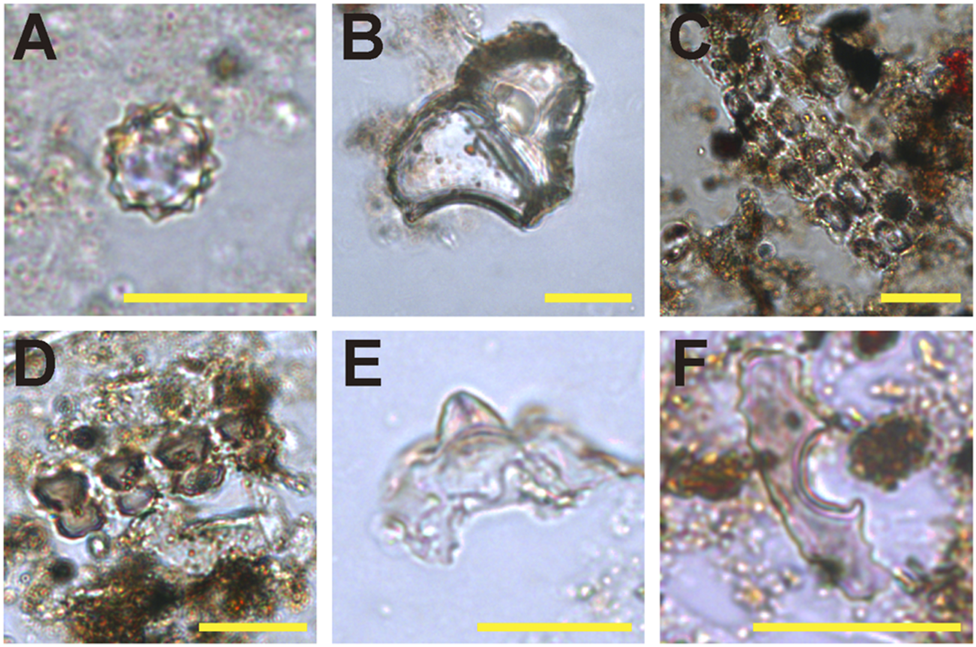
We have already depended upon those traces more than once. At Fahien, banana phytoliths preserved evidence for human interaction with wild Musa deep in the Late Pleistocene; at Kuk, they became much more powerful when found within a landscape marked by mounds, drainage, burning and other evidence of cultivation.3536 Lentfer’s later work also showed that seed phytoliths can sometimes distinguish particular Musa groups and related Ensete more confidently than earlier studies had allowed.35 If the banana itself has vanished, phytoliths can function as something like its mineral fingerprints.
Unfortunately, the fingerprint is often smudged.
Wilson’s pioneering work at Kuk captured the problem clearly. Musaceae phytoliths could be identified in archaeological sediments, but determining what they meant was more difficult. Did they represent cultivated bananas, or wild plants thriving in disturbed ground created by human activity? Later studies expanded comparative collections and improved identification, yet the interpretive problem remained. Leaf phytoliths, including the characteristic volcaniform forms associated with Musaceae, can overlap between genera, sections and species, limiting how confidently a particular trace can be assigned.3435
Finding Musa, therefore, is not the same thing as finding a domesticated banana. Within the natural range of wild bananas, a phytolith may tell us little more than that the plant was present. On its own, it cannot reveal whether people ate it, transplanted it, cultivated it or had already altered its biology through selection. Much of the argument has to come from context.
Geography can sometimes make that context especially powerful. If Musa appears somewhere that wild bananas could not plausibly have reached unaided, human transport becomes a much stronger explanation. Lentfer therefore emphasizes that cultivation is often easiest to infer when banana remains occur beyond the natural range of the plant or when they appear alongside clear archaeological indicators of cultivation.35 Sometimes the significance of a phytolith lies less in its morphology than in where it was found.
Phytoliths are only one archive. Starch grains preserved on tools, pottery or in sediments can reveal plant processing, although confirmed archaeological banana starch remains comparatively rare.35 Genetics can reconstruct relationships between surviving cultivars and wild populations, preserving traces of contacts that occurred long before the plants themselves disappeared. Historical linguistics can follow the movement and transformation of banana names through the communities that cultivated them.37 None of these sources provides a complete history on its own, but together they recover journeys that the fruit itself failed to preserve.
That is why the apparent archaeological silence surrounding bananas has to be treated carefully. Absence still matters, but it cannot be read as straightforward proof that bananas were absent from a landscape. A crop that is herbaceous, tropical, increasingly seedless and usually propagated vegetatively is simply less likely to leave behind the kinds of durable remains archaeobotanists recover most easily.
Its history therefore survives unevenly: in microscopic silica, in starch, in living genomes, in words passed between languages and, sometimes, in the simple fact that a plant appears somewhere nature alone cannot explain.
The trail is fragmentary, but it is enough to follow. From here, those fragments begin carrying us far beyond the landscapes in which the banana first evolved.
Into the Pacific
In a Samoan legend recorded in the nineteenth century and later retold by the botanist L. H. MacDaniels, bananas once went to war.
On one side stood the lowland plantains. On the other were the mountain bananas, the soaqua —the plants we would now place among the Fe‘i bananas of the Pacific. What provoked the quarrel the story does not say. What mattered was the outcome. The mountain bananas won, and in triumph the victors lifted their heads toward the sky. The defeated lowland bananas were so humiliated that they bowed theirs and, according to the legend, never raised them again.38
Look at the plants and the legendary outcome becomes immediately recognizable. The bunches of most familiar bananas hang downward, while many Fe‘i bananas do the opposite: their fruits rise above the plant in an erect or semi-erect bunch, sometimes glowing orange or copper against the leaves. MacDaniels treated the story as a clue to the antiquity of Fe‘i bananas in Pacific tradition. Whether or not the legend can carry that chronological weight, it reveals something more immediate. Long before botanists began reconstructing banana genomes, Pacific communities were already distinguishing between bananas with very different identities.
Figure 5
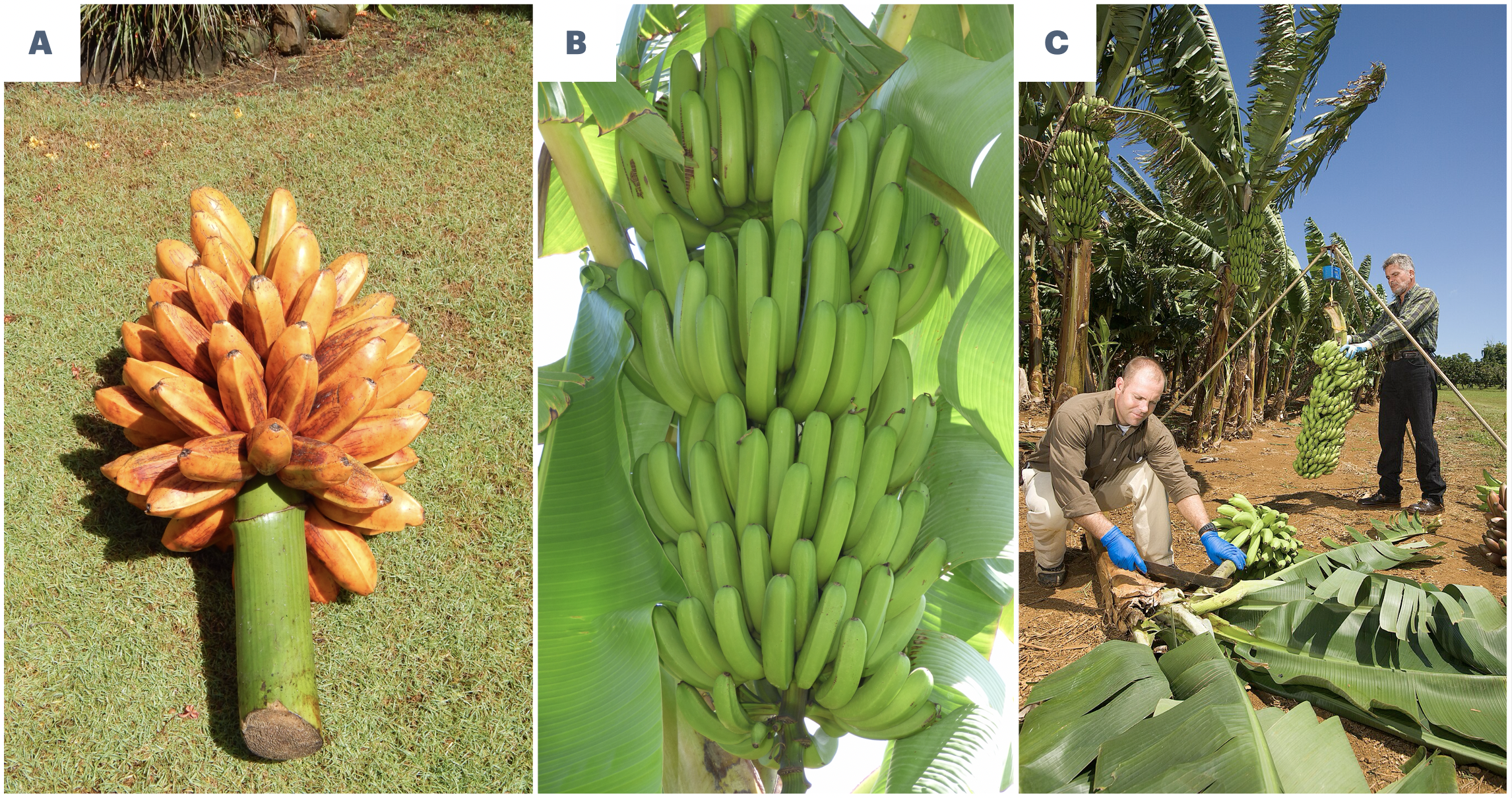
They were right to do so, because the Pacific did not receive one banana. It received several different banana lineages.
To see why, remember the two genomes introduced earlier. Musa acuminata contributed the A genome and Musa balbisiana the B. Their descendants include a group of traditional Pacific cooking bananas generally known as the Maoli–Popoulu–Iholena complex. These are AAB triploids, carrying three chromosome sets assembled from the histories of both species. Genetic work traces their A ancestry particularly strongly to M. acuminata subsp. banksii, the New Guinea population we encountered at Kuk, while their B ancestry derives from M. balbisiana.3940
Even within this group, however, the history is not that of a single clone copied endlessly eastward. Kagy and colleagues found enough genetic diversity to indicate several triploid lineages produced through separate recombination events in or around the New Guinea region.40
Alongside them traveled another banana altogether.
Fe‘i bananas belong to a different branch of Musa. Their ancestry lies principally among Papuasian bananas traditionally grouped as Australimusa, now generally incorporated within section Callimusa, involving wild relatives such as Musa maclayi and related forms.3941 Their erect bunches are only the most conspicuous sign of that difference. Many also possess striking orange-yellow flesh, reddish or purple sap and growth forms unlike the A- and B-genome bananas that dominate much of the world today.
More important still, edible parthenocarpic bananas appear to have emerged independently within these different branches of the genus.39 Seedlessness and dependence upon vegetative propagation were therefore not achieved once and then inherited by every cultivated banana. Different human communities, working with different wild Musa populations, arrived at remarkably similar outcomes: useful fruits whose development became increasingly detached from sexual reproduction and whose continuation therefore depended more heavily upon people.
Both histories nevertheless pull us back toward Papuasia. Fe‘i ancestry points toward northern New Guinea, the Bismarck Archipelago and neighboring islands, while the Pacific AAB bananas likewise preserve substantial New Guinea ancestry.394041 Kennedy identified at least three prehistoric banana lineages reaching eastern Oceania, all with some connection to the New Guinea region, while cautioning against imagining that they had been assembled there at the same time or transported eastward as a single crop package.39
That matters because Kuk gives us one extraordinarily important history of banana cultivation in the New Guinea highlands, not the birthplace of every banana that would later enter the Pacific. By the time we reach the coasts, islands and archipelagos surrounding New Guinea, centuries of movement, hybridization and selection had already produced a much more complicated botanical landscape.
Around 3,400 years ago, communities associated with the Lapita cultural complex were established in the Bismarck Archipelago, just off the northeastern coast of New Guinea. Within a remarkably short period, people were voyaging eastward through the islands beyond the main Solomons, reaching Vanuatu and New Caledonia and eventually Fiji, Tonga and Samoa. These journeys are famous for their dentate-stamped pottery, but pottery was only one part of what moved. People carried animals, tools, knowledge and living plants.42
For a banana, that last category matters. A ceramic vessel can be loaded onto a canoe and remain a ceramic vessel when it reaches another island. A banana sucker is alive. It must survive the journey, be planted into suitable soil at the destination and then be propagated again if the introduction succeeds. Every island on which a sterile or weakly fertile banana established itself therefore records a sequence of deliberate human actions.
At the early Lapita sites of Nenumbo and Ngamanie in Reef/Santa Cruz, on the southeastern edge of the Solomon Islands, archaeology allows us to glimpse that process directly. Researchers recovered starch grains and phytoliths from sediments and pottery belonging to a horticultural assemblage. Among them were traces of both seeded Australimusa/Callimusa bananas and domesticated Eumusa/ Musa bananas, together with taro and sago palm.42 The evidence places different kinds of banana within an early horticultural landscape in Remote Oceania and supports the movement of selected planting material into newly settled islands.
It does not allow us to place every later Fe‘i or Maoli cultivar aboard a particular Lapita canoe, nor should we imagine one perfectly packaged ancestral collection moving neatly from west to east.39 What the archaeology does show is that bananas were already participating in these voyages, and that more than one lineage was involved.
Once they arrived, the story did not simply stop with transport.
Vegetatively propagated plants are copies, but they are not perfectly frozen ones. Somatic mutations can arise as a plant grows, producing changes in fruit, color, growth habit or other characteristics. If a cultivator values one of those differences and propagates a sucker from that plant, a variation that might otherwise have vanished with one individual can become a lineage of its own. Where fertile or partly fertile forms persisted, occasional sexual recombination could generate still more variation.
Pacific horticulturalists became extraordinarily effective at preserving and multiplying such differences. Thomson and colleagues suggest just how far this process could go among Fe‘i bananas: Tahiti eventually possessed more than twenty named cultivars that may have descended from only four or five ancestral introductions.41 Movement had not ended domestication. Each successful introduction created another landscape in which selection could continue.
The Maoli, Popoulu and Iholena bananas reveal the same process from another angle. Kagy and colleagues found extensive morphological diversity across the Pacific resting upon a much smaller number of closely related genetic backgrounds.40 Human communities had taken ancient triploid clones and, through centuries of vegetative propagation and attentive selection, transformed them into locally named varieties distinguished by fruit shape, color, growth pattern and culturally valued traits.
Some of those distinctions acquired meanings that reached far beyond food. Conspicuously red forms could become associated with divinities or reserved for chiefs and offerings. Fe‘i bananas provided fruit, fiber, dyes and medicines, while in parts of New Caledonia their red-purple sap could be understood as ancestral blood. Particular forms were associated with clans, ritual restrictions and protective planting around houses; elsewhere bananas entered systems of chiefly exchange and ceremonial offering.41
By then, the banana had moved far beyond the category of transported crop. Pacific communities inherited introduced lineages, distinguished them, named them, selected them and embedded them within local systems of memory and identity. The Samoan battle therefore seems rather less whimsical than it first appeared. The raised head of the Fe‘i was not simply a botanical curiosity, but a visible difference important enough to explain through myth.
Across the Pacific, the movement of living plants had become a process of cultural as well as biological diversification.
Yet the Pacific represented only one direction in which bananas were moving. While some lineages traveled eastward across increasingly large stretches of ocean, others were moving north into mainland Southeast Asia and southern China, while still others were beginning much longer journeys west.
Northward
The early history of agriculture in China is often told through rice.
There is good reason for that. By the Neolithic, communities along the Yangtze and farther south were cultivating rice, and over the following millennia it would become one of the great staple crops of East and Southeast Asia. Its charred grains preserve well, its domestication can be traced through changing spikelet bases and grain morphology, and its archaeological visibility has helped make rice one of the organizing characters in narratives of early Chinese agriculture.
At Xincun, on the southern coast of China, the evidence tells a less familiar story.
The late Neolithic settlement, occupied broadly between 3500 and 2470 BCE, produced surprisingly few conventional plant remains. No great deposit of charred rice grains anchors the subsistence economy, and the acidic tropical soils were poorly suited to preserving much of what people had eaten or cultivated. Instead, researchers turned to residues trapped on grinding stones, where starch grains and phytoliths survived after the plants themselves had disappeared.43
What they found was a remarkably diverse plant economy. The residues included palms, roots and tubers, rice and at least seventeen starch grains identified as banana.43 Rice was present, but it was only one component of a much broader tropical repertoire. The result complicates any simple picture in which southern China moved steadily toward a rice-centered agricultural system while other plants waited at the margins. In at least some coastal communities, bananas and other vegetatively propagated plants belonged to the landscape alongside cereals.
Exactly what kind of bananas were being used at Xincun remains difficult to determine. Starch morphology can identify Musa more confidently than it can distinguish every wild and cultivated form, and southern China lies close enough to the wider natural distribution of bananas that presence alone cannot demonstrate domestication.43 The plants might have been wild, cultivated or forms occupying the increasingly familiar territory between those categories. What matters is that they were being processed by people within a late Neolithic settlement thousands of years before bananas entered the textual histories that later make them easier to see.
How those bananas fitted into the wider history of domestication takes us south again, toward one of the most complicated regions in the entire story.
The Philippines sit between several of the banana worlds we have already encountered. To the east lies New Guinea and the banksii -rich region that contributed so heavily to cultivated bananas. To the south and west stretch Sulawesi, Borneo and the rest of Island Southeast Asia, home to other differentiated Musa acuminata populations. The archipelago was not simply a corridor between these regions. It contained wild bananas of its own, including forms such as M. acuminata subsp. errans, and genetic studies have increasingly placed the Philippines within the network of contact through which cultivated banana ancestry became mixed.4445
The geography matters because bananas arriving from one region could encounter populations from another. Banksii -derived cultivars moving west from New Guinea and nearby islands entered a landscape occupied by different Musa lineages, creating opportunities for hybridization that had not existed while the populations remained geographically separated. De Langhe and colleagues have argued that interactions within the broad Philippines–Sulawesi–New Guinea region were especially important in the generation of the AAB plantains that would later become enormously significant both in the Pacific and, much farther west, in Africa.45
It would be tempting to turn this into another origin point.
By now, we should probably be suspicious whenever the banana story appears to offer us one of those.
The Philippines were better understood as part of a wider contact zone in which plants, people and useful traits moved between islands. Different banana populations entered those networks at different times, and the motivations behind their movement may not always have centered on fruit. Here, linguistic evidence introduces another possibility.
Historical linguists reconstruct a family of banana terms conventionally represented as qaRutay, with descendants distributed through parts of the Philippines and beyond.46 Importantly, related forms are associated not only with edible bananas but also with abacá, Musa textilis, a Philippine banana cultivated primarily for fiber. The association does not prove that every early movement represented by the term involved fiber bananas, but it preserves a reminder that Musa traveled within technological worlds as well as food systems.46
That possibility becomes more interesting when placed beside the archaeological evidence for plant-fiber technology in the region. At Tabon Cave on Palawan, microscopic traces of plant processing on stone tools suggest that people were manufacturing flexible plant materials such as cordage or basketry between roughly 39,000 and 33,000 years ago.47 The residues cannot be used to identify abacá or bananas specifically, and they predate the agricultural dispersals considered here by tens of thousands of years. Their importance is broader: Southeast Asian communities possessed deep traditions of working plant fibers long before the later movements of cultivated Musa. A banana useful for cordage, wrapping or other fibers therefore entered a world already equipped to value those properties.
The old warning returns here. Bananas did not necessarily travel for their fruit alone.
Their movement northward onto the Asian mainland is difficult to reconstruct in detail, but linguistic and genetic evidence both indicate repeated connections between Island Southeast Asia and regions farther west and north.4546 Cultivated forms crossed ecological and linguistic boundaries, acquired new names and encountered new agricultural systems. Some of those movements probably contributed to the bananas ultimately exploited in southern China, although the Xincun starches themselves cannot be assigned securely to a particular dispersal or genetic lineage.43
That uncertainty is important because Xincun does not give us a neat arrow running from New Guinea through the Philippines and into China. It gives us something more revealing about the agricultural world into which bananas were moving. Rice was present, but so were palms, tubers and bananas, preserved not as a field of charred grains but as microscopic traces on the surfaces of tools.43
Seen from the later history of Chinese agriculture, such plants are easy to treat as background. Rice would become archaeologically conspicuous, economically dominant and central to historical narratives of the region. Bananas were less cooperative. They left no equivalent archive of charred seed and, as their cultivation increasingly depended upon vegetative propagation, could become important without becoming equally visible.
Xincun therefore offers a glimpse of a landscape before the later dominance of rice makes that diversity harder to see. It does not show bananas replacing rice, nor does it demonstrate that they were the principal staple of southern China. It shows something subtler: communities drawing upon a mixed tropical food economy in which bananas already had a place.
From here, the trail begins to turn west. Cultivated bananas would move through mainland Southeast Asia toward the Indian subcontinent, but the plants were no longer the only evidence traveling with them.
Their names traveled too.
The Words Bananas Left Behind
By now, the banana has presented us with a familiar problem. The plants moved, but much of the evidence did not survive with them. Seeds disappeared from cultivated fruit, pseudostems and leaves decayed, and even phytoliths can carry the story only so far. Yet traces of those journeys survived somewhere less obvious: in language.
Across Island Southeast Asia and the Pacific, communities did not simply carry suckers and corms from one garden to another. They carried names with them. Those names changed as languages changed. Sounds shifted, syllables were rearranged, older terms disappeared, and neighbouring communities borrowed words from one another. Historical linguists reconstruct those relationships by looking not for superficial resemblance alone, but for recurring sound correspondences, patterns of inheritance and evidence of borrowing across related languages.48
That caution matters because two similar-sounding banana words do not automatically prove a prehistoric connection. Languages in close contact can exchange vocabulary extensively, sometimes obscuring their deeper relationships rather than revealing them. Work on Austronesian languages has shown how geography and social interaction can produce lexical similarities that are difficult to distinguish from common inheritance unless the words are considered within broader patterns of sound change and linguistic history.49
For bananas, however, the method proved unexpectedly revealing. Mark Donohue and Tim Denham assembled roughly 850 banana terms stretching from Southwest Asia into the Pacific and organized them into twenty-four cognate sets: families of words interpreted as historically related.50 What emerged was not one vocabulary radiating neatly from a single center. Different banana terms occupied different parts of the map, overlapped one another and appeared to preserve several distinct histories of movement.
One of the most revealing is muku. Terms belonging to the muku family are concentrated around New Guinea and extend westward through areas historically occupied by Papuan and other non-Austronesian languages, while their distribution eastward into Oceania is much more limited.50 That pattern is difficult to explain solely through the later Austronesian expansion. Donohue and Denham instead argue that it preserves traces of an older movement of bananas westward from the New Guinea region, before Austronesian-speaking communities entered much of Island Southeast Asia around 4,000–3,500 years ago.50
The linguistic evidence therefore converges neatly with the archaeological world we have already encountered at Kuk. People in New Guinea were cultivating bananas long before Austronesian dispersals transformed the region, and muku suggests that some of those plants, or at least traditions associated with them, may already have been moving between communities before those later migrations began.
Another word family brings us back to the Philippines. Historical linguists reconstruct qaRutay there, with descendants extending south through parts of eastern Indonesia and west toward mainland Southeast Asia and eventually South Asia.50 The relationship does not depend simply upon modern words looking alike. Forms can be linked through recurring changes in sound, loss of consonants and metathesis—the reversal or rearrangement of sounds and syllables—which allow very different-looking words to preserve traces of an older common form.
In this sense, language becomes almost cartographic. A word associated with one corner of the banana world reappears, altered but still recognizable, thousands of kilometers away.
QaRutay also carries an echo of an older theme in the story. Related forms were associated not only with edible bananas but with fiber-producing Musa, including abacá.50 That does not tell us exactly which plant accompanied every borrowing of the word, but it reinforces what the archaeological and ethnobotanical evidence has already suggested: fruit was not the only reason bananas moved.
Nor was qaRutay the only linguistic trail. Punti spread widely through parts of Indo-Malaysia and the Pacific, but its conspicuous absence from much of the Philippines, Java, Sumatra and the Malay Peninsula suggests that it belongs to a different and probably later dispersal history.50 BaRat preserves another pattern linking parts of the Philippines, Borneo and the mainland, while pisang, now one of the most familiar banana terms in Island Southeast Asia, is concentrated much more strongly among Malayic-speaking communities and their neighbors and appears to reflect a later historical expansion associated with Malay influence.50
These overlapping distributions are important precisely because they refuse to collapse into one migration. A single crop moving once from one homeland should, in principle, leave a simpler linguistic trail. Instead we find several word families spreading through different regions at different times, sometimes following one another, sometimes overlapping, sometimes replacing older terminology.
The words are therefore telling us much the same thing as the genomes. There was no single banana traveling beneath a single name. Different plants, cultivars, uses and technologies moved through different human networks, and the vocabulary shifted as those networks changed. Sometimes a word traveled with a plant. Sometimes it was borrowed between neighboring communities. Sometimes an older term was retained after the banana itself changed, or replaced by a newer name moving through a different political or linguistic world.
Linguistics cannot provide a perfect migration map any more than phytoliths or genomes can. Its value lies in convergence. Archaeology gives us cultivated landscapes such as Kuk. Genetics preserves contact between banana populations whose wild ancestors once lived apart. Language records names moving through the communities that carried, exchanged and renamed those plants.51 When those independent archives begin pointing in the same direction, the historical argument becomes much stronger than any one line of evidence could make on its own.
Some of those trails now begin to point decisively west. QaRutay -related terms extend toward the Indian subcontinent, while other banana vocabularies appear within South Asian language families farther ahead. For the first time, the movement of bananas toward India can be followed not only through plants and genes, but through words.
And in South Asia, another kind of archive is about to join them.
At the Edge of the Banana World
When Greek and Roman writers looked back on Alexander the Great’s campaigns in India during the fourth century BCE, they described a landscape that seemed to strain the vocabulary of the Mediterranean world. India appeared in their accounts as a place of unfamiliar animals, immense trees and plants unlike those of their homelands. Among them was something Pliny the Elder would later call the pala. Its leaves spread broadly, its fruit grew in clusters and the flesh was remarkably sweet. Pliny placed it among the Sydraci, near what he described as the furthest point reached by Alexander’s expeditions.52 Theophrastus, writing much closer to Alexander’s lifetime, had already recorded reports of extraordinary Indian trees and sweet fruits, although matching each of his descriptions securely to a modern species is more difficult.53
For Mediterranean readers, the banana belonged near the limits of the known world. Yet there is a pleasing reversal here. What appeared to Greek and Roman writers as one geographical edge was also, in another sense, an edge of the banana world. India and Sri Lanka lie close to the western margin of the natural distribution of Musa and its relatives, while farther east stretches the enormous arc of wild banana diversity we have followed from New Guinea through Island Southeast Asia and the Asian mainland.54 By the time Mediterranean writers began describing the plant, two very different geographical stories had begun to overlap.
Something else changes here as well. Until now, the banana has rarely spoken for itself in written history. We have reconstructed its movements from microscopic silica bodies, ancient cultivation features, genomes, the distribution of wild populations and words carried between languages. In South Asia, the archive begins to widen. Bananas appear not only in soils and living plants, but eventually in literature, ritual traditions and visual representation. Written history, for the first time in our story, begins to catch up.
It arrives very late.
South Asia’s relationship with Musa reaches back tens of thousands of years before the classical accounts. At Fahien Rock Shelter in southwestern Sri Lanka, wild banana phytoliths occur deep within Late Pleistocene deposits associated with human occupation, showing that people were interacting with local Musaceae long before cultivated bananas moved westward through the region.55 The details of those early uses remain uncertain, but the broader point is important: bananas did not enter South Asian history when literate societies first chose to describe them.
That long familiarity reflects South Asia’s unusual geographical position. Wild Musa balbisiana, populations of M. acuminata and other Musaceae occurred across parts of the subcontinent and Sri Lanka, while indigenous Ensete formed part of the wider regional flora.54 The great concentration of wild Musa diversity still lay farther east, but South Asia was not an empty agricultural frontier waiting for a foreign crop to arrive. Cultivated bananas entering the region encountered landscapes in which related plants were already known.
Farther northwest, however, the archaeological evidence becomes much more arresting. At Kot Diji, in the Indus region of present-day Pakistan, Musa-type phytoliths have been reported from Mature Harappan contexts dating broadly to about 2500–1900 BCE.56 That places bananas there more than a millennium before the classical descriptions and, more importantly, in a landscape far removed from the humid tropical environments with which wild bananas are usually associated.
That geography changes the significance of the evidence. Within the natural range of Musa, a phytolith may represent a wild plant growing locally. At Kot Diji, that explanation is much harder to sustain. By this stage, the cultivated bananas we have been following were increasingly dependent upon human propagation, and the presence of Musa in Sindh points toward deliberate movement of planting material into a region where the plant would not simply have arrived unaided.
What sort of banana had reached Kot Diji is harder to say. Fuller and Madella noted that the dimensions of the phytoliths may be compatible with bananas involving M. balbisiana, whose ancestry could have contributed traits useful in more seasonal environments.56 Later syntheses, however, stress the limits of that identification: the Kot Diji remains cannot presently be assigned below the genus level.57 We cannot name the cultivar, reconstruct its genome or assume that fruit was the only reason it was valued. What Kot Diji gives us securely is something more modest but still important—a banana out of place, and therefore evidence of movement.
One possible part of that movement leads back through Sri Lanka. Premathilake and Hunt have proposed that edible AA bananas may have reached the island from farther east by the mid-Holocene, perhaps ultimately from the Indonesia–New Guinea region. In their reconstruction, introduced cultivated bananas entered landscapes already occupied by wild Musa, creating opportunities for further interaction before related cultivars moved northward into India and Pakistan.55 The model is attractive because it places Sri Lanka not merely at the receiving end of dispersal, but at a possible junction between Southeast Asia, the subcontinent and the western Indian Ocean.
The evidence does not yet allow that reconstruction to harden into a route. Perrier and colleagues place the principal formative zones of cultivated banana hybridization farther east, especially in Island Southeast Asia and western Melanesia, and note that South Asian M. acuminata populations related to burmannica do not appear to have contributed substantially to the major cultivated groups known today.57 South Asia may have participated in further diversification after cultivated bananas arrived, but the surviving evidence does not justify turning the region into another singular center of origin.
Language points instead toward the same kind of layered movement we have already encountered elsewhere. Dravidian languages preserve several reconstructed banana terms rather than one ancestral form spread evenly across the subcontinent, while Indo-Aryan and Munda traditions add others, including forms related to Pali kadalī and Sanskrit mocha.56 At the same time, descendants of the qaRutay family we followed out of the Philippines extend westward through mainland Southeast Asia and into the Indian subcontinent.58
The genetic record follows a strikingly similar direction. Perrier and colleagues identify ancestry related to the Mlali group, whose deeper history lies much farther east, in Indian AAB cultivars including Pome, Nendra Padathi and Nadan.57 They connect this westward genetic movement with the chain of qaRutay-related linguistic forms stretching from Indonesia through mainland Southeast Asia toward India. Neither archive gives us a complete route on its own, but together they preserve the same broad movement: cultivated bananas arriving in South Asia from regions farther east and becoming incorporated into new agricultural and linguistic worlds.
By the first millennium BCE, the evidence begins to look very different. Bananas appear in Pali Buddhist material and Sanskrit sources, while later Tamil Sangam literature preserves additional references.5659 Nayar also notes their place in medicinal and ritual traditions, and by the final centuries BCE the plant enters the visual record. Banana representations appear in sculpture at Bharhut and Sanchi, followed centuries later by painted examples at Ajanta.59
A plant that had once survived for us only as microscopic silica and reconstructed ancestry was now carved into stone.
This is where the classical descriptions belong. Pliny’s pala did not announce the arrival of the banana in South Asia; it recorded the moment when a much older South Asian history became visible to Mediterranean literature. To Greek and Roman writers looking east, India seemed close to the edge of their known world. To the banana, it represented another boundary altogether: the western margin of the broad Asian landscapes in which wild Musaceae had evolved and in which cultivated forms had been moving for millennia.
By then, however, that boundary was already becoming permeable. Cultivated bananas had traveled west from Island Southeast Asia, entered South Asian agricultural systems, acquired new names and become visible in texts, ritual and art. From the subcontinent, their next movements would carry them beyond the natural banana world altogether, toward the ports and irrigated landscapes of the Arabian Sea, the Persian Gulf and the Red Sea.
At the western edge of Asia, the banana was about to encounter a much more difficult landscape.
Across Dry Lands
Somewhere west of India, the banana entered a landscape that should have stopped it. The plant we have followed from New Guinea belonged to a world of heavy rain, saturated soils and dense vegetation, where heat usually came with moisture and green growth crowded every layer of the landscape. Arabia offered the heat, but little else: exposed rock, gravel plains and long summer months with little to no rain. Almost everything the banana needed was missing.
If it was going to survive here, people would have to build the conditions themselves.
In the oases of Arabia and along the irrigated margins of the Red Sea, that is precisely what happened. Springs and wells fed channels carrying water across otherwise dry ground, while terraces and layered gardens created pockets of shade beneath taller crops. In Oman, bananas remain largely confined to well-watered oases in the north and the monsoon-influenced landscapes of Dhofar; at Wadi Tiwi, they grow beneath date palms alongside citrus trees on irrigated terraces.60 Keeping them alive meant learning how to negotiate with the desert. Water had to be found, captured and guided, and gardens arranged so that one plant helped create the conditions needed by another.
At Umq Bi’r, high in the Hajar Mountains, that negotiation survives in miniature. Researchers examining a half-abandoned oasis found an old Musa acuminata cultivar clinging to a moist limestone niche beside a permanent spring. Ferns grew among the wet rocks, two old citrus trees survived nearby, and several banana plants remained tucked into the corner.60 Long after much of the surrounding cultivation had disappeared, the spring preserved the small artificial world in which a tropical plant could continue to survive.
Why anyone first carried such a demanding crop into Arabia is harder to reconstruct. Clonal propagation did, however, give the journey one important advantage. A traveler carrying a sucker from a valued cultivar was not gambling on the qualities of a seed-grown descendant; they were transporting a known plant whose desirable characteristics could be reproduced at the destination. Whatever combination of fruit, leaves, fiber or other uses first justified the effort, someone eventually decided the banana was valuable enough to carry beyond landscapes in which it could survive unaided.
There were certainly routes along which that decision could travel. For millennia, the Arabian Sea connected South Asia with the Persian Gulf and Red Sea, feeding networks that reached Arabia, Iran, Mesopotamia, Egypt and the eastern Mediterranean. By the Bronze Age, those connections were already carrying biological materials across remarkable distances. South Asian foods and aromatics reached regions far to the west through chains of exchange that did not require a single merchant or vessel to complete the entire journey.6162
The difficulty is identifying exactly when bananas joined that traffic.
At Tel Erani in the southern Levant, an individual buried around 1100–1000 BCE carried an unexpected trace in the mineralized plaque on their teeth. Researchers identified a fruit-ripening protein represented by two peptides and most consistent with Musa.63 It is an unusually intimate kind of evidence: not a phytolith in soil or a plant remain in a storeroom, but a molecular trace of something consumed by one person roughly three thousand years ago.
Where that person ate the banana cannot be recovered. The protein may indicate that banana fruit had reached the southern Levant by the early first millennium BCE, but the individual might equally have traveled farther east, consumed it there and only later been buried at Tel Erani.63 Nor would the presence of fruit necessarily imply local cultivation. Fresh bananas spoil quickly, but drying can extend their life substantially, allowing fruit to move through commercial networks without the living plant ever taking root.64 A dried banana arriving through a port would leave a very different history from a sucker planted beside a spring: one could be eaten and disappear, while the other had to survive long enough to become agriculture.
That agricultural history comes into much clearer focus centuries later. By the ninth century CE, bananas were certainly growing in southeastern Arabia. Abu Hanifa al-Dinawari considered the plant native to Oman, while in the following century Ibn Hawqal described the country as rich in bananas.65 Whatever uncertainty surrounds their first arrival, the plant had by then become familiar enough to appear as an ordinary feature of the cultivated landscape.
Oman was particularly well positioned for such a transformation. Its ports faced India across the Arabian Sea while its commercial connections extended through the Gulf, Red Sea and East Africa. D. T. Potts has suggested that eastern Arabia sometimes functioned as an intermediary where crops arriving from India could be acclimatized before moving farther west.65 Whether every plant followed such a route is less important than what the Omani evidence shows was possible. A tropical clone could be introduced into an irrigated oasis, sheltered among other trees and maintained generation after generation until its continued presence depended less upon the climate it had entered than upon the agricultural system constructed around it.
This adds another dimension to the geodomestication we encountered earlier. In New Guinea and Island Southeast Asia, human movement brought different banana populations into contact and allowed the plants themselves to change. In Arabia, people increasingly changed the surroundings instead. Springs were channeled, terraces maintained, shade cultivated and gardens layered vertically. The banana’s journey was no longer only through geography; agriculture was beginning to reshape geography around the plant.
Across the Red Sea, the archaeological record eventually gives us something more tangible.
At Quseir al-Qadim on the Egyptian coast, arid preservation conditions protected plant remains that would ordinarily have vanished. Among the Islamic-period deposits, archaeologists recovered a fragment of banana skin.66 After following the plant through phytoliths, reconstructed genomes, linguistic trails and proteins trapped in dental calculus, we finally encounter part of the fruit itself.
The banana did not arrive alone. Sugarcane, lime, taro and aubergine appear in the same Islamic-period assemblages, forming part of a wider group of crops whose origins lay beyond the traditional agricultural worlds of Egypt and the Mediterranean.66 Quseir had already participated deeply in eastern trade during the Roman period, and its earlier deposits contain an extraordinary range of imported foods. Bananas and several of these other tropical crops, however, are absent from those Roman levels and become visible only in the medieval deposits.66
The contrast captures something larger than changing taste. Van der Veen and Morales distinguish between crops that arrive as imported commodities and those that become integrated into local systems of production.66 During the early Islamic centuries, bananas increasingly belong to the second category. Their history was no longer confined to fruit moving through ports; behind the surviving fragments stood irrigation works, gardens and cultivators learning how to make an ecologically demanding plant productive.
For much of the twentieth century, this wider transformation was discussed through the idea of an Islamic “agricultural revolution.” Andrew Watson argued that the commercial and political connections of the early Islamic world encouraged crops such as banana, sugarcane, rice, citrus, taro and aubergine to spread westward from regions around India, while irrigation allowed tropical and subtropical plants to be cultivated in environments otherwise poorly suited to them.67 Subsequent scholarship has complicated that picture. Several crops were present farther west before the Islamic period, and the surviving evidence is considerably better at documenting their expansion from the ninth and tenth centuries onward than at identifying a single moment of introduction.67
The banana fits that messier chronology rather well. Tel Erani hints at movement many centuries earlier, Oman gives us secure evidence for cultivation by the ninth century, and Quseir places bananas within a broader transformation of Red Sea agriculture in the medieval period. Instead of one introduction followed by orderly expansion, the evidence suggests repeated movements, uneven establishment and long intervals in which bananas may have been present in some places while remaining archaeologically invisible in others.
Language preserves the same uncertainty. Arabic mauz, the common word for banana, has long been linked to Sanskrit moca, seemingly offering a linguistic thread from India westward. Yet moca in early Sanskrit could refer specifically to the banana flower or bud rather than simply to the plant or fruit, and the relationships among mauz, muz and related forms remain uncertain.68 Even the familiar English word banana has been connected with Arabic banān, “fingers” or “fingertips,” an appealing image for a hand of fruit, though the derivation remains proposed rather than secure.68
These words therefore preserve movement without reducing it to a single route. Like the plants themselves, names could be borrowed, reapplied and reshaped as they passed through multilingual commercial worlds. Their trajectories tell us less about one decisive introduction than about the networks through which bananas repeatedly moved.
The living plants preserve a similarly complex history. Traditional bananas documented in Oman, Egypt and Jordan include AA, AAA, AAB, AB and ABB genome groups.68 Such diversity is difficult to reconcile with the descendants of one isolated clone introduced on a single occasion. Western Asia appears instead to have received different banana lineages through repeated movements and then incorporated them into agricultural systems in which no wild Musa had previously existed.
By this stage, something fundamental had changed in the journey. In New Guinea and Southeast Asia, people had moved bananas through landscapes where wild relatives already belonged. Across Arabia and the Red Sea, the plant survived because people supplied what the environment withheld: water, shade and continual propagation. A relationship that began with maintaining a reproductively dependent plant had expanded into the maintenance of entire landscapes around it.
The dry lands were not the end of the route. Arabian ports faced east toward India, but they also opened west and south across the Red Sea and Indian Ocean. Beyond them lay another continent where bananas would become far more important than the scattered traces of their arrival might suggest.
Africa would be harder to read.
Where the Banana Took Root
In one of the founding traditions of the Baganda, Kintu, the ancestral founder of Buganda, did not arrive with a garden.
He came into the country with little enough to begin one. It was Nambi, his wife, who followed, bringing with her the things from which a settled life might grow: animals, planting material, and, among them, a banana plant. In another telling preserved by D. N. McMaster, that first plant was remembered as coming from the country around Mount Elgon. Once planted, it multiplied. Later generations would look across the groves of Buganda and trace them, in story, back to that beginning.69
The tradition was never a botanical field report, and McMaster himself cautioned against treating it as one. Stories surrounding Kintu accumulated over generations, absorbing migrations, dynasties and changing ideas about the past. Yet the presence of the banana within a foundation story is striking. Here was an Asian plant so thoroughly absorbed into the world of the northern Great Lakes that it could stand beside cattle, land and agriculture among the things from which society itself was imagined to have grown.6970
By the time Europeans began describing Buganda in detail, bananas were everywhere. Groves filled the wetter country north of Lake Victoria, and dozens of varieties were distinguished according to how they were cooked, roasted, brewed or eaten. The plant supplied food, beer, fiber and wrapping material, while cultivation generated a vocabulary elaborate enough to occupy whole sections of the language.69 Farther south and east, bananas were similarly woven into Chagga home gardens around Kilimanjaro; among the Haya, banana gardens surrounded homesteads and supplied food and beer; among the Nyakyusa, plantains entered ritual life as well as agriculture. What had begun thousands of kilometers away as a collection of Asian Musa populations had become part of the architecture of African life.
How that transformation began is considerably harder to reconstruct.
Africa opens several possible doors at once. To the north lay Egypt and the Red Sea corridor. Across the western Indian Ocean lay Arabia and India. Farther south, the East African coast faced Zanzibar and Pemba, the Comoros and Madagascar. Ships had moved through these waters for centuries before bananas become securely visible in the African archaeological record, and modern genetic evidence suggests that the continent did not receive one uniform crop through one route. The starchy AAA bananas that would eventually dominate the Great Lakes are not the same population as the AAB plantains that became extraordinarily diverse in Central and West Africa, nor are either identical to the AA diploids cultivated along parts of the East African coast and highlands.70
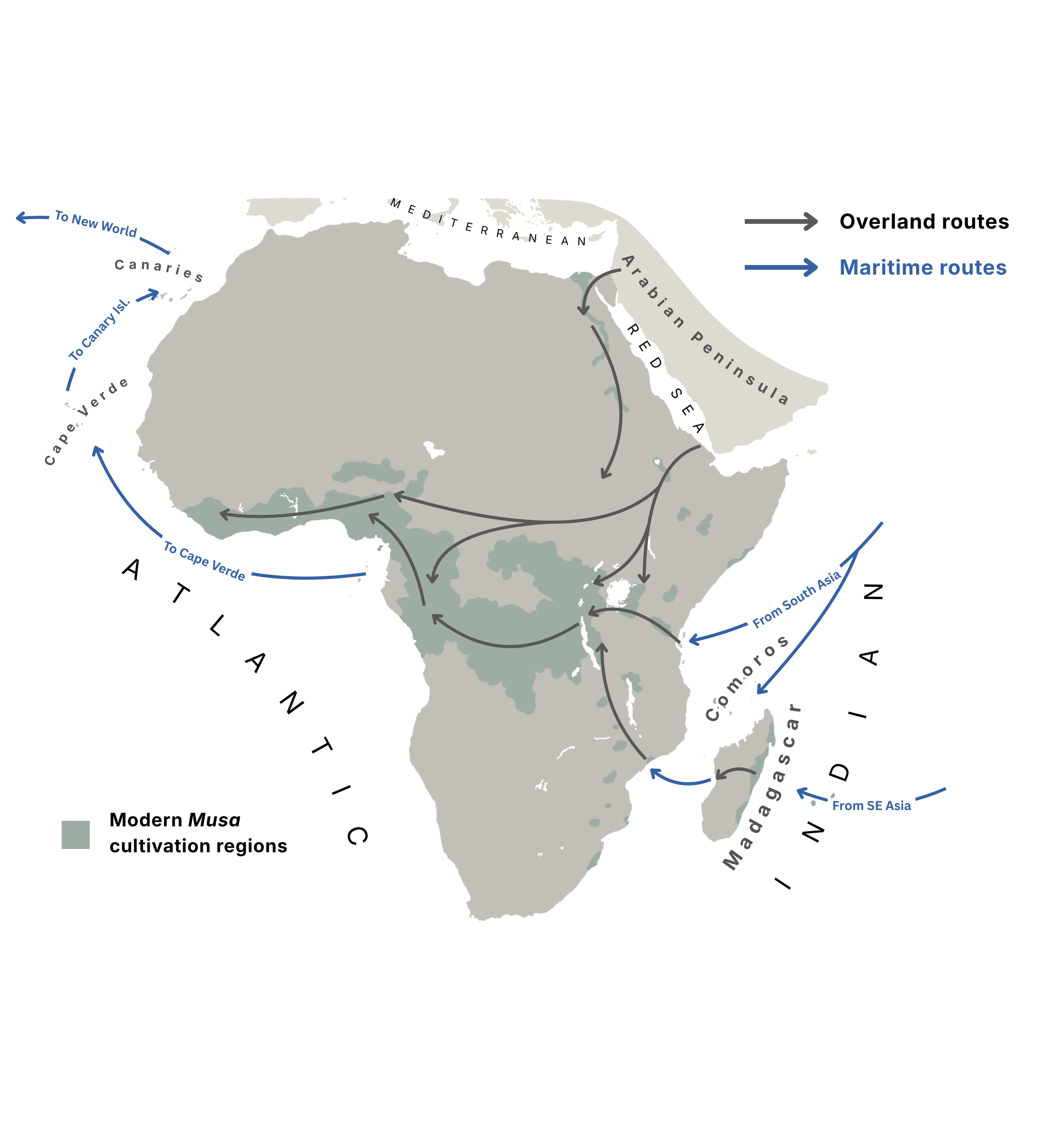
The crossing itself nevertheless required intention. A sack of pepper could be dried, loaded aboard a vessel and sold months later. A cultivated banana had to arrive alive. A sucker or corm had to survive the journey and then be planted somewhere with suitable soil and water. Every successful introduction therefore records more than contact between distant regions; it preserves a decision to transport a living plant across the sea.
The western Indian Ocean offered many opportunities for that decision to be made. Madagascar preserves one of the clearest examples of large-scale human movement across the ocean, as Austronesian-speaking populations ultimately connected with Island Southeast Asia settled there during the later first millennium CE and entered a maritime world already tied closely to the African coast. The Comoros, Zanzibar and Pemba formed further nodes within the same network. Genetic work on East African bananas points back toward southern Island Southeast Asia, while linguistic evidence preserves correspondences between banana terms on opposite sides of the ocean.70
Even this does not reduce the story to a single voyage from Indonesia to Madagascar and then onward to Africa. Some banana lineages may have moved through Madagascar or the Comoros before reaching the mainland, while others could have arrived more directly at ports around Zanzibar or Pemba. Perrier and colleagues envisage several introduction events, potentially involving diploid Mchare ancestors and later triploid forms rather than one completed package crossing the ocean together.70 The western Indian Ocean is better imagined here not as a bridge but as a web.
Somewhere inside that web, however, the archaeological trail almost disappears.
In principle, Africa ought to offer unusually clear evidence for banana introduction. No wild Musa is native to the continent; indigenous African Musaceae belong instead to Ensete. A securely identified ancient Musa phytolith should therefore mark the arrival of a plant transported by people. In practice, the preservation problems that have followed us throughout this story return with force. Seedless cultivars leave no durable seed, the pseudostem is not wood, and humid tropical soils are rarely kind to soft plant tissue. The surviving microscopic traces have consequently generated some of the most contested claims in the entire banana story.
At Munsa in western Uganda, Musaceae phytoliths were recovered from sediment cores beneath layers dated to the fourth millennium BCE. Eight basal phytoliths were identified as Musa-type, which, if accepted at face value, would place bananas near the Great Lakes astonishingly early.71 The authors themselves were cautious. The oldest radiocarbon dates came from bulk sediment and may have incorporated older material, while distinguishing Musa from indigenous African Ensete presents its own difficulties. Later reviews have therefore treated the chronology with considerable skepticism. The phytoliths remain intriguing, but Munsa cannot carry the early history of African bananas by itself.
Nkang in southern Cameroon presents a different problem. There, Musa-type phytoliths were reported from village contexts dating to the first millennium BCE, more than two thousand kilometers west of the East African coast.72 Their identification and chronology remain debated, but if the early interpretation is correct, bananas—more probably AAB plantains—had already traveled remarkably deep into Central Africa. If the dates prove younger, the geographical problem remains almost as interesting: how did an Asian crop become established so far west while leaving so little trace of the route between?
Following “the banana” as though it were one plant moving along one path begins to break down here.
East of the Rift, another history was unfolding. AA diploids and several AAA types became established across a zone stretching from the coast and offshore islands into the highlands of Kenya and Tanzania. Their modern names still preserve fragments of that geography: Mchare among the Chagga, Huti among Shambaa communities, Muraru farther north in Kenya, with related forms on Zanzibar, Pemba, the Comoros and Madagascar.70 Their genetics point back across the Indian Ocean, and their vocabulary often points in the same direction.
One example reaches back to a word encountered much earlier in the story. Punti was among the banana terms dispersed through the Austronesian world. In East Africa, a related form appears as Huti, used for Mchare bananas among Shambaa and Bondei speakers around the Usambara region and adjacent coast, while across the ocean Malagasy hontsy and fontsy belong to the same wider linguistic family.70 These correspondences are not coordinates for one reconstructable voyage, but they preserve contact across precisely the regions through which the genetic evidence suggests bananas moved.
Other words point inland. Forms related to tooke, familiar from Ugandan matooke, occur through western Tanzania and northern Malawi toward the coast. As banana cultivation spread through the Great Lakes, languages did not merely borrow a single name for an introduced crop. They generated terminology for cultivars, plant parts, cultivation, cooking and brewing. Schoenbrun’s reconstruction places the western Great Lakes between roughly CE 800 and 1500 among the major African regions in which increasingly specialized banana knowledge developed.73
That movement was not inevitable. The East African Rift, changes in rainfall and long distances between humid agricultural zones could interrupt the spread of a perennial crop that could not simply be abandoned between settlements. Bananas nevertheless entered agricultural worlds already accustomed to managing long-lived plants. Africa also possessed its own Musaceae tradition in Ensete, long cultivated and valued in parts of Ethiopia and eastern Africa, and some scholars have suggested that familiarity with its vegetative management may have made the adoption of Musa less unfamiliar than it otherwise would have been.70 Bananas did not enter an agricultural vacuum.
By the first millennium CE, linguistic reconstructions suggest that banana-growing knowledge was moving from the East African coastal zone toward the interior. Perrier and colleagues, drawing on Schoenbrun’s work, place cooking- and beer-banana cultivation near the coast during the first half of that millennium, followed by movement across the Rift toward Lake Victoria and then westward and southward through the Great Lakes.7073 By around CE 1200–1500, increasingly specialized vocabulary reflects communities doing much more than keeping an introduced plant alive. Bananas were being divided by use, named, cooked, brewed and maintained in groves over generations.
Around Lake Victoria, the crop encountered landscapes particularly well suited to it. Warm temperatures, fertile soils and rainfall distributed across much of the year allowed a perennial plant to remain productive while annual grain harvests rose and fell with the seasons. In Buganda, banana groves could be maintained on the same land for decades and harvested through much of the year.74 Once established, a grove was not simply another field awaiting harvest; it became a comparatively stable reservoir of food.
That stability altered the landscape around it. Permanent banana gardens accumulated around permanent settlements, entangling houses, paths, livestock, trees and cultivated plants with groves capable of outliving the people who first established them. Kottak later argued that this dependable subsistence base helped sustain the dense populations and permanent settlement characteristic of Buganda, although stronger claims that banana cultivation itself generated Ganda political complexity require more caution.74 What is harder to dispute is the scale of the transformation: an introduced crop had become capable of supporting entire agricultural worlds.
Those worlds developed identities of their own. Schoenbrun identified the western Great Lakes as a major arena of banana experimentation, and later Luganda vocabulary contains dozens of names for banana varieties alongside specialized terms for parts of the plant and stages in preparing food and beer.73 Among the Haya, the banana garden became the kibanja, the cultivated space surrounding the household. Around Kilimanjaro, generations of Chagga farmers developed layered home gardens in which bananas grew beneath taller trees and above other crops. Banana beer entered hospitality, marriage and ritual, while particular cultivars elsewhere could become associated with ancestry, gender or sacred places. A plant could be eaten, fermented, inherited, named, gifted and remembered.
From here, the old Kintu story begins to look different. The question is not whether Nambi literally carried a sucker from Mount Elgon or whether every Ganda banana descends from the plant preserved in the tradition. The deeper history makes something stranger possible: somewhere behind that memory, people really did carry bananas into landscapes where none had grown before. Someone planted them, others kept their descendants, and generations of cultivators transformed those descendants until a crop whose ancestors lay in Asia could be remembered as though it had stood near the beginning of Buganda itself.
Farther west, another banana world had been taking shape. Across the forests of the Congo Basin and into West-Central Africa, AAB plantains became enormously important. Their modern center of diversity lies far from the Great Lakes, particularly across the broad region extending from the Congo Basin toward Gabon and southeastern Nigeria. Linguistics again preserves signs of deep adoption: Blench traces a family of terms including reconstructed kondo through the same broad zone in which plantain diversity became exceptionally rich, while also suggesting that older terminology associated with indigenous Ensete may sometimes have been transferred onto the newly arrived crop.75
Yet plantains are curiously scarce across much of the East African coastal corridor through which a simple east-to-west migration would require them to pass. Blench finds no straightforward linguistic trail carrying plantains neatly across the continent from the Indian Ocean toward their western center of diversity.75 The coast, the Great Lakes and the forests of Central Africa instead appear to preserve different pieces of different dispersals.
By the late precolonial period, describing bananas and plantains merely as Asian introductions had therefore become historically inadequate. In Buganda, Buhaya, the Kilimanjaro highlands, the Congo Basin and regions farther west, they had entered cuisines, settlement systems, exchange, ritual and language. What had arrived as transported planting material had become part of the way communities organized landscapes and remembered themselves.
And yet those landscapes conceal one final contradiction. Across the Great Lakes and through Central and West Africa, farmers maintained an extraordinary number of visibly distinct bananas and plantains. To anyone walking through those groves, Africa could almost look like one of the great homelands of banana diversity.
Genetically, it was not.
The Africa Problem
By the time the banana reached Africa, the story should have been getting simpler. The plant was now thousands of kilometers from the forests in which its wild ancestors grew, and its cultivated populations had passed through repeated bottlenecks as living clones moved from island to island, coast to coast and eventually across the Indian Ocean. Each journey ought to have narrowed the possibilities.
Africa did the opposite.
Around the Great Lakes, farmers cultivated an astonishing array of East African Highland bananas: tall and short plants, fruits of different shapes and colors, cultivars preferred for cooking, others for brewing, and others known by names associated with particular communities and landscapes. Farther west, through the forests of the Congo Basin and into West Africa, plantains diversified just as spectacularly. To someone walking through those gardens, Africa could almost appear to be one of the great homelands of the banana.
Genetically, it was not.
Two cultivated complexes dominate the puzzle. Around the Great Lakes are the AAA East African Highland bananas, commonly grouped within the Mutika complex. Across Central and West Africa are the AAB plantains. Both are extraordinarily diverse in appearance and use, yet both descend from much narrower Asian ancestry than their visible variation suggests. Perrier and colleagues describe the traditional African Mutika and Plantain groups as possessing low genetic diversity despite striking differences in color, shape, taste and other traits.76 De Langhe and colleagues go further for African plantains, describing them as the most morphologically diverse subgroup of triploid bananas in the world, with more than a hundred African cultivars believed to have arisen from a limited ancestral stock.77
That distinction changes what diversity means. A landscape filled with dozens of visibly different bananas might suggest repeated local domestications or the survival of ancient wild variation, but there are no wild Musa populations in Africa from which these cultivars could have been domesticated independently. Africa was not another New Guinea. Its great banana diversity developed after cultivated plants arrived.
The mechanism is one we have already encountered elsewhere. Vegetatively propagated bananas preserve ancient lineages, but they can also preserve occasional somatic mutations that arise as a plant grows. In a sexually reproducing population, many such changes might disappear with the individual in which they occurred. Under clonal cultivation, a farmer who notices a useful difference can take a sucker from that plant and reproduce it directly.76
In Africa, that possibility was multiplied across centuries of cultivation.
A difference in a plant only becomes a cultivar when somebody notices it, values it and keeps it. African farmers therefore transformed biological variation into agricultural diversity through repeated acts of selection. A plant might be retained because of fruit size, taste, color, yield, cooking quality, brewing quality, maturation time, stature or some other characteristic meaningful within a particular farming system. Once maintained, the clone could acquire a name, pass between households, move into another settlement and enter another generation of selection.
The extraordinary cultivar diversity of Africa is therefore not simply a record of mutation. It is a record of decisions about which differences deserved to survive.
Around the Great Lakes, those decisions produced the remarkable East African Highland banana complex. Its underlying genetic base is highly restricted, yet the cultivars maintained within it became diverse enough to be divided into clone sets and categories associated with particular foods and drinks. Cooking bananas and beer bananas developed distinct nomenclatures and cultural associations, while modern genetic work indicates that much of this diversity accumulated through long vegetative propagation and selection acting upon a severe founder bottleneck.76
The Kintu and Nambi tradition acquires an unexpected resonance here. In the story, an immense world of banana cultivation grows from a single ancestral plant. Genetics cannot authenticate that narrative, and the narrative cannot date an introduction, but the biological history is strangely compatible with the image at its center: one or a few founding clones entering a new landscape and proliferating until their descendants appear almost innumerable.
West of the Great Lakes, a related process produced something visibly different. African AAB plantains display extraordinary variation in plant stature, bunch orientation, fruit number, fruit size and inflorescence structure, producing categories such as French, False Horn, Horn and French-Horn plantains.77 Some cultivars bear many relatively small fruits beneath a persistent male bud, while others produce only a few enormous horn-like fruits and lose much of the male portion of the inflorescence. In the field, these plants can look radically different from one another, even though their visible morphology does not correspond to equally deep molecular divergence.77
That is the Africa problem in miniature. A relatively narrow ancestral population has produced forms different enough that, without genetic evidence, we might reasonably imagine much deeper separation.
Nor did this diversification occur in one African center. East African Highland bananas developed around the Great Lakes, while plantains reached their greatest diversity much farther west in the humid forests of Central and West Africa. Different cultivated lineages entered different ecological and social worlds and were subsequently selected in different ways. Africa did not receive one banana and spread it uniformly across the continent; it received several cultivated histories whose later development became increasingly African.
This extraordinary diversity creates an obvious temptation. If more than a hundred plantain cultivars accumulated in Africa and dozens of East African Highland forms emerged around the Great Lakes, perhaps the number of cultivars could be used as a clock, allowing us to estimate how long bananas must have been present.
Unfortunately, the biology does not permit such a simple calculation. We do not know how often useful somatic mutations arose in past cultivated populations, how consistently farmers preserved them, how quickly successful clones moved between communities, or how many ancestral cultivars entered Africa in the first place. Perrier and colleagues explicitly caution that mutation rates, selection pressures and rates of spatial dispersal are too poorly constrained to turn modern cultivar diversity into a reliable chronology.76 Diversity can tell us that selection and propagation operated for a long time; it cannot tell us exactly how many centuries that process required.
Archaeology does not resolve the question neatly either. Munsa still offers its extraordinary but disputed phytolith sequence, while Nkang preserves possible evidence of Musa in Cameroon during the first millennium BCE. Both remain important because the later biological and cultural histories make an early African presence plausible enough to take seriously, but neither provides the firm chronological anchor we might want. Problems of dating, context and the distinction between Musa and indigenous Ensete continue to complicate the record.78
Perhaps that is why Africa provides such an appropriate place to end the early history of the banana. Here, every archive we have used has to work together. Archaeology supplies fragments; genetics reveals bottlenecks hidden beneath visible abundance; linguistics follows names across regions where the plants themselves have vanished; clonal propagation explains how particular lineages endured; somatic mutation introduces new variation; and human selection determines which variations persist. Oral traditions preserve something different again—not dates, but the memory of a crop becoming inseparable from settlement, ancestry and social life.
By the late precolonial period, describing bananas and plantains simply as “Asian introductions” had become technically correct but historically inadequate. In Buganda, Buhaya, the Kilimanjaro highlands, the Congo Basin and regions farther west, these plants had entered cuisines, farming systems, exchange networks, ritual practices and vocabularies. They were planted around homes, brewed into beer, cooked into staple foods, divided into named varieties and passed from one generation to the next. In some places, entire agricultural landscapes had been reorganized around them.
Africa did not domesticate the banana from the wild. But Africa domesticated its possibilities.
That is why parts of the continent are sometimes described as secondary centers of diversification. The primary biological transformations that produced cultivated bananas occurred in Asia and the western Pacific, but African farmers inherited those lineages and subjected them to another evolutionary process: taking a narrow collection of imported clones and multiplying their possibilities through centuries of observation, selection and care.7677 Near the end of the fifteenth century, that African history encountered another maritime frontier. Portuguese and other European mariners arrived along a western African coast where bananas and plantains were already old crops, embedded in farming systems stretching from Senegambia through the Gulf of Guinea and into Central Africa. At the same time, Atlantic islands such as Madeira, the Canaries, Cape Verde and São Tomé were being drawn into expanding networks of maritime exchange, plantation agriculture and coerced labor. Plants moved through those networks alongside people, technologies and commodities.
By the late fifteenth and early sixteenth centuries, bananas had reached the Canary Islands, probably through more than one route connecting the archipelago with Africa and the Mediterranean.79 From there the historical trail becomes much less ghostly. Gonzalo Fernández de Oviedo later recorded that in 1516 the Dominican friar Tomás de Berlanga carried bananas from Gran Canaria to Hispaniola, and within a decade Oviedo was already remarking on their abundance in the Caribbean and on the American mainland.79 De Paz-Sánchez cautions against treating this as the movement of one single clone or one perfectly documented introduction, but the broader transition is unmistakable: the banana had entered the Atlantic world.
For thousands of years, its great journeys had unfolded through the Pacific and Indian Oceans. New Guinea supplied some of the earliest cultivated forms. Island Southeast Asia mixed and transformed them. Voyagers carried them east into Oceania. Farmers and traders moved them west through South Asia, Arabia and Africa. At each stage, the plant that continued onward was not quite the same as the one that had arrived.
Now another ocean lay ahead.
The people who carried bananas across it were entering a world of conquest, plantation agriculture, forced migration and global commerce. The plant that would later become entangled with colonial estates, multinational companies, monocultures and global disease epidemics was about to begin the most familiar chapter of its history.
But it did not leave Africa as the same banana that had once arrived from Asia.
Africa had received the banana from the east. It would send it west.
Conclusion
At the beginning of this story, Panama Disease seemed to expose a flaw in the banana. Gros Michel had been devastated by one strain of Fusarium; Cavendish, introduced as its replacement, now faces another. The modern commercial crop appears dangerously uniform, reproduced again and again from plants that share many of the same strengths and many of the same weaknesses.
After following the banana backward through its history, that vulnerability looks different.
Clonal propagation was never simply a defect waiting to become a problem. It was one of the great possibilities upon which the cultivated banana depended. A plant that produced little viable seed could nevertheless survive if someone chose to keep it. A useful variation could be noticed, reproduced and carried forward rather than disappearing with the individual in which it arose. A valued clone could move between gardens, across islands and eventually over oceans. What looks from the perspective of modern monoculture like dangerous repetition was, for most of the banana’s history, also a remarkable technology of continuity.
That is why the banana was never made only once.
The process began long before anything resembling a supermarket fruit existed. People encountered wild Musa, used it, moved it and altered the landscapes in which it grew. Cultivation brought previously separated populations into contact. Hybridization generated new combinations. Declining fertility changed what survival meant, while vegetative propagation allowed plants increasingly dependent upon humans to persist. Once those plants began traveling, the process continued. Pacific horticulturalists turned a small number of transported lineages into locally distinctive cultivars. Farmers in South Asia incorporated bananas into agricultural, linguistic and ritual worlds of their own. In Arabia, cultivation pushed the plant beyond environments in which it could survive without carefully managed water. In Africa, imported lineages became staples, beer crops, inherited varieties and elements of cultural memory. By the time bananas reached the Atlantic, they had already been remade repeatedly by thousands of years of human attention.
The title of this article is therefore meant quite literally. The banana is not simply a wild fruit that humans discovered and improved. The crop familiar today emerged from an extended relationship in which people repeatedly decided which plants would continue, where they would grow and what qualities were worth preserving. Domestication did not end when the first edible banana appeared. It traveled with the plant.
Africa makes that point especially clearly. No wild Musa population waited there to be domesticated, yet African farmers created some of the most extraordinary banana and plantain diversity in the world from relatively narrow introduced genetic foundations. Africa did not domesticate the banana from the wild. But Africa domesticated its possibilities.
That history also complicates the idea that crop diversity is something inherited passively from nature. Much of the diversity encountered throughout this article was made historically: by moving plants, allowing different lineages to meet, preserving mutations, naming new forms and maintaining them through generations of cultivation. The banana’s past is therefore not simply a history of biological narrowing. It is also a history of people repeatedly creating diversity from the material available to them.
The modern commercial banana represents only one outcome of that much larger history. Cavendish became extraordinarily successful because uniformity could be made useful: predictable fruit could be produced on a vast scale for distant markets. The same system, however, leaves little room for variation when a pathogen capable of exploiting that cultivar appears. Panama Disease did not create the banana’s dependence upon cloning. It exposed what happens when one ancient reproductive strategy is compressed into industrial monoculture.
Understanding the banana’s origins cannot by itself resolve the challenges facing the crop today. But it changes the perspective from which we approach them. The history reconstructed through archaeology, genetics and linguistics shows that bananas were never static. Their resilience came repeatedly from movement, mixing, experimentation and the preservation of differences that people found valuable. The apparently singular banana of the global marketplace sits at the end of a history that was anything but singular.
Perhaps that is the central lesson of its making. Humans did not simply domesticate bananas, nor did bananas simply become dependent upon humans. Over thousands of years, the relationship moved in both directions. People carried bananas into landscapes they could never have reached alone, while bananas became foundations for cuisines, economies, settlements and memories upon which human communities themselves came to depend.
The vulnerability visible in a diseased Cavendish plantation and the diversity visible in a Ugandan banana grove belong to the same history.
Both are products of the choices through which people made the banana.
Epilogue
At the end of this research, my mind kept returning to the hills of western Uganda where the questions behind this article first began.
When I arrived there, the banana groves seemed almost effortless. They covered slopes, surrounded homes and appeared again at the research station whenever we sat down to eat. Matooke quickly became part of the rhythm of the field season. I knew, of course, that bananas mattered in Uganda. What I did not yet understand was how extraordinary it was that they were there at all.
There are no wild Musa populations native to Uganda. Somewhere far behind those groves lies a history beginning in Asia and the western Pacific, passing through cultivation, declining fertility, human transport and journeys across the Indian Ocean. The plants that eventually reached the Great Lakes did not remain what they had been when they arrived. Generations of farmers distinguished them, named them, selected them and carried their descendants forward until bananas could become so thoroughly embedded in the landscape that traditions of Buganda placed them close to the beginnings of society itself.
Seen from that perspective, a plate of matooke becomes something rather stranger than it first appears. It is the end point of journeys nobody recorded, decisions made by cultivators whose names are lost, biological accidents that somebody chose to preserve, and generations of care repeated until an introduced plant could feel completely at home. Archaeology rarely allows us to recover those individual moments. What it can sometimes recover is the accumulated consequence of them.
That may be what I have enjoyed most about following this story. Archaeology has a habit of taking things that seem ordinary and making them unfamiliar again. A banana is about as familiar an object as one could choose. Yet behind it lies a history crossing forests, islands, languages, oceans and thousands of years of human attention.
The hills looked ordinary when I first saw them.
I am no longer so sure that they were.
Notes
-
Ploetz, Randy C. 2000. “Panama Disease: A Classic and Destructive Disease of Banana.” Plant Health Progress. doi:10.1094/PHP-2000-1204-01-HM. ↩ ↩2
-
Soluri, John. 2002. “Accounting for Taste: Export Bananas, Mass Markets, and Panama Disease.” Environmental History 7(3): 386–410. ↩ ↩2
-
Ploetz, Randy C. 2005. “Panama Disease: An Old Nemesis Rears Its Ugly Head. Part 1. The Beginnings of the Banana Export Trades.” Plant Health Progress. doi:10.1094/PHP-2005-1221-01-RV. ↩
-
Munhoz, Thayne, Jorge Vargas, Luiz Teixeira, Charles Staver, and Miguel Dita. 2024. “Fusarium Tropical Race 4 in Latin America and the Caribbean: Status and Global Research Advances towards Disease Management.” Frontiers in Plant Science 15:1397617. ↩ ↩2 ↩3 ↩4
-
Karamura, Deborah. 2011. “Economic Significance of Banana Varieties Other than Cavendish —Uganda Case Study.” FAO Intergovernmental Group on Bananas and Tropical Fruits, Fifth Session. ↩
-
Heslop-Harrison, J. S., and Trude Schwarzacher. 2007. “Domestication, Genomics and the Future for Banana.” Annals of Botany 100(5): 1073–1084. ↩ ↩2
-
De Langhe, Edmond, Luc Vrydaghs, Pierre de Maret, Xavier Perrier, and Tim Denham. “Why Bananas Matter: An Introduction to the History of Banana Domestication.” ↩ ↩2 ↩3 ↩4
-
Perrier, Xavier, Edmond De Langhe, Mark Donohue, Carol Lentfer, Luc Vrydaghs, Frédéric Bakry, Françoise Carreel, et al. 2011. “Multidisciplinary Perspectives on Banana ( Musa spp.) Domestication.” Proceedings of the National Academy of Sciences 108(28): 11311–11318. ↩
-
Heslop-Harrison, J. S., and Trude Schwarzacher. “Domestication, Genomics and the Future for Banana.” Annals of Botany 100, no. 5 (2007): 1073–1084. https://doi.org/10.1093/aob/mcm191. ↩ ↩2 ↩3 ↩4 ↩5 ↩6
-
Karamura, Deborah, Eldad Karamura, and Guy Blomme. “General Plant Morphology of Musa.” In Banana Breeding: Progress and Challenges, Chapter 1. ↩ ↩2 ↩3 ↩4 ↩5
-
Perrier, Xavier, Edmond De Langhe, Mark Donohue, Carol Lentfer, Luc Vrydaghs, Frédéric Bakry, Françoise Carreel, et al. “Multidisciplinary Perspectives on Banana ( Musa spp.) Domestication.” Proceedings of the National Academy of Sciences 108 (2011). https://doi.org/10.1073/pnas.1102001108. ↩ ↩2 ↩3 ↩4 ↩5 ↩6
-
Mertens, Arne, Rony Swennen, Nina Rønsted, Filip Vandelook, Bart Panis, Gabriel Sachter-Smith, Dang Toan Vu, and Steven B. Janssens. “Conservation Status Assessment of Banana Crop Wild Relatives Using Species Distribution Modelling.” Diversity and Distributions 27 (2021): 729–746. https://doi.org/10.1111/ddi.13233. ↩ ↩2
-
Sardos, Julie, Catherine Breton, Xavier Perrier, Ines Van den Houwe, Sebastien Carpentier, Janet Paofa, Mathieu Rouard, and Nicolas Roux. “Hybridization, Missing Wild Ancestors and the Domestication of Cultivated Diploid Bananas.” Frontiers in Plant Science 13 (2022): 969220. https://doi.org/10.3389/fpls.2022.969220. ↩
-
Hapsari, Lia, Jean Kennedy, Dewi Ayu Lestari, Ahmad Masrum, and Wiwik Lestarini. 2017. “Ethnobotanical Survey of Bananas (Musaceae) in Six Districts of East Java, Indonesia.” Biodiversitas 18(1): 160–174. ↩
-
Kennedy, Jean. 2009. “Bananas and People in the Homeland of Genus Musa: Not Just Pretty Fruit.” Ethnobotany Research & Applications. ↩ ↩2 ↩3
-
Bae, Christopher J., Katerina Douka, and Michael D. Petraglia. 2017. “Human Colonization of Asia in the Late Pleistocene: An Introduction to Supplement 17.” Current Anthropology 58(S17). ↩
-
Denham, Tim, Richard Fullagar, and Lesley Head. 2009. “Plant Exploitation on Sahul: From Colonisation to the Emergence of Regional Specialisation during the Holocene.” Quaternary International. ↩ ↩2
-
Premathilake, Rathnasiri, and Chris O. Hunt. “Earliest Musa Banana from the Late Quaternary Sequence at Fahien Rock Shelter in Sri Lanka.” ↩ ↩2 ↩3 ↩4
-
Lentfer, Carol J. 2009. “Tracing Domestication and Cultivation of Bananas from Phytoliths: An Update from Papua New Guinea.” Ethnobotany Research & Applications 7: 247–270. ↩ ↩2 ↩3
-
Denham, Tim P., S. G. Haberle, C. Lentfer, R. Fullagar, J. Field, M. Therin, N. Porch, and B. Winsborough. 2003. “Origins of Agriculture at Kuk Swamp in the Highlands of New Guinea.” ↩ ↩2
-
Wilson, Samuel M. 1985. “Phytolith Analysis at Kuk, an Early Agricultural Site in Papua New Guinea.” Archaeology in Oceania 20(3): 90–97. ↩ ↩2
-
Perrier, Xavier, Edmond De Langhe, Mark Donohue, Carol Lentfer, Luc Vrydaghs, Frédéric Bakry, Françoise Carreel, et al. 2011. “Multidisciplinary Perspectives on Banana ( Musa spp.) Domestication.” Proceedings of the National Academy of Sciences. ↩
-
Martin, Guillaume, Céline Cardi, Gautier Sarah, Sébastien Ricci, Christophe Jenny, Emmanuel Fondi, Xavier Perrier, Jean-Christophe Glaszmann, Angélique D’Hont, and Nabila Yahiaoui. 2020. “Genome Ancestry Mosaics Reveal Multiple and Cryptic Contributors to Cultivated Banana.” The Plant Journal 102: 1008–1025. ↩ ↩2 ↩3
-
Sardos, Julie, Catherine Breton, Xavier Perrier, Ines Van den Houwe, Sebastien Carpentier, Janet Paofa, Mathieu Rouard, and Nicolas Roux. 2022. “Hybridization, Missing Wild Ancestors and the Domestication of Cultivated Diploid Bananas.” Frontiers in Plant Science 13: 969220. ↩
-
Martin, Guillaume, Céline Cardi, Gautier Sarah, Sébastien Ricci, Christophe Jenny, Emmanuel Fondi, Xavier Perrier, Jean-Christophe Glaszmann, Angélique D’Hont, and Nabila Yahiaoui. 2020. “Genome Ancestry Mosaics Reveal Multiple and Cryptic Contributors to Cultivated Banana.” The Plant Journal 102: 1008–1025. The Plant Journal - 2020 - Mart… ↩ ↩2
-
Joldersma, Dirk, and Zhongchi Liu. 2018. “The Making of Virgin Fruit: The Molecular and Genetic Basis of Parthenocarpy.” Journal of Experimental Botany 69(5): 955–962. erx446 ↩ ↩2 ↩3
-
Picarella, Maurizio E., and Andrea Mazzucato. 2019. “The Occurrence of Seedlessness in Higher Plants; Insights on Roles and Mechanisms of Parthenocarpy.” Frontiers in Plant Science 9: 1997. fpls-09-01997 ↩ ↩2
-
Lentfer, Carol J. 2009. “Tracing Domestication and Cultivation of Bananas from Phytoliths: An Update from Papua New Guinea.” Ethnobotany Research & Applications 7: 247–270. ↩
-
Martin, Guillaume, Céline Cardi, Gautier Sarah, Sébastien Ricci, Christophe Jenny, Emmanuel Fondi, Xavier Perrier, Jean-Christophe Glaszmann, Angélique D’Hont, and Nabila Yahiaoui. 2020. “Genome Ancestry Mosaics Reveal Multiple and Cryptic Contributors to Cultivated Banana.” The Plant Journal 102: 1008–1025. ↩ ↩2 ↩3
-
Donohue, Mark, and Tim Denham. 2009. “Banana ( Musa spp.) Domestication in the Asia-Pacific Region: Linguistic and Archaeobotanical Perspectives.” Ethnobotany Research & Applications 7: 293–332. ↩
-
Perrier, Xavier, Edmond De Langhe, Mark Donohue, Carol Lentfer, Luc Vrydaghs, Frédéric Bakry, Françoise Carreel, et al. 2011. “Multidisciplinary Perspectives on Banana ( Musa spp.) Domestication.” Proceedings of the National Academy of Sciences 108(28): 11311–11318. ↩ ↩2
-
Denham, Tim. 2011. “Early Agriculture and Plant Domestication in New Guinea and Island Southeast Asia.” Current Anthropology 52(S4): S379–S395. ↩
-
Arshad, Rida, Tayyaba Razzaq, Bilal Ahmad, et al. 2025. “Banana Breeding by Genome Design.” Journal of Integrative Plant Biology 67: 2816–2847. ↩
-
Wilson, Samuel M. 1985. “Phytolith Analysis at Kuk, an Early Agricultural Site in Papua New Guinea.” Archaeology in Oceania 20(3): 90–97. ↩ ↩2
-
Lentfer, Carol J. 2009. “Tracing Domestication and Cultivation of Bananas from Phytoliths: An Update from Papua New Guinea.” Ethnobotany Research & Applications 7: 247–270. ↩ ↩2 ↩3 ↩4 ↩5 ↩6
-
Premathilake, Rathnasiri, and Chris O. Hunt. 2018. “Earliest Musa Banana from the Late Quaternary Sequence at Fahien Rock Shelter in Sri Lanka.” Journal of Quaternary Science 33(6): 624–638. ↩
-
Donohue, Mark, and Tim Denham. 2009. “Banana ( Musa spp.) Domestication in the Asia-Pacific Region: Linguistic and Archaeobotanical Perspectives.” Ethnobotany Research & Applications 7: 293–332. ↩
-
MacDaniels, L. H. 1947. A Study of the Fe‘i Banana and Its Distribution with Reference to Polynesian Migrations. Bernice P. Bishop Museum Bulletin 190. Honolulu: Bernice P. Bishop Museum, pp. 45–46. ↩
-
Kennedy, Jean. 2008. “Pacific Bananas: Complex Origins, Multiple Dispersals?” Asian Perspectives 47(1): 75–94. ↩ ↩2 ↩3 ↩4 ↩5 ↩6
-
Kagy, Valérie, Maurice Wong, Henri Vandenbroucke, Christophe Jenny, Cécile Dubois, Anthony Ollivier, et al. 2016. “Traditional Banana Diversity in Oceania: An Endangered Heritage.” PLOS ONE 11(3): e0151208. ↩ ↩2 ↩3 ↩4
-
Thomson, Lex A. J., Jeff Daniells, Paul A. Geraghty, Adriana Hiariej, Valérie Kagy, Jean Kennedy, Angela K. Kepler, et al. 2022. “The Origins and Dispersal Throughout the Pacific Islands of Fehi Bananas ( Musa Series Australimusa).” Journal of the Polynesian Society 131(3): 289–335. ↩ ↩2 ↩3 ↩4
-
Lentfer, Carol J., Alison Crowther, and Roger C. Green. 2021. “The Question of Early Lapita Settlements in Remote Oceania and Reliance on Horticulture Revisited: New Evidence from Plant Microfossil Studies at Reef/Santa Cruz, South-East Solomon Islands.” Technical Reports of the Australian Museum Online 34: 87–106. ↩ ↩2
-
Xincun archaeobotanical study on starch and phytolith residues from late Neolithic southern China; see annotated bibliography for evidence concerning banana exploitation, sago-type palms and limited rice. ↩ ↩2 ↩3 ↩4 ↩5
-
Li, Lin-Feng, Hua-Ying Wang, Cui Zhang, Xin-Feng Wang, Feng-Xue Shi, Wen-Na Chen, and Xue-Jun Ge. 2013. “Origins and Domestication of Cultivated Banana Inferred from Chloroplast and Nuclear Genes.” PLOS ONE 8(11): e80502. ↩
-
De Langhe, Edmond, Xavier Perrier, Mark Donohue, and Tim Denham. 2015. “The Original Banana Split: Multi-disciplinary Implications of the Generation of African and Pacific Plantains in Island Southeast Asia.” Ethnobotany Research & Applications 14: 299–312. ↩ ↩2 ↩3
-
Donohue, Mark, and Tim Denham. 2009. “Banana ( Musa spp.) Domestication in the Asia-Pacific Region: Linguistic and Archaeobotanical Perspectives.” Ethnobotany Research & Applications 7: 293–332. ↩ ↩2 ↩3
-
Xhauflair, Hermine, Sheldon Jago-on, Timothy James Vitales, et al. 2023. “The Invisible Plant Technology of Prehistoric Southeast Asia: Indirect Evidence for Basket and Rope Making at Tabon Cave, Philippines, 39–33,000 Years Ago.” PLOS ONE 18(6): e0281415. ↩
-
Labov, William. 1972. “Some Principles of Linguistic Methodology.” Language in Society 1(1): 97–120. ↩
-
Donohue, Mark, Tim Denham, and Stephen Oppenheimer. “New Methodologies for Historical Linguistics? Calibrating a Lexicon-Based Methodology for Diffusion vs. Subgrouping.” Supplementary materials. ↩
-
Donohue, Mark, and Tim Denham. 2009. “Banana ( Musa spp.) Domestication in the Asia-Pacific Region: Linguistic and Archaeobotanical Perspectives.” Ethnobotany Research & Applications 7: 293–332. ↩ ↩2 ↩3 ↩4 ↩5 ↩6 ↩7
-
Perrier, Xavier, Edmond De Langhe, Mark Donohue, Carol Lentfer, Luc Vrydaghs, Frédéric Bakry, Françoise Carreel, et al. 2011. “Multidisciplinary Perspectives on Banana ( Musa spp.) Domestication.” Proceedings of the National Academy of Sciences 108(28): 11311–11318. ↩
-
Pliny the Elder. Natural History 12.24. Trans. H. Rackham. Cambridge, MA: Harvard University Press, 1952. ↩
-
Theophrastus. Enquiry into Plants 4.4.3. Trans. Arthur Hort. London: William Heinemann, 1916. ↩
-
Nayar, N. M. 2010. “The Bananas: Botany, Origin, Dispersal.” Horticultural Reviews 36: 117–164. Nayar maps the western occurrence of Musa through Sri Lanka and India and reviews the distribution of M. acuminata and M. balbisiana. ↩ ↩2
-
Premathilake, Rathnasiri, and Chris O. Hunt. “Earliest Musa Banana from the Late Quaternary Sequence at Fahien Rock Shelter in Sri Lanka.” See annotated bibliography for the Late Pleistocene phytolith sequence and the proposed mid-Holocene appearance of cultivated bananas. ↩ ↩2
-
Fuller, Dorian Q., and Marco Madella. 2009. “Banana Cultivation in South Asia and East Asia: A Review of the Evidence from Archaeology and Linguistics.” Ethnobotany Research & Applications 7: 333–351. ↩ ↩2 ↩3 ↩4
-
Perrier, Xavier, Edmond De Langhe, Mark Donohue, Carol Lentfer, Luc Vrydaghs, Frédéric Bakry, Françoise Carreel, et al. 2011. “Multidisciplinary Perspectives on Banana ( Musa spp.) Domestication.” Proceedings of the National Academy of Sciences 108(28): 11311–11318. Perrier et al. note that Kot Diji is presently identifiable only to Musa and trace westward genetic ancestry into Indian cultivars. ↩ ↩2 ↩3
-
Donohue, Mark, and Tim Denham. 2009. “Banana ( Musa spp.) Domestication in the Asia-Pacific Region: Linguistic and Archaeobotanical Perspectives.” Ethnobotany Research & Applications 7: 293–332. ↩
-
Nayar, “The Bananas,” for early Indian literary references, ritual and medicinal use, and representations at Bharhut, Sanchi and Ajanta. ↩ ↩2
-
Buerkert, Andreas, Edmond De Langhe, and Saleem Al Khanjari. 2009. “Ecology and Morphological Traits of an Ancient Musa acuminata Cultivar from a Mountain Oasis of Oman.” Genetic Resources and Crop Evolution 56: 609–614. ↩ ↩2
-
Scott, Ashley, Robert C. Power, Victoria Altmann-Wendling, Michal Artzy, Mario A. S. Martin, Stefanie Eisenmann, Richard Hagan, et al. 2020. “Exotic Foods Reveal Contact between South Asia and the Near East during the Second Millennium BCE.” Proceedings of the National Academy of Sciences. ↩
-
Scott et al. 2020, for the wider evidence of Bronze Age and Early Iron Age Indo-Mediterranean exchange. ↩
-
Scott et al. 2020, for the probable Musa protein identified in the dental calculus of individual ERA017 at Tel Erani and the authors’ alternative interpretations of that evidence. ↩ ↩2
-
Maeir, Aren M. 2023. “‘Their Voice Carries Throughout the Earth, Their Words to the End of the World’ (Ps 19, 5): Thoughts on Long-Range Trade in Organics in the Bronze and Iron Age Levant.” In “And in Length of Days Understanding” (Job 12:12): Essays on Archaeology in the Eastern Mediterranean and Beyond in Honor of Thomas E. Levy. ↩
-
Potts, D. T. 1994. “Contributions to the Agrarian History of Eastern Arabia II. The Cultivars.” Arabian Archaeology and Epigraphy 5: 236–275. ↩ ↩2
-
Van der Veen, Marijke, and Jacob Morales. 2017. “Food Globalisation and the Red Sea: New Evidence from the Ancient Ports at Quseir al-Qadim, Egypt.” In Human Interaction with the Environment in the Red Sea, edited by Dionisius A. Agius, Emad Khalil, Eleanor M. L. Scerri, and Alun Williams, 254–289. Leiden: Brill. ↩ ↩2 ↩3 ↩4
-
Brett, Michael. 1985. Review of Andrew M. Watson, Agricultural Innovation in the Early Islamic World: The Diffusion of Crops and Farming Techniques, 700–1100. Bulletin of the School of Oriental and African Studies 48(1): 126–128. ↩ ↩2
-
De Langhe, Edmond. 2006. Banana Diversity in the Middle East (Jordan, Egypt, Oman). INIBAP/Bioversity International. ↩ ↩2 ↩3
-
D. N. McMaster. 1962. “Speculations on the Coming of the Banana to Uganda.” Journal of Tropical Geography 16: 57–69; reprinted in J. M. Konczacki and Z. A. Konczacki, eds., An Economic History of Tropical Africa, Volume One: The Pre-Colonial Period. ↩ ↩2 ↩3
-
Xavier Perrier et al. 2019. “East African Diploid and Triploid Bananas: A Genetic Complex Transported from South-East Asia.” Annals of Botany 123: 19–36. ↩ ↩2 ↩3 ↩4 ↩5 ↩6 ↩7 ↩8
-
B. Julius Lejju, Peter Robertshaw, and David Taylor. 2006. “Africa’s Earliest Bananas?” Journal of Archaeological Science 33: 102–113. ↩
-
C. M. Mbida et al. 2000. “Evidence for Banana Cultivation and Animal Husbandry during the First Millennium BC in the Forest of Southern Cameroon.” Journal of Archaeological Science 27: 151–162; C. M. Mbida et al. 2001. “First Evidence of Banana Cultivation in Central Africa during the Third Millennium before Present.” Vegetation History and Archaeobotany 10: 1–6. ↩
-
David L. Schoenbrun. 1993. “Cattle Herds and Banana Gardens: The Historical Geography of the Western Great Lakes Region, ca. AD 800–1500.” African Archaeological Review 11: 39–72. ↩ ↩2 ↩3
-
Conrad P. Kottak. 1972. “Ecological Variables in the Origin and Evolution of African States: The Buganda Example.” Comparative Studies in Society and History 14(3): 351–380. ↩ ↩2
-
Roger Blench. 2009. “Bananas and Plantains in Africa: Re-interpreting the Linguistic Evidence.” Ethnobotany Research & Applications 7: 363–380. ↩ ↩2
-
Xavier Perrier et al. 2019. “East African Diploid and Triploid Bananas: A Genetic Complex Transported from South-East Asia.” Annals of Botany 123: 19–36. ↩ ↩2 ↩3 ↩4 ↩5
-
Edmond De Langhe, Michael Pillay, Abdou Tenkouano, and Rony Swennen. 2005. “Integrating Morphological and Molecular Taxonomy in Musa: The African Plantains ( Musa spp. AAB Group).” Plant Systematics and Evolution 255: 225–236. ↩ ↩2 ↩3 ↩4
-
B. Julius Lejju, Peter Robertshaw, and David Taylor. 2006. “Africa’s Earliest Bananas?” Journal of Archaeological Science 33: 102–113; C. M. Mbida et al. 2000. “Evidence for Banana Cultivation and Animal Husbandry during the First Millennium BC in the Forest of Southern Cameroon.” Journal of Archaeological Science 27: 151–162. ↩
-
Manuel De Paz-Sánchez. 2014. “‘Plantain of Guinea’: The Atlantic Adventure of Banana.” Global Journal of Science Frontier Research: Biological Science 14(2). ↩ ↩2