
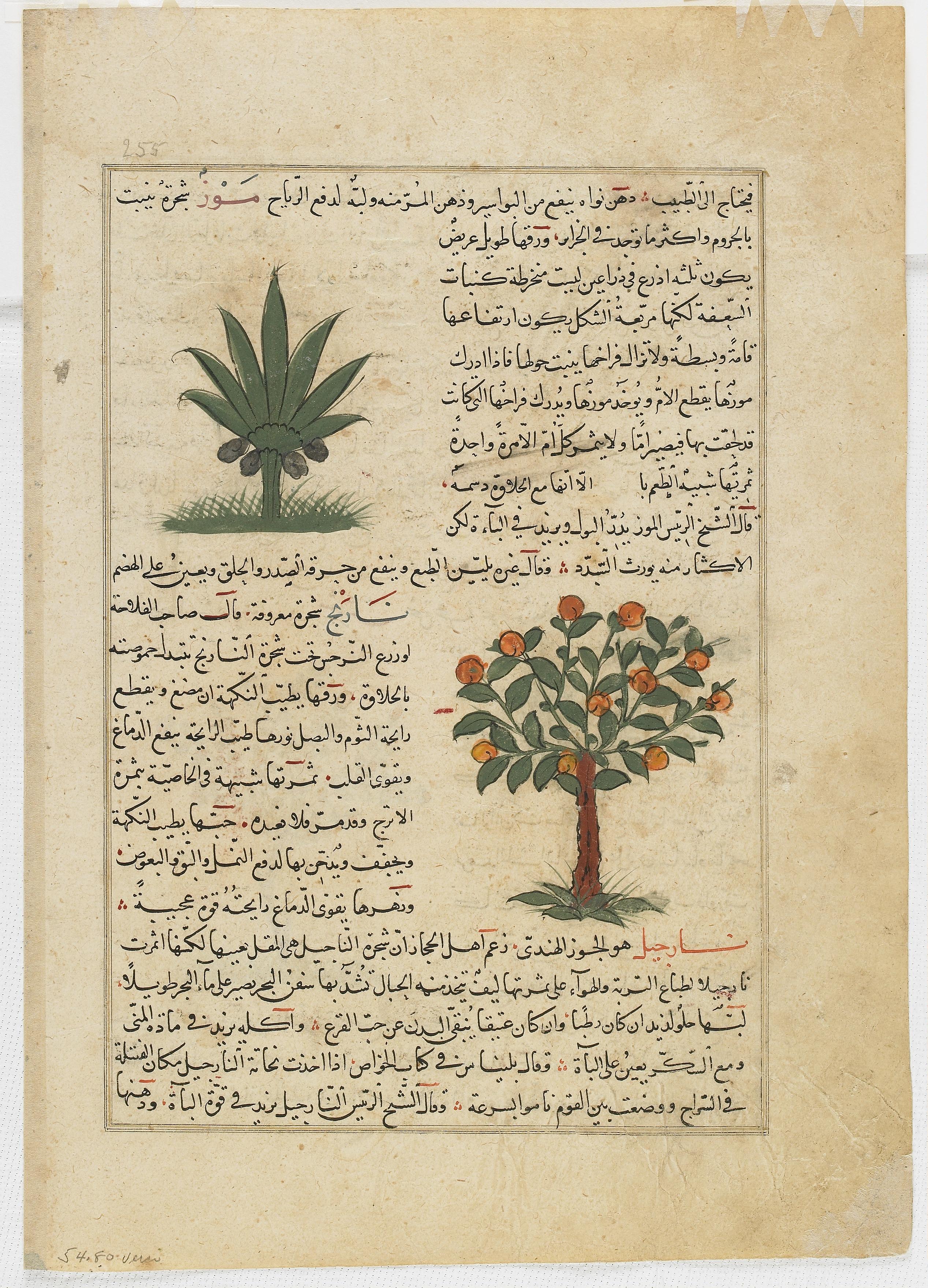
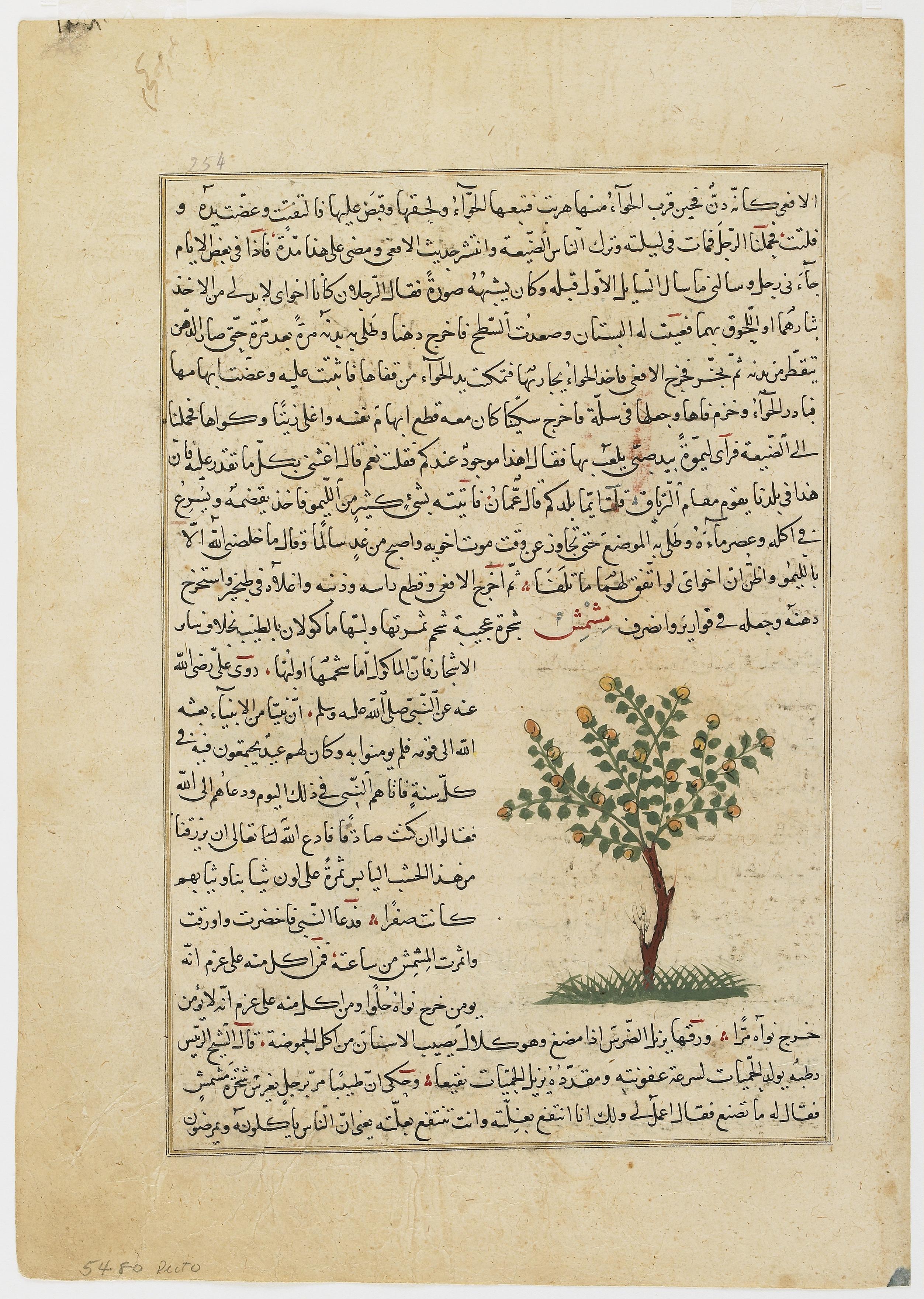
Folio from ʿAjaʾib al-makhluqat by al-Qazwini, early 15th century. Freer Gallery of Art, Smithsonian National Museum of Asian Art, F1954.80. CC0.
The whole object
What Does an Image Remember?
At first glance, this is a picture of a banana. Look longer and the image begins to accumulate histories.
A plant whose deeper ancestry lies thousands of kilometres east of the manuscript's probable place of production. A cultivated crop moved by people into environments where its wild ancestors had never grown. A name written into another language. A fruit placed beside an orange, painted onto paper, and incorporated into an attempt to describe the created world.
The folio cannot tell us precisely when every banana variety travelled, who carried it, or which route brought the particular plant known to the people who made this manuscript. Archaeology itself cannot yet answer all of those questions.
But the image establishes something quieter. By the early fifteenth century, the banana could appear on this page without explanation as an impossibly foreign thing. It had a name. It had a shape. It had a place within an ordered universe.
The banana no longer needed an introduction. It belonged on the page.
Object Information
- Object
- Folio from ʿAjaʾib al-makhluqat (Wonders of Creation)
- Author of work
- Zakariyya ibn Muhammad al-Qazwini (1203-1283)
- Date
- Early 15th century
- Origin
- Iraq or Eastern Turkey
- Recto
- Apricot Tree (mishmish)
- Verso
- Banana Tree (mawz), Orange Tree (naranj)
- Medium
- Opaque watercolour, ink and gold on paper
- Dimensions
- 32.7 × 22.4 cm
- Type
- Detached manuscript folio
- Collection
- Freer Gallery of Art, Smithsonian National Museum of Asian Art
- Accession
- F1954.80
- Credit line
- Purchase - Charles Lang Freer Endowment
- Image rights
- CC0 / Public Domain
Folio from ʿAjaʾib al-makhluqat by al-Qazwini, early 15th century. Freer Gallery of Art, Smithsonian National Museum of Asian Art, F1954.80. CC0.
View museum recordSources & Further Reading
The Object
The Book and Its Images
- Badiee, Julie. ‘The Sarre Qazwīnī: An Early Aq Qoyunlu Manuscript?’ Ars Orientalis 14 (1984): 97-113.
- Library of Congress. The Wonders of Creation.
- U.S. National Library of Medicine. Natural History: ʿAjāʾib al-makhlūqāt wa-gharāʾib al-mawjūdāt by al-Qazwīnī.
The Banana
- Royal Botanic Gardens, Kew. Plants of the World Online, genus Musa L.
- Li, Lin-Feng, and Xue-Jun Ge. ‘Origin and Domestication of Cultivated Banana.’ Ecological Genetics and Genomics 2 (2017): 1-2.
- Scott, Ashley, Robert C. Power, Victoria Altmann-Wendling, et al. ‘Exotic Foods Reveal Contact between South Asia and the Near East during the Second Millennium BCE.’ PNAS 118.2 (2021): e2014956117.
- Grimaldi, Ilaria M., Tinde R. van Andel, and Tim P. Denham. ‘Looking beyond history: tracing the dispersal of the Malaysian complex of crops to Africa.’ American Journal of Botany 109.2 (2022): 193-208.